

Life Cycle Analysis (LCA)
Life Cycle Analysis (LCA) is a tool for evaluating the potential environmental impacts associated with a product, service, system, or process. It is a multi-criteria and multi-stage assessment method (more comprehensive than a single-criterion greenhouse gas emissions assessment). Life Cycle Analysis evaluates the environmental impact of a service provided by a product, which is the functional unit. For example, a life cycle assessment does not aim to study the impact of a cotton t-shirt but the impact of a cotton t-shirt worn and washed 40 times over 1 year.
The first work on LCA dates back to 1970. It is now a robust, standardized method (ISO 14040 and 14044). It is a procedure based on a mathematical model of transformations allowing all incoming and outgoing flows to be characterized at each stage of the life cycle in terms of environmental impacts.
Applications of Life Cycle Analysis
- In a defined context, LCA makes it possible to understand the environmental impacts of a system (product, service, or process) over its entire life cycle (by life cycle stage or by subsystem: components, materials used, processes);
- Compare systems or different types of scenarios (different material choices, for example);
- Make informed choices to identify eco-design avenues or improve the environmental performance of the system;
- Communicate on performance within the company and to consumers.
A life cycle analysis relies on several stages:
- Set objectives: what levers can I act on and how? Why is it necessary to carry out an LCA (see above)?
- Define the scope of the study: the functional unit and system boundaries.
- Detail the life cycle (extraction of raw materials, production, transport, use, and end-of-life), the inputs and outputs at each stage to identify flows.
- Evaluate impacts at each stage of the life cycle, using LCA software.
- Analyze the results to draw conclusions.
The applications of a life cycle analysis are numerous, so it is important to precisely define its objectives before embarking on it. Depending on the objectives and needs, it is possible to choose between two types of LCA: simplified or robust.
Simplified Life Cycle Analysis
- Define at which stages and processes the most significant environmental impacts of a product are located;
- Quickly identify eco-design avenues to reduce environmental impacts;
- Various tools available for textile and footwear products, for example: HIGG PM.
Robust Life Cycle Analysis
- Adapted for advanced LCA needs, with superior precision;
- Allows communication on LCA results and environmental performance;
- Requires a critical review by a third party;
- Requires more time, resources, and skills for its implementation.
The case study presented here was carried out by Levi Strauss & Co in 2013 to study the environmental impact of their Levi's 501 jeans product. Consult the complete study, The Life Cycle Of A Jean, here.
Point of attention: The LCA was carried out in a specific context based on assumptions and a scope specific to Levi Strauss's situation. The results presented below therefore cannot be attributed globally to all cotton jeans on the market.
Objective and context of the study
Following an initial study carried out by Levi Strauss in 2007, the company launched a new, expanded study in 2013, increasing its scope of study thanks to technical advancements in life cycle analysis, with the objective of obtaining more complete results.
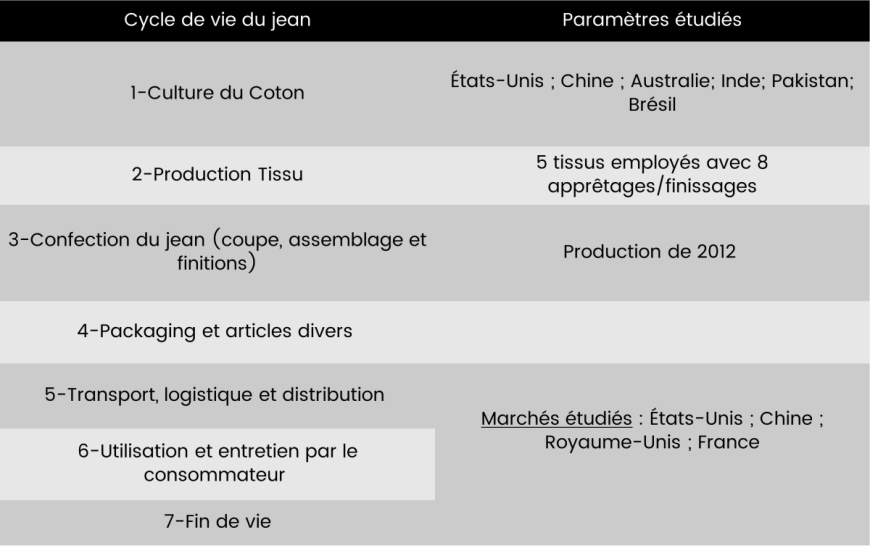
This notably included incorporating the most important cotton-producing countries: United States; China; Australia; India; Pakistan; Brazil.
The study aims to help Levi Strauss and other brands take more effective and appropriate measures to reduce the environmental impacts of the denim industry.
Study Parameters
- Study Basis: "LS&Co's product lifecycle categories", which determines the life cycle phases of jeans, and "The required impact categories of the Sustainable Apparel Coalition’s Product Category Rule guidance", which includes the 4 environmental impact criteria chosen by Levi Strauss.
- Functioal Unit: Levi's 501 jeans worn for 1 year.
2 - Impact assessment results
Share of the different impact categories studied by life cycle phase
You can find the glossary of the different impacts right here.
Climate change, water consumption, eutrophication, and land use are the indicators that were selected to assess the environmental impact of a pair of Levi’s 501 jeans. The results of the life cycle analysis show that the most significant impacts occur during the cotton cultivation phase and during consumer use and maintenance.
3 - General conclusions
- The study conducted in 2013 broadened its scope (compared to the first study conducted in 2007), resulting in a 68% increase in the water consumption criterion.
- Cotton production is the stage of the life cycle that has the greatest impact on the water consumption indicator.
- The use, more specifically the maintenance, and production of the fabric are the phases of the life cycle that consume the most energy and contribute to climate change.
- The transport of materials and products, packaging, losses during production, distribution, sales, and end of life are the stages with the least impact.
4 - Areas for improvement identified by Levi Strauss
A - Increasing the use of recycled materials, which are more durable or easier to recycle, is key to reducing environmental impact.
B - Raise consumer awareness about proper clothing care by informing them about the right steps to take.