

Industry
Refashion Day 2025

Watch replays of the morning's presentations
(turn on YouTube’s automatic English subtitles to view them)
During its 5th edition, Refashion Day 2025 put a strong emphasis on the imperative need to act together — a sine qua non condition for a genuine circular transition.
Between creativity, overconsumption, complexity and interdependence, all stakeholders in the sector must embrace a global, collaborative approach.
Building bridges between brands, manufacturers and recycling players, continuing to work with other sectors, exploring and scaling efficient waste-management solutions — this is how the textiles and footwear value chain will rise to the challenge of a more resource-efficient and circular model.
Gaspard Koening set the tone for a morning of insights focused on challenging assumptions and reframing preconceived ideas.
Across all topics, the moderation by Eva Sadoun, Christophe Brunot and Fabien Gaboriaud highlighted the need to innovate collectively in order to build new, sustainable circular business models.
With the goal of breaking down misconceptions and moving forward together, here are some key takeaways to keep in mind.
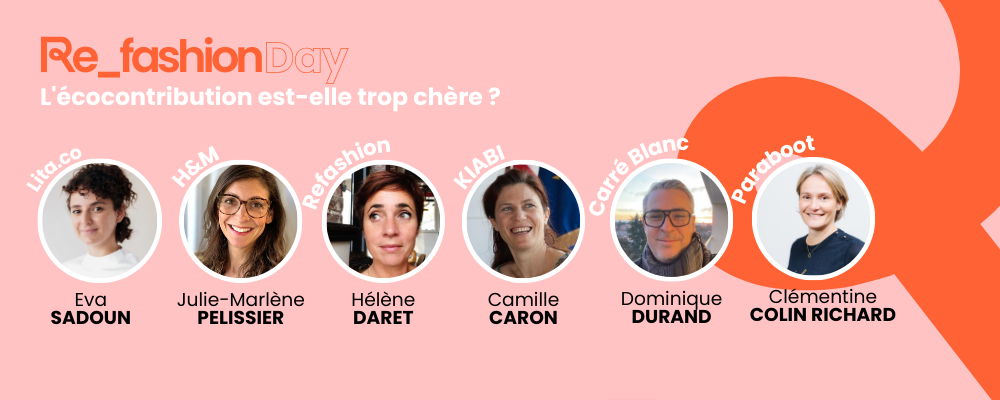
Panel discussion 1 — Topic: Is the eco-fee too expensive?
With Camille Caron (Kiabi), Clémentine Colin Richard (Paraboot), Dominique Durand (Carré Blanc), Julie-Marlène Pellissier (H&M), and Hélène Daret (Refashion).
Opening the day, this first discussion shed light on contrasting yet complementary perspectives regarding the cost and the role of the eco-fee.
But everyone agreed on one point: it is a key driver of transformation for the textiles and footwear sector.
Key messages:
- Refashion, as the eco-organization, acts as a catalyst within this complex ecosystem.
- The eco-fee is the cornerstone that finances the sector’s transition towards a circular economy. It should be viewed as a collective tool supporting the reduction of environmental impacts.
- While the eco-fee represents a significant cost for producers, it does not cover the actual cost of waste treatment. Better understanding how it works, its purpose and how it is used is essential to grasp its full value.
- The eco-fee should be seen as an environmental investment — provided we have indicators to measure its tangible impact.
Panel discussion 2 — Topic: Second-hand and new products — two irreconcilable worlds?
With Isabelle Desfontaines (Eram), Matthieu Giovanonne (Tissons la Solidarité), Samuel Massé (Zara), and Adèle Rinck (Refashion).
This panel discussion showed how second-hand has become central to the transformation of the textiles and footwear industry. The speakers demonstrated that new and second-hand products are not opposites: they complement each other within a profitable and sustainable circular approach.
Key takeaways:
- Second-hand should help shift the sector “from fashion to a new way of living.”
- Some brands have already taken the leap, proving that it is possible to create value while reducing environmental impact.
- This model highlights how a consumer can also become a supplier by returning used products and giving them a second life.
- The success of the circular model depends on collaboration between stakeholders, as well as on the structuring and industrialisation of French collection and sorting channels. This also represents a concrete opportunity to create strong economic and social value across our territories.

Panel discussion 3 — Topic: Incorporating recycled materials — illusion or solution for the future?
With Olivier Civil (Plaxtil), Irène Jousse (Faguo), Emilie Mauffet (Decathlon) and Véronique Allaire (Refashion).
The final panel discussion highlighted both the challenges and progress of the industry when it comes to recycling. All speakers agreed: incorporating recycled materials is no longer a distant dream — it works, and it’s a solution for the future, provided industrial capacities continue to develop and demand is boosted and stabilised.
What to remember:
- Initiatives are multiplying, and experience shows that recycling is already a reality — although still limited in scale.
- To move to the next level, we need to develop sorting, feedstock qualification and material preparation infrastructures in France and Europe, to keep resources within the European market.
- Marketers play a crucial role in stimulating demand for recycled materials and encouraging innovation.
- Closed-loop recycling is growing, but remains costly and technically demanding.
- And above all: desirability remains the primary driver of purchase. Recycled materials should be a bonus, not a constraint.

Watch the aftermovie of Refashion Day 2025
