

October 9, 2026
Jules and textile-to-textile circularity
Feedback on the industrial incorporation of post-consumer recycled cotton, with insights from Monika Fontaine (Circularity Manager) and Amélie Duriez (Denim Category Manager)
Can you explain the origins of the textile-to-textile approach at Jules and the role of recycled materials in your eco-design strategy?
At Jules, as a mission-based company, the environmental approach is at the heart of our model. When we analyse our overall footprint, the conclusion is clear: raw materials alone account for two thirds of our environmental impact, and cotton represents 70% of all our material volumes. It was therefore clear that transforming our material supply chains was the main lever for sustainably reducing our impact.
This awareness is not new. Around fifteen years ago, we carried out a very first trial with a pullover made from recycled jeans which, in hindsight, it has to be said, did not meet our style expectations! All of that has evolved. Today, recycled materials are part of an overall Preferred Fibers policy, which also includes organic cotton, regenerative cotton, certified wool and single-component materials to facilitate future recyclability.
But our real challenge concerns post-consumer recycling. While the recycling of industrial offcuts or regenerated wool has existed for a very long time, reintroducing used textile waste into new products is an innovative topic. The Corporate Social Responsibility (CSR) team acts as an accelerator to test and remove barriers, but the project is then fully driven by the product and purchasing teams in order to make it an industrial standard.
« The fundamental challenge for a mission-driven brand like Jules is not to design an exceptional showcase product, but to successfully scale up the integration of recycled cotton from our own post-consumer textile waste, with no compromise on durability or on price for the customer. »
How did you structure your initial experimentation phases and orchestrate the transition to industrial scale?
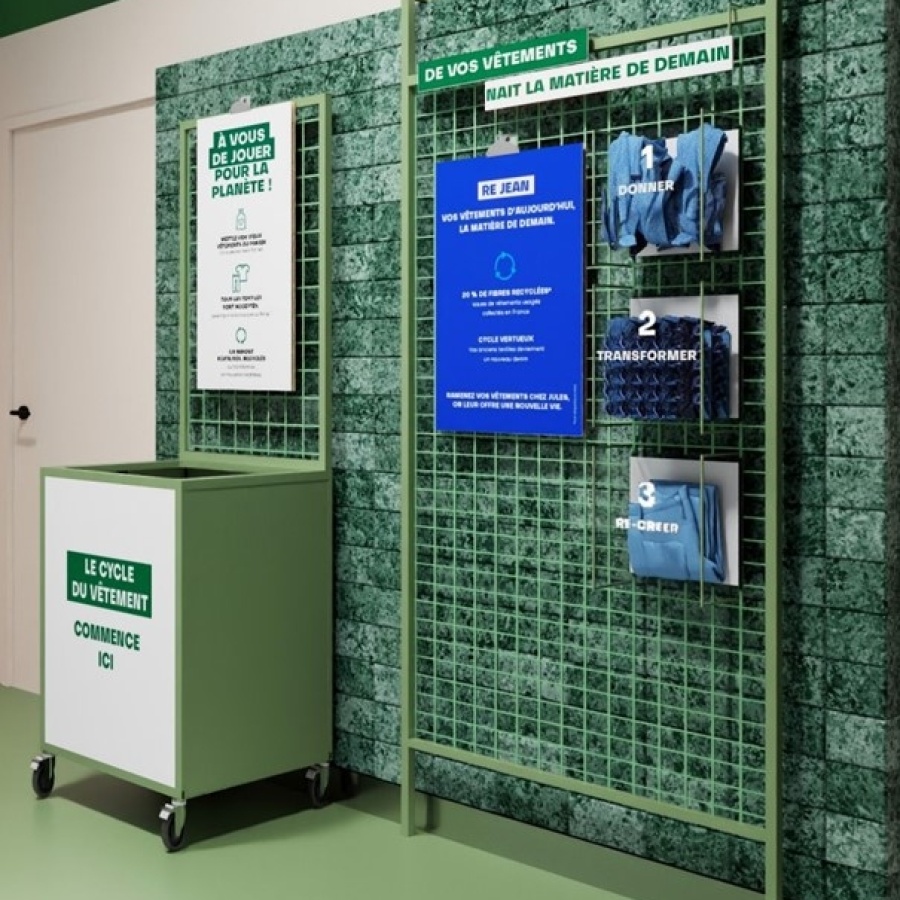
Our approach began three years ago with an initial test, a proof of concept. We collected jeans in-store, then reworked the material with a Spanish partner to produce 500 items containing 5% post-consumer recycled cotton. This test proved the technical feasibility, but also showed us its limitations: the process was very expensive, the feedstock was poorly qualified, and the approach was not scalable on a large scale.
This test gave us a fundamental realisation: we had to move beyond the illusion of purism. Wanting to make a new garment exclusively from old garments returned by our own customers is an economic and logistical dead end. As a textile issuer, our responsibility is to process the overall French textile feedstock, regardless of the original brand of the used garment.
To scale up, we reorganised the chain: we have fibre from the French feedstock sorted and garnetted in France in order to promote local players, then we ship it to our international partner spinners and weavers in Asia. It is this structuring that enabled us to move from 500 test items to mass production across our permanent ranges.
How exactly is your value chain organised, from local sorting through to spinning and weaving with partners?
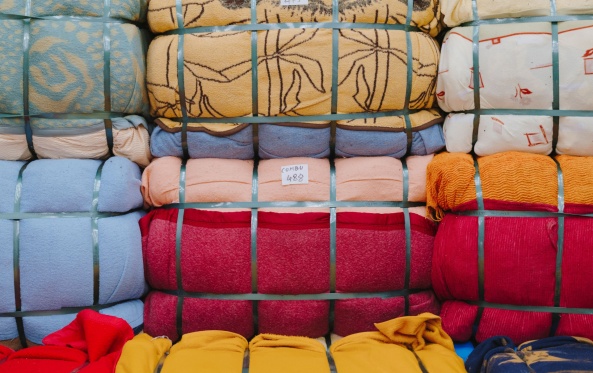
We have built a collaborative ecosystem to secure each stage. Upstream, we work with Dagobaire, a sorting operator based in Northern France that is committed to local reindustrialisation. Dagobaire buys bales from collectors and prepares the textile fibre. They have invested in an optical sorting machine capable of analysing the exact composition and colour of garments moving along a conveyor belt.
Once the fibres have been garnetted and packed into bales, Dagobaire manages the export to our partner spinners in Bangladesh and Pakistan. We prioritise integrated players that carry out spinning and weaving under the same roof, which greatly simplifies the technical issues specific to the use of recycled material.
This loop adds around three months to the traditional production schedule, which requires us to plan ahead. To optimise container transport costs, we practise coopetition by partnering with other brands to share freight containers. For example, in a 20-foot container filled with 20 tonnes, Jules loaded 14 tonnes of bales and a partner brand added 6 tonnes, thereby significantly reducing the financial impact of logistics.
What are the technical limitations of mechanical cotton recycling and how do you adapt to them?
Mechanical recycling inevitably shortens the cotton fibre, which creates constraints in spinning. It is therefore difficult to use recycled cotton to produce very fine yarns, such as those used for smooth dress shirts. Recycled yarn is often a carded yarn, suited to thicker products such as denim, knitwear, overshirts or fleece.
In addition, feedstock bales always contain slight impurities or polyester residues — between 0.5% and 14%. As cotton dye does not take on polyester, this can create small white specks on the fabric. To work around these limitations, we cap the incorporation rate of post-consumer recycled cotton at between 20% and 25% — with Research and Development (R&D) work under way to reach 30% — blended with virgin cotton to ensure the same durability as a new product.
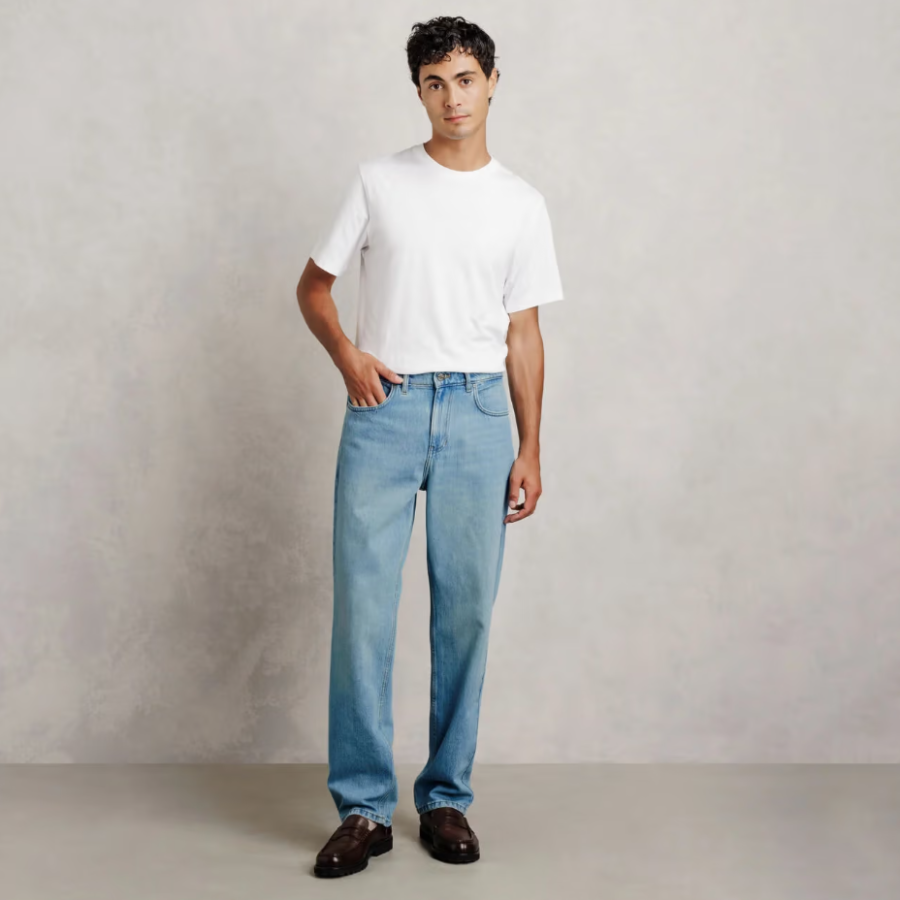
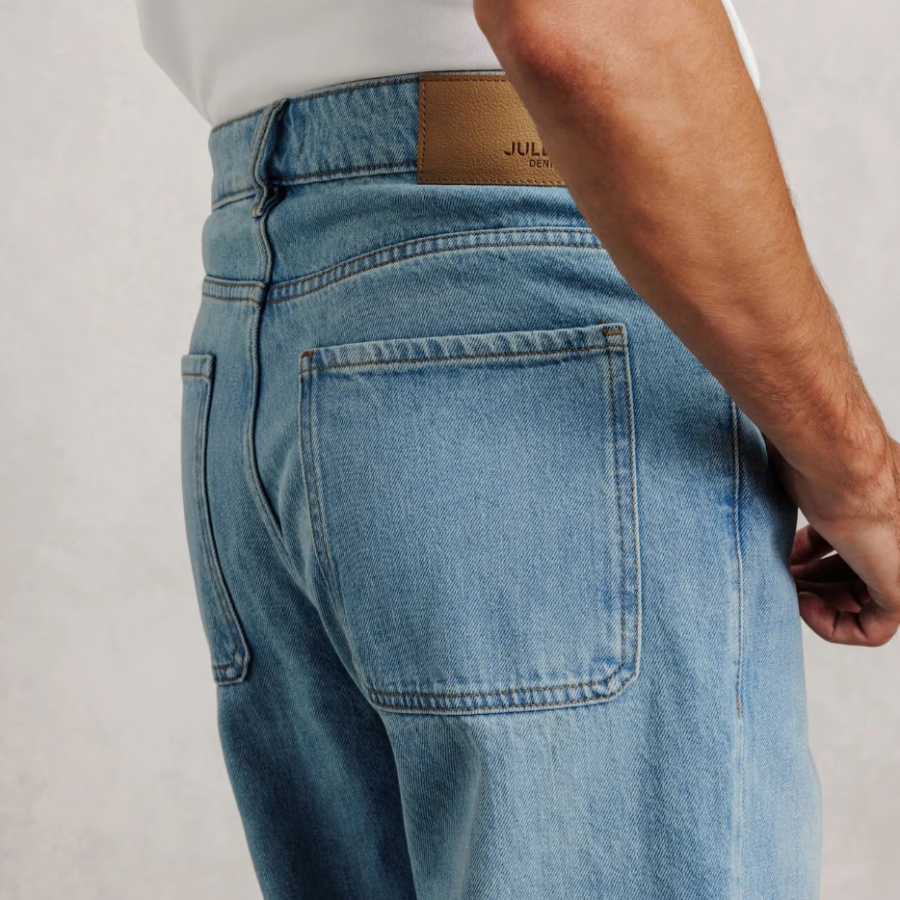
For denim, we incorporate the recycled fibre into the warp yarn, which is then re-dyed in indigo blue, perfectly masking shade variations. Finally, we prioritise cotton bales in ecru or neutral shades to retain a broad range of possible dyeing options.
What is your marketing strategy for promoting these recycled products to your customers?
The approach is based on dedicated marketed products, such as Re-Jean and Re-Pull. This is an excellent Corporate Social Responsibility (CSR) image lever: in particular, the product has a specific name.
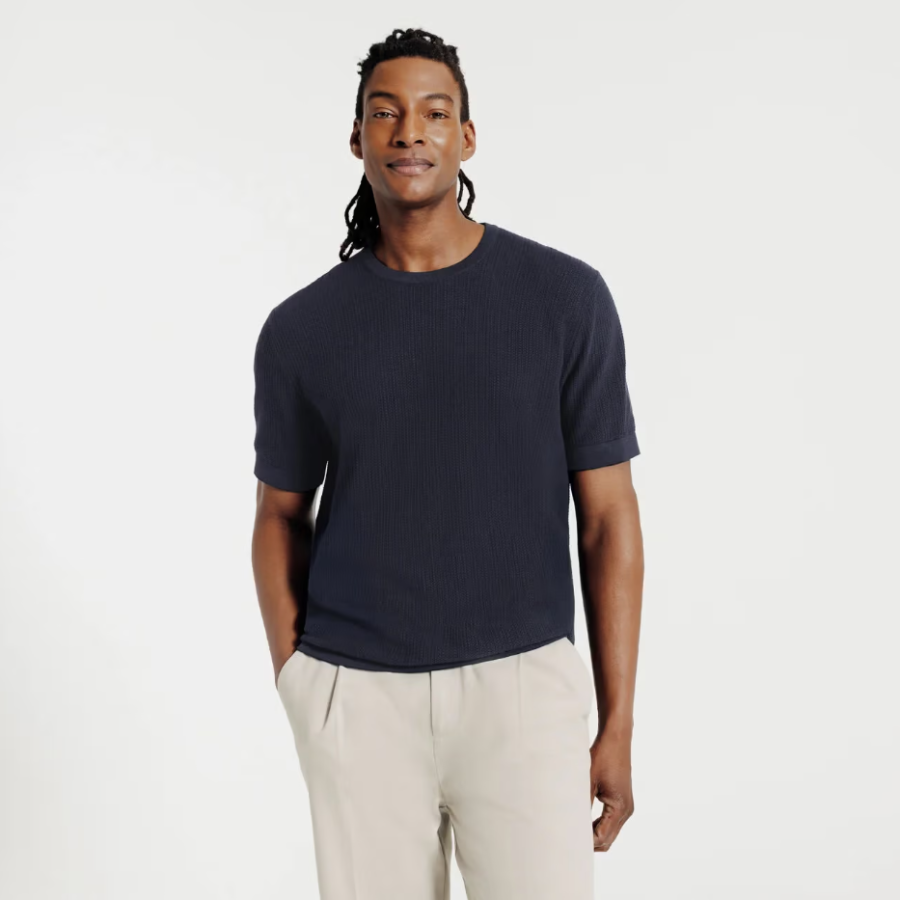
In addition, we are developing support products such as our 100% recycled shopping bag, made between Spain and Morocco and sold at cost price (€5.99), with a QR code providing educational information to raise our customers’ awareness of this issue.

How are these products received by consumers, and how do you manage the economic equation?
The commercial response to Re-Jean has been very positive: the product sold very well, and the aesthetic nuances achieved through washing give it a highly appreciated authentic look. However, there is a preconceived idea among consumers that a recycled garment should cost less because the raw material is perceived as free.
In reality, optical sorting, shredding and logistics generate a real additional cost compared with virgin cotton. Jules has made the strong choice to absorb this margin impact and sell its recycled jeans at the same price as its usual ranges, namely €39 for the standard jeans and €49 for the premium segment.
We believe that customers should not have to pay an ecological premium and that it is up to the brand to structure the sector to make eco-designed fashion accessible to all.
What are the next steps in your circularity roadmap and your long-term objectives?
Our roadmap sets the target of reaching 100% Preferred Fibers in our overall tonnage by 2030. For post-consumer mechanical textile-to-textile recycling, we are aiming for 5% of our total tonnage by 2028, which represents a four- or fivefold increase compared with our current volumes.
We are also developing new sectors, such as recycled nylon made from used fishing nets bought back from fishers in Asia for our pullovers and parkas, as well as closed-loop recycling of old business-to-business (B2B) work uniforms.
Finally, we are continuing inter-brand coopetition to pool our logistics flows.