




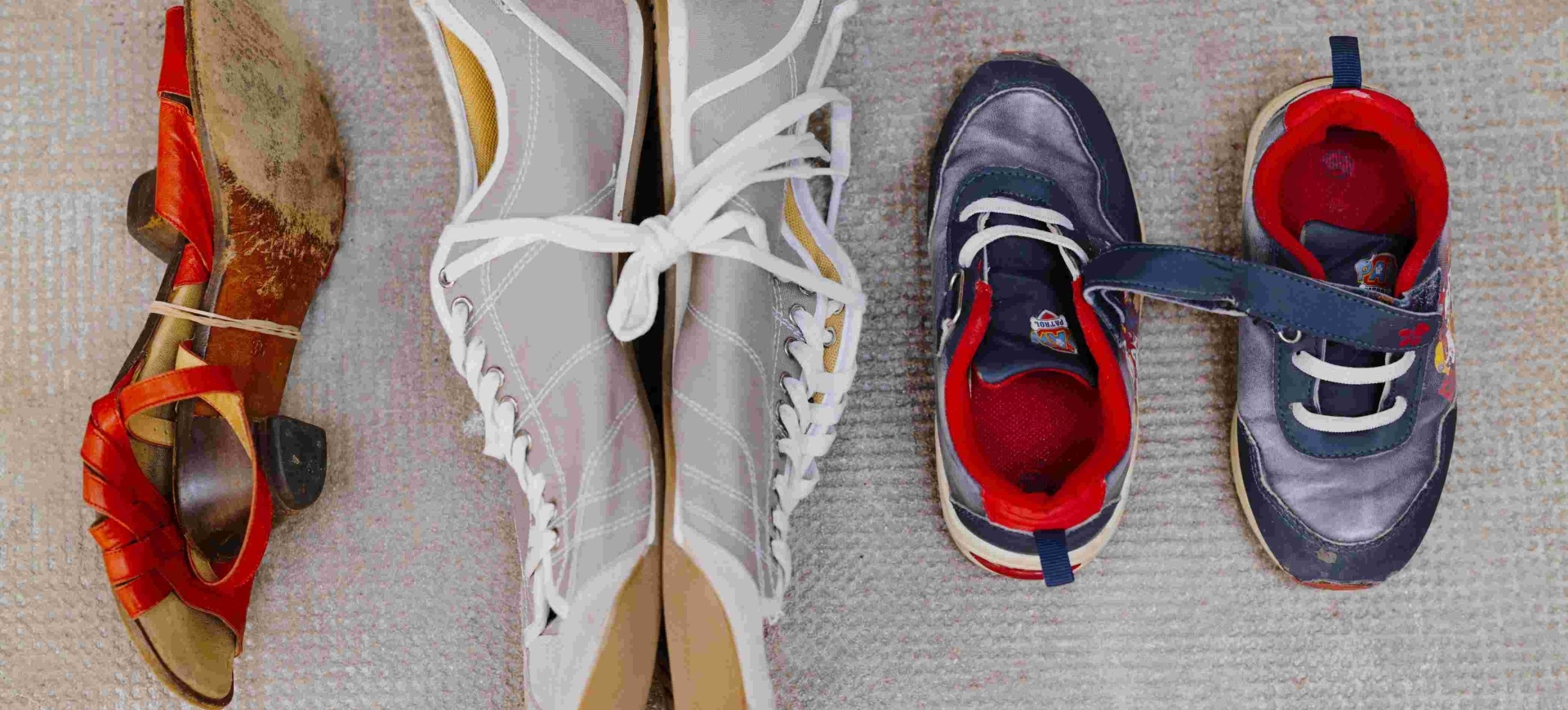
A landmark study of post-consumer footwear waste in Europe reveals that design complexity – not material scarcity – is one of the primary barriers to circularity
Half of all post-consumer footwear collected in Europe is non-rewearable and most ends up incinerated or in landfill, according to a new report from Fashion for Good and Circle Economy that provides what is described as the most detailed analysis to date of post-consumer shoe waste streams.
The Closing the Footwear Loop Phase 1 report – produced in partnership with sorting and recycling specialists CETIA, Matoha, Picvisa, and The 8 Impact – draws on analysis of 1,200 individual post-consumer shoes collected at a sorting facility in Catalunya, Spain, generating data across 14 variables per shoe including material composition, assembly technique, colour, damage type and archetype.
The report notes how the global footwear industry produces around 23.8 billion pairs annually, yet approximately 90% of discarded shoes are landfilled or incinerated.
[...]
The report concludes that footwear legislation should be decoupled from apparel frameworks under the EU’s Waste Framework Directive and Ecodesign for Sustainable Products Regulation (ESPR), with tailored EPR incentives and recycled-content targets introduced specifically for shoes.
“The key path forward involves strengthening circular design practices, promoting the rewear potential, improving sorting and preprocessing capacity and technology, and establishing robust data systems,” concludes the report. Noting that transforming non-rewearable shoes from a complex waste challenge into a valuable material resource is challenging, but possible through collaborative intervention. “By grounding future policy and innovation in real-world product evidence, the footwear sector can take decisive steps toward closing the loop.”
[...]