
Artificial and cellulose fibres
Understand the material, its key figures, the stages of its manufacturing process, its properties and applications, the environmental issues, as well as information on the durability, recyclability, and alternatives available to this material.
30 min de lecture
Update : Oct 2026
8.4 million tonnes
Of man-made cellulosic fibres produced worldwide in 2024, representing around 6% of the global fibre market.
80 %
Of man-made cellulosic fibre volumes are made up of viscose.
3rd
Most widely produced fibre in the world.
Introduction
Man-made cellulosic fibres occupy an intermediate position between natural and synthetic fibres. They are derived from plant cellulose, an organic compound found in plant cell walls, most often from wood pulp, but require extensive chemical processing—dissolution, esterification or another chemical reaction depending on the type of fibre—in a solvent in order to be spun 1. This processing gives them characteristics similar to those of natural fibres, but at a lower cost.
Man-made cellulosic fibres belong to the category of man-made fibres, in the same way as man-made protein fibres (casein, soy, zein), which will not be covered in this factsheet.
Key data
- Fibre type: Man-made cellulosic fibres, or MMCF (Man-Made Cellulosic Fibers). What distinguishes these fibres from one another is the cellulose transformation process:
- Regenerated cellulose fibres (viscose, modal, lyocell and cupro) 2: involve the cellulose being dissolved and then regenerated in a new crystalline form.
- Modified cellulose fibres (acetate, triacetate)3 : here, the cellulose is esterified by reaction with acetic anhydride (a reaction with acetic anhydride that makes the cellulose less sensitive to water and thermoplastic) and remains chemically transformed in the final fibre. It is the degree of esterification that distinguishes acetate from triacetate. - Annual global production: Annual global production of man-made cellulosic fibres has been increasing for 30 years. This production has more than doubled since 1990, when it amounted to just over 3 million tonnes, reaching around 7.1 million tonnes by the end of the 2010s. After a temporary decline in 2020 linked to the Covid-19 pandemic (6.5 million tonnes), production rebounded to 7.2 million tonnes as early as 2021, before reaching 7.9 million tonnes produced in 2023 and 8.4 million tonnes in 2024 4. Viscose accounts for 80% of man-made cellulosic fibre volumes, followed by acetate/triacetate and then lyocell, with 13% and 5% of volumes respectively. 5
Global fibre market
Man-made cellulosic fibres produced in 2024
6%
Other fibres
94%
- Principaux pays producteurs et acteurs 6: En amont, la production de pâte à dissoudre (pâte de cellulose obtenue à partir de bois avec un taux très élevé de cellulose) est concentrée en Afrique du Sud, Indonésie, Brésil, Etats-Unis et Chili. En aval, près des deux tiers de la transformation s’effectue en Asie, notamment en Chine, Indonésie et en Inde qui figurent parmi les plus gros importateurs de pâte à dissoudre.
- Place dans la production mondiale de fibres : les fibres artificielles cellulosiques occupent la 3ᵉ place avec 6 % de la production mondiale derrière le polyester (59%) et le coton (19%). 7
Properties and examples of applications
Man-made cellulosic fibres are used in a wide variety of textile products:
- Clothing: linings, lingerie, dresses (viscose, acetate, triacetate). Lyocell and modal are versatile materials used for clothing such as denim, t-shirts and tops.
- Household linen: bed linen (lyocell).
Common properties: Regenerated cellulosic fibres share good moisture absorption and management, good breathability and a soft feel with natural cellulosic fibres.
Distinctive properties 8: The fibres differ mainly in their resistance to moisture, which has historically been viscose’s weak point, as it loses around half of its strength when wet. Lyocell retains a certain level of moisture resistance; in fact, it is the only regenerated cellulosic fibre whose wet strength exceeds that of wet cotton. Modal, produced using the same basic process as viscose, has significantly better resistance to stretching and moisture than viscose, allowing machine washing without deformation. Triacetate stands out for its ability to be thermoformed (pleating), but has lower abrasion resistance.
Production
Stages of the production process
Step 1
Production of dissolving pulp
The raw material (wood, mainly eucalyptus, bamboo, beech, pine or spruce) is first cut, shredded and then chemically cooked in order to remove lignin and other undesirable components, and obtain dissolving pulp (highly purified cellulose). Cupro is the only exception, as it is made from cotton linters (short fibres from cotton seeds, rich in pure cellulose). 9
Step 2
Dissolution of cellulose
This stage differentiates each fibre.
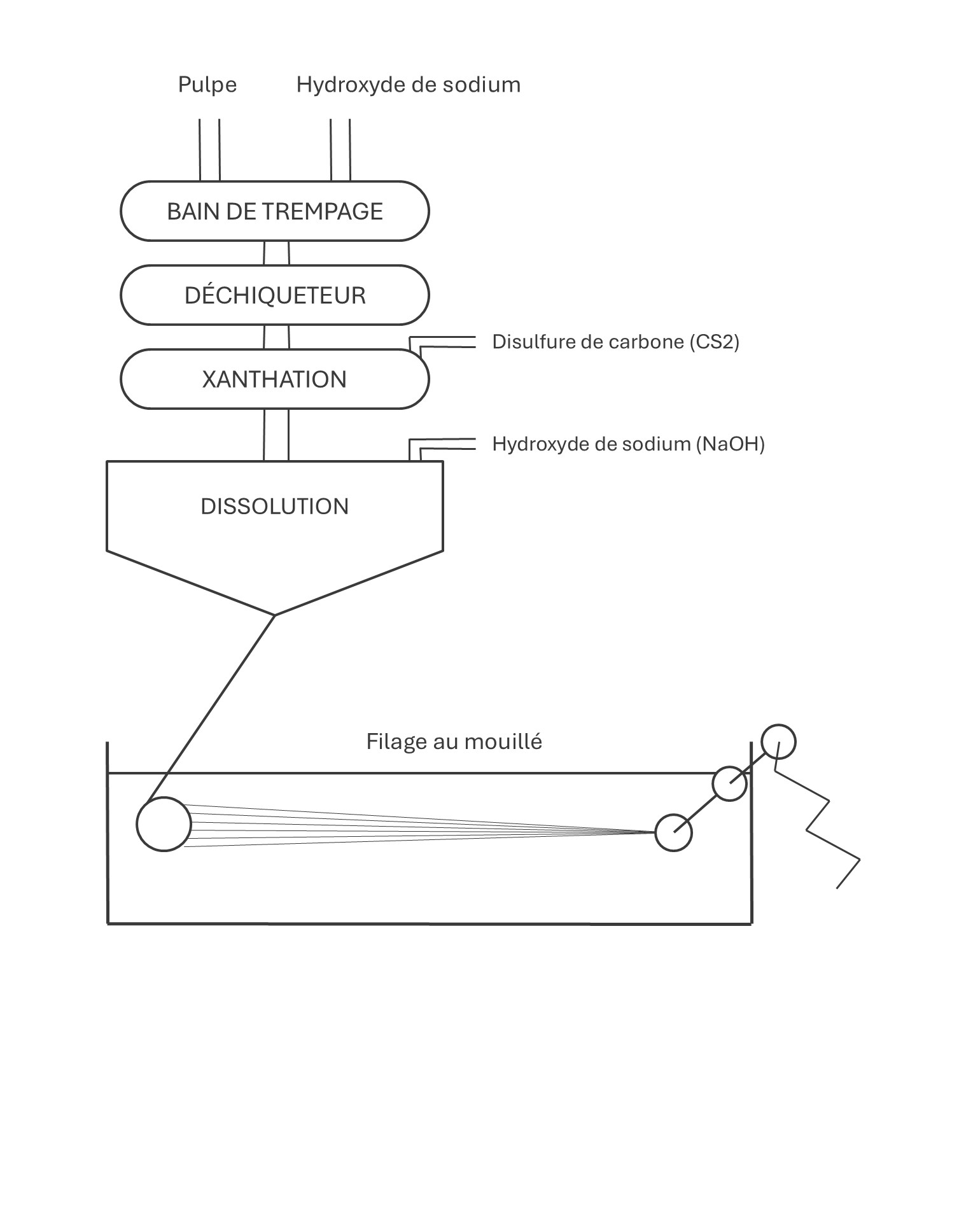
- For viscose, the pulp is first soaked in a soda solution (alkalisation), then shredded into flakes 10, pressed and aged before reacting with carbon disulphide (xanthation). 11
- Modal is based on the same chemical principle as viscose, but uses a higher-quality pulp and an optimised spinning process, which produce a denser fibre structure and therefore significantly better mechanical performance, particularly in the wet state. 12
- Lyocell and cupro dissolve the cellulose directly without derivatisation, respectively in an organic solvent (N-methylmorpholine N-oxide, or NMMO) and in an ammoniacal copper sulphate solution. 13
- Acetate is not dissolved but esterified by acetylation (a reaction with acetic anhydride that makes cellulose less sensitive to water and thermoplastic)
- Emerging processes: other, more recent cellulose dissolution processes remain at the research or industrial pilot stage to date, with no commercial production. These include the carbamate process (Carbacell), which avoids carbon disulphide by reacting cellulose with urea 14, and the Ioncell process, which dissolves cellulose in an ionic liquid and has reached pilot stage at Aalto University (Finland), including using used textiles. 15
Step 3
Spinning
Two main routes, depending on the fibre type.
- Wet route (viscose, modal, cupro): the filaments are extruded into a liquid coagulation bath 16. Lyocell follows a variation of this wet route, known as dry-jet wet spinning: the solution passes through a small air gap before entering the coagulation bath, which promotes better molecular orientation and makes the fibre stronger.
- Dry route (acetate, triacetate): the filaments are extruded into a stream of hot air that gradually evaporates the solvent (acetone), without a liquid bath.
Step 4
Drawing, washing, finishing
The filaments are drawn to strengthen their molecular orientation (and therefore their resistance), washed to remove chemical residues, then cut or wound depending on the final use.
Production diagram
Environmental impact
Environmental issues of production
🧪 Ecotoxicity
Viscose and modal are based on the same high-risk chemical process: the CS2 (carbon disulphide) released during dissolution generates toxic by-products (H2S or hydrogen sulphide, and trithiocarbonate); during spinning, the zinc sulphate used in the coagulation bath alone accounts for more than 90% of the process toxicity for aquatic ecosystems 17. In practical terms, CS2 is a recognised neurotoxin, associated with nervous, cardiovascular and reproductive disorders in exposed workers 18; H2S contributes to acid rain and fish mortality. These releases occur in particular when wastewater from production sites is not treated before being discharged into rivers. 19
Lyocell differs significantly in this respect: without CS2 or metal salts, it reduces freshwater ecotoxicity by 35% compared with viscose. 20 However, this advantage in terms of chemical toxicity is not systematically reflected in terms of energy consumption.
💧 Water consumption
The water consumption of man-made cellulosic fibres depends on the raw material used to produce the pulp (rainfed or irrigated): cotton requires intensive irrigation, whereas wood generally requires no artificial water input. For most cellulosic fibres, water consumption is therefore dominated by the transformation process, particularly during the production of dissolving pulp and during soaking prior to xanthation. 21
🌱 Land use and biodiversity
22 Le changement d'utilisation des terres est l'une des principales menaces pesant sur les écosystèmes, car il entraîne la destruction et la fragmentation des habitats naturels, réduisant la capacité des espèces à se nourrir, se reproduire et se déplacer. L'utilisation des terres induite par le modal et la viscose européenne (0,7 ha/t-an) est légèrement inférieure à celle du coton (0,8 ha/t-an). Cette empreinte diminue nettement pour la viscose asiatique (0,3 ha/t-an) et le lyocell (0,2 ha/t-an), grâce à l’utilisation de l'eucalyptus, dont la croissance est bien plus rapide que celle du hêtre européen. Ce gain en surface a toutefois une contrepartie : les monocultures d'eucalyptus, moins riches en biodiversité que les forêts naturelles, pèsent aussi sur les ressources en eau locales du fait de leur forte consommation et sont moins résilientes aux incendies.
🌡️ Energy consumption
Man-made cellulosic fibres are energy-intensive: their manufacture requires a heavy industrial process (chemical cooking of wood, dissolution, spinning). However, energy consumption depends less on the process itself than on the location and type of production site. An integrated plant (pulp and fibre on the same site, recovery of by-products as fuels) powered by clean energy significantly reduces this consumption. Simply relocating production can reduce the climate impact by up to 38%, without any change to the process. 23
🌱 Deforestation
According to the NGO Canopy, whose figures are cited by the European Environment Agency, around 150 million trees are felled each year for viscose production, equivalent to 2.5 to 3 tonnes of wood per tonne of fibre (2020 data) 24. However, wood sourcing is increasingly well controlled: according to Canopy’s 2025 Hot Button Report, 70% of producers of man-made cellulosic fibres, representing 53% of global volume, are now classified as low risk for sourcing from ancient and endangered forests. In addition, around two thirds of man-made cellulosic fibres are now produced from Forest Stewardship Council (FSC)/Programme for the Endorsement of Forest Certification (PEFC)-certified or controlled raw materials. 25
Eco-design issues
1. Durability
1. The role of crystalline structure
The durability of cellulosic fibres depends directly on the crystalline structure of each fibre. Crystalline regions are the portions of the fibre where the cellulose chains are perfectly aligned and tightly bound together, forming a compact structure that resists water infiltration and mechanical deformation. This crystallinity depends primarily on the dissolution and regeneration process used; for example, lyocell has a significantly higher crystallinity (80%) than viscose (41%) and modal (49%). This means that viscose is more prone to shrinkage, loss of shape over time and faster degradation. This high crystallinity allows lyocell to better tolerate machine washing at low temperature, making it the easiest-care man-made cellulosic fibre. Conversely, acetate is sensitive to heat and certain solvents, so dry cleaning is often recommended for this fibre. 26
2. The importance of care
Appropriate care significantly extends the lifespan of these fibres: hand washing or using a delicate cycle with a reduced load, limited spinning, air drying rather than tumble drying, and ironing at low temperature with a damp cloth. These recommendations, common to viscose and modal, limit fibre swelling and dimensional deformation, which make them more fragile.
2. Recyclability
1. Mechanical recycling : As with other fibres, mechanical recycling (shredding, garnetting) remains possible, but it shortens the fibres with each cycle, limiting outlets to lower-value applications as the cycles accumulate. It should be noted that mechanical recycling of man-made cellulosic fibres can be complex: viscose and lyocell are favoured for lightweight, fluid fabrics woven with fine yarns, which makes them very difficult to garnett.
2. Chemical recycling: he advantage of man-made cellulosic fibres lies in their ability to use cellulosic textile waste, particularly cotton, as an alternative raw material to virgin dissolving pulp. This recycling remains more complex than virgin fibre production, as it requires a purification stage to remove dyes, finishes and other fibres present in the used textile 27. his is the principle behind the technologies that are currently the most developed at pilot or industrial scale: Circulose, Refibra, NuCycl and Infinna transform cotton-based textile waste into new regenerated cellulosic fibres. Chemical recycling of man-made cellulosic fibres into new man-made cellulosic fibres, for example from used viscose or modal into new fibre, remains a much less mature route, as illustrated by recent work on the Ioncell process, which redissolves already degraded viscose and modal fibres in an ionic liquid in order to spin them again into new lyocell-type fibres 28. The main challenge for these sectors remains production costs, which are higher than those of virgin fibre, slowing their large-scale adoption.
3. Incorporation of recycled material
Recycled dissolving pulp is now a secondary raw material that is increasingly being studied in the man-made cellulosic fibre industry. Its incorporation into new fibres makes it possible to recover cellulosic textile waste while reducing the consumption of virgin dissolving pulp.
In recent years, progress in purification and dissolution processes has helped improve the quality of recycled pulp, in particular by limiting the cellulose degradation traditionally associated with this type of recycling. At the same time, emerging dissolution processes are exploring the transformation of already highly degraded fibres, such as used viscose or modal, into new lyocell-type fibres.
These advances are gradually expanding the outlets for recycled material, although it is still generally blended with virgin pulp in order to preserve the mechanical properties of the final fibre.
Action levers
Points to watch
As with any eco-design approach, before choosing a material, it is essential to analyse the environmental impact of a product’s entire life cycle and to compare different scenarios in order to identify which one has the lowest environmental impact. There is no ideal material; a material must be chosen according to the product’s intended use and its environmental objectives.
Considering the environmental issues specific to cellulosic fibres, there are two relevant types of certification. Those focusing on the upstream stage, particularly the origin of raw materials such as wood, and those aimed at reducing the impact of production process stages and the use of chemicals.
There are several labels and certifications for this material; here are those eligible for Refashion’s “Environmental Labels” eco-modulation. 29 30 31 32
Eco-modulations: Refashion promotes product eco-design initiatives through a system of bonuses and penalties. Find out about the criteria and procedures for declaring eco-modulations.

Ecocert ERTS certification (Ecological & Recycled Textile Standard)
Ecocert ERTS (Ecological & Recycled Textile Standard) certification explicitly covers man-made cellulosic fibres (lyocell, TENCEL™ etc.) and requires that 100% of the wood fibres used for these fibres come from sustainably managed forests

OEKO-TEX® MADE IN GREEN label
The OEKO-TEX® MADE IN GREEN label is a traceability label that covers the entire textile production chain, including wet-spinning facilities (viscose, lyocell), which must be OEKO-TEX STeP certified

bluesign label
The bluesign label extended its scope to fibre manufacturers in March 2020. For viscose, it involves recovering carbon disulphide (CS2) from the air released by factories rather than allowing it to escape, thereby limiting toxic emissions. For lyocell, the objective is to recycle at least 99% of the solvent used, avoiding the need to produce new solvent and regularly dispose of it. The certification also sets limits on what factories may discharge into water

Eu Ecolabel
The EU Ecolabel is the only European regulatory certification that specifically covers man-made cellulosic fibres (viscose, modal, lyocell), with precise criteria including a minimum of 25% pulp from wood managed sustainably according to FAO principles.
Alternative materials available :
Alternative fibres: to produce a man-made cellulosic fibre, resources other than wood can be used, including next-generation fibres (Next Gen Fibers), which refer to man-made cellulosic fibres produced from post-consumer textile waste or raw materials that are alternatives to virgin forests. These include cotton linter (a ginning residue, used in particular for cupro), wheat, oat or rice straw, sugarcane bagasse, and post-consumer textile waste, which enters the chemical recycling streams discussed above. These alternatives can be of interest by recovering agricultural co-products or offering faster yields than wood, with a smaller land footprint. However, this observation must be qualified, as it depends strongly on the type of agriculture practised: any alternative raw material must undergo an LCA before it can be presented as more virtuous—the impact depends on the agricultural context, location and method of recovering the co-product. 33
Less impactful processes: Lyocell uses a manufacturing process recognised as less impactful than viscose and modal, since the solvent in which the pulp is dissolved (NMMO) is recovered at more than 99% and then reintegrated into the process in a closed loop, a level of recycling that neither viscose nor modal achieves 34. It is also non-toxic and non-corrosive, and has reduced water consumption. In addition, the wood used is largely eucalyptus, a fast-growing species that enables shorter rotation cycles and a higher yield per hectare than European species such as beech. However, the impact should still be qualified, since eucalyptus monoculture plantations significantly reduce biodiversity.
Sources34
- 1 Regenerated cellulose fibres and their composites: From fundamental properties to advanced applications, ScienceDirect, 2025, consulté le 6 juillet 2026, https://www.sciencedirect.com/science/article/pii/S0079642525001252
- 2 Ibid.
- 3 Regenerated cellulose fibres and their composites: From fundamental properties to advanced applications, ScienceDirect, 2025: https://www.sciencedirect.com/science/article/pii/S0079642525001252
- 4 Textile Exchange (2022). Preferred Fiber and Materials Market Report 2022: https://textileexchange.org/app/uploads/2022/10/Textile-Exchange_PFMR_2022.pdf
- 5 Textile Exchange, Materials Market Report 2025, Textile Exchange, septembre 2025: https://textileexchange.org/knowledge-center/reports/materials-market-report-2025/
- 6 Bharadwaj, B., Mathews, R.E. et Barrie, J., The water footprints of global textiles trade, Chatham House, 24 juillet 2026 (https://www.chathamhouse.org/2026/07/water-footprints-global-textiles-trade/impacts-fresh-water-along-textile-value-chain) ; Textile Exchange, Materials Market Report 2025, Textile Exchange, septembre 2025 (https://textileexchange.org/knowledge-center/reports/materials-market-report-2025/)
- 7 Textile Exchange, Materials Market Report 2025, Textile Exchange, septembre 2025: https://textileexchange.org/knowledge-center/reports/materials-market-report-2025/
- 8 Zhang, S., Chen, C., Duan, C., et al., "Regenerated Cellulose by the Lyocell Process, a Brief Review of the Process and Properties," BioResources 13(2), 4577-4592, 2018: https://bioresources.cnr.ncsu.edu/wp-content/uploads/2018/03/BioRes_13_2_4577_Review_Zhang_CDHLLLMSN_Regenerated_Cellulose_Lyocell_Review_Process_Properties_13491.pdf
- 9 Wastepaper-Based Cuprammonium Rayon Regenerated Using Novel Gaseous–Ammoniation Injection Process, PMC: https://pmc.ncbi.nlm.nih.gov/articles/PMC11397804/
- 10 Regenerated Cellulosic Fibre — an overview, ScienceDirect Topics: https://www.sciencedirect.com/topics/engineering/regenerated-cellulosic-fibre
- 11 Regenerated cellulose fibres and their composites, ScienceDirect, 2025: https://www.sciencedirect.com/science/article/pii/S0079642525001252
- 12 Regenerated Viscose Fibers Enabled by Recycled Cotton Pulps with Different Degrees of Polymerization from Waste Textiles, Polymers (MDPI), 2026: https://doi.org/10.3390/polym18111302
- 13 Wastepaper-Based Cuprammonium Rayon Regenerated Using Novel Gaseous–Ammoniation Injection Process, PMC: https://pmc.ncbi.nlm.nih.gov/articles/PMC11397804/
- 14 Cellulose carbamate derived cellulose thin films: preparation, characterization and blending with cellulose xanthate, Cellulose, Springer Nature, 2019: https://link.springer.com/article/10.1007/s10570-019-02600-z
- 15 Investigating the Routes to Produce Cellulose Fibers from Agro-Waste: An Upcycling Process, ChemEngineering (MDPI), 2024: https://www.mdpi.com/2305-7084/8/6/112
- 16 A perspective on the wet spinning process and its advancements in biomedical sciences, ScienceDirect, 2022: https://www.sciencedirect.com/science/article/abs/pii/S0014305722006851
- 17 Regenerated cellulose fibres and their composites: From fundamental properties to advanced applications, ScienceDirect, 2025 (https://www.sciencedirect.com/science/article/pii/S0079642525001252); Guo, S., Li, X., Zhao, R., Gong, Y., "Comparison of life cycle assessment between lyocell fiber and viscose fiber in China," The International Journal of Life Cycle Assessment, Springer, 2021 (https://link.springer.com/article/10.1007/s11367-021-01916-y)
- 18 Gelbke, H.P., Göen, T., Mäurer, M., Sulsky, S.I., "A review of health effects of carbon disulfide in viscose industry and a proposal for an occupational exposure limit," Critical Reviews in Toxicology 39(Suppl 2), 2009; Carbon Disulfide (CICADS 46), Programme international sur la sécurité des substances chimiques (IPCS/OMS), 2002 (https://www.inchem.org/documents/cicads/cicads/cicad46.htm)
- 19 Changing Markets Foundation, Dirty Fashion: How pollution in the global textiles supply chain is making viscose toxic, Changing Markets Foundation, 2017: https://changingmarkets.org/wp-content/uploads/2018/01/DIRTY_FASHION_SPREAD_PAGE_WEB.pdf
- 20 A Comparative Life Cycle Assessment of T-Shirt Production Using from Viscose, Lyocell, Cotton, and Polyester, Sustainability (MDPI), 2026: https://www.mdpi.com/2071-1050/18/8/4070
- 21 Deckers, J., Manshoven, S., Mortensen, L.F., The role of bio-based textile fibres in a circular and sustainable textiles system, ETC-CE Report 2023/5, European Environment Agency / European Topic Centre on Circular economy and resource use, mai 2023
- 22 Deckers, J., Manshoven, S., Mortensen, L.F., The role of bio-based textile fibres in a circular and sustainable textiles system, ETC-CE Report 2023/5, European Environment Agency / European Topic Centre on Circular economy and resource use, mai 2023
- 23 Étude MDPI, 2026 : A Comparative Life Cycle Assessment of T-Shirt Production Using Viscose, Lyocell, Cotton, and Polyester, Sustainability, 18(8), 4070: https://www.mdpi.com/2071-1050/18/8/4070
- 24 Canopy (2020), cité dans Deckers, B. et al., ETC-CE Report 2023/5 — The role of bio-based textile fibres in a circular and sustainable textiles system, Agence européenne pour l'environnement (EEA), 2023: https://www.eionet.europa.eu/etcs/etc-ce/products/etc-ce-report-2023-5-the-role-of-bio-based-textile-fibres-in-a-circular-and-sustainable-textiles-system
- 25 Textile Exchange, Materials Market Report 2025, Textile Exchange, septembre 2025 (https://textileexchange.org/knowledge-center/reports/materials-market-report-2025/) ; Canopy, Hot Button Report 2025, octobre 2025 (https://canopyplanet.org/tools-and-resources/hot-button-report)
- 26 Crystallinity changes in lyocell and viscose-type fibres by caustic treatment, Polymer (ScienceDirect), 2002: https://www.sciencedirect.com/science/article/abs/pii/S0014305702001325
- 27 Seifali Abbas-Abadi, M., Tomme, B., Goshayeshi, B., Mynko, O., Wang, Y., Roy, S., Kumar, R., Baruah, B., De Clerck, K., De Meester, S., D'hooge, D.R., Van Geem, K.M., "Advancing Textile Waste Recycling: Challenges and Opportunities Across Polymer and Non-Polymer Fiber Types", Polymers, MDPI, publié le 26 février 2025: https://doi.org/10.3390/polym17050628
- 28 Schlapp-Hackl, I., Rissanen, M., Airaksinen, T., Alexandre, S., Twaroch, N., Roy, S., Siren, N., Heimala, S., Hytti, M., Leinonen, A., Sixta, H., Hummel, M., "From Viscose to Lyocell-Type Fibers: Chemical Recycling of Viscose and Modal Fibers Using the Ioncell Process", ChemSusChem, Wiley, vol. 19, n°11, e202502288, 2026, DOI : 10.1002/cssc.202502288.
- 29 ADEME, "Ecocert Textile," Agir pour la transition: https://agirpourlatransition.ademe.fr/particuliers/node/21924
- 30 OEKO-TEX®, "OEKO-TEX® MADE IN GREEN" (https://www.oeko-tex.com/en/our-standards/oeko-tex-made-in-green) — voir aussi le standard technique détaillant les exigences pour les installations de filage voie humide (viscose, lyocell) : OEKO-TEX®, "Standard OEKO-TEX® MADE IN GREEN", Édition 01.2025 (https://www.oeko-tex.com/importedmedia/downloadfiles/OEKO-TEX_MADE_IN_GREEN_Standard_EN.pdf)
- 31 bluesign® CRITERIA for production sites — Annex Fiber Manufacturing, v1.0, mars 2020
- 32 Décision de la Commission du 5 juin 2014 (2014/350/UE), établissant les critères d'attribution du label écologique de l'Union européenne aux produits textiles, JO L 174 du 13.6.2014, p. 45, Critère 9 ("Fibres cellulosiques artificielles, y compris viscose, modal et lyocell"), EUR-Lex: https://eur-lex.europa.eu/legal-content/FR/TXT/HTML/?uri=CELEX:02014D0350-20201201
- 33 Producing dissolving pulp from agricultural waste, RSC Sustainability, 2025
- 34 Deckers, J., Manshoven, S., Mortensen, L.F., The role of bio-based textile fibres in a circular and sustainable textiles system, ETC-CE Report 2023/5, European Environment Agency / European Topic Centre on Circular economy and resource use, mai 2023
Plus de ressources sur le même sujet


