

Cotton
Understand the material, its key figures, the stages of its manufacturing process, its properties and applications, the environmental issues, as well as information on the durability, recyclability, and alternatives available to this material.
30 min de lecture
Update : Oct 2026
24.5 million tonnes
Of cotton fibre produced worldwide in 2024, representing approximately 19% of the global fibre market
34 %
Of the cotton placed on the market in 2024 came from certified sources
1 %
Of the cotton placed on the market in 2024 was recycled cotton
Introduction
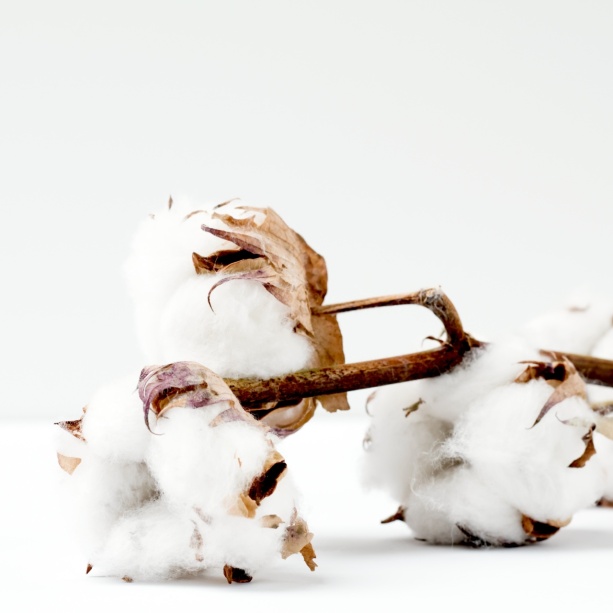
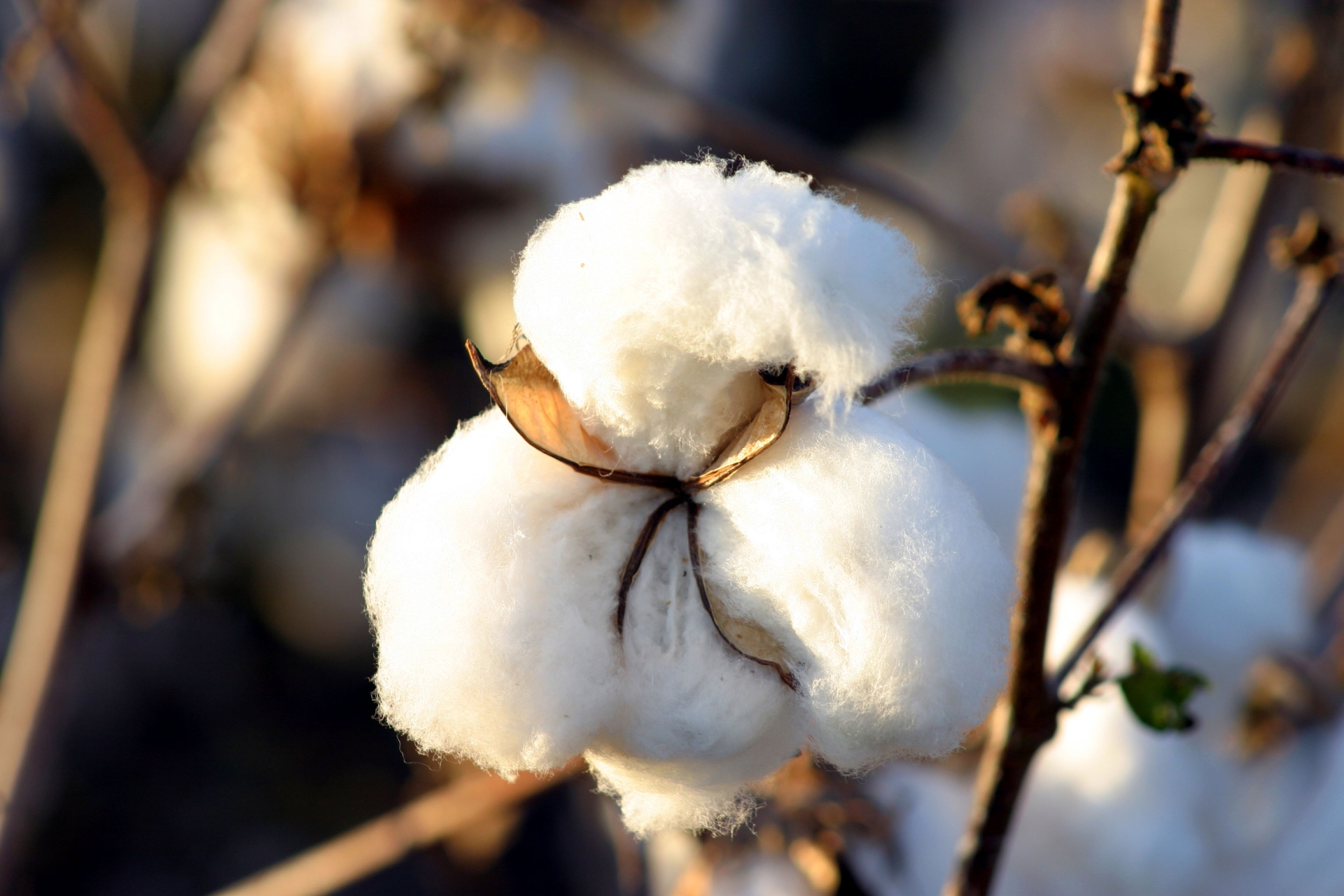
Cotton fibre comes from a plant called the cotton plant, which, after flowering, produces a capsule made up of seeds and a mass of fibres. These are the fibres that are harvested and then used by the textile industry.
Key data
- Type of fibre : Natural plant-based fibre.
- Global cotton production : Around 24.5 million tonnes of cotton fibre (2023/2024), representing 19% of global fibre production. Cotton is produced in more than 70 countries and supports 100 million households worldwide. 1
- Main merino wool-producing countries : According to the International Cotton Advisory Committee (ICAC), three quarters of global cotton production come from four countries: China, India, Brazil and the United States. Although this ranking varies from year to year, China remains the world’s leading producer of cotton fibres. 2
- Position of cotton in global fibre production : 2nd place, behind polyester (59%). First place among natural fibres.
Global fibre market
Cotton produced in 2024
19%
Other fibre
81%
Share of certified material
Conventional cotton
Certified cotton
Properties and examples of applications
Cotton is the most widely used natural fibre in the fashion, textile and clothing industry.
It has many sought-after properties :
- Its softness, breathability, lightness and versatility make it ubiquitous in clothing, household linen, workwear and even the medical sector.
- Its exceptional absorbency properties — capable of absorbing up to 65% of its weight in water — allow cotton to be used in a wide range of applications, from T-shirts and jeans to medical compresses.
- Good tensile strength and resistance to washing.
However, cotton has weaknesses in terms of abrasion and tearing, making it less resistant than synthetic materials, particularly polyester, although a good-quality fibre/spinning process can greatly improve its resistance. Cotton/polyester and cotton/elastane blends provide new properties: polyester adds greater resistance and reduces creasing, while elastane adds greater elasticity.
Production
Stages of the production process 5
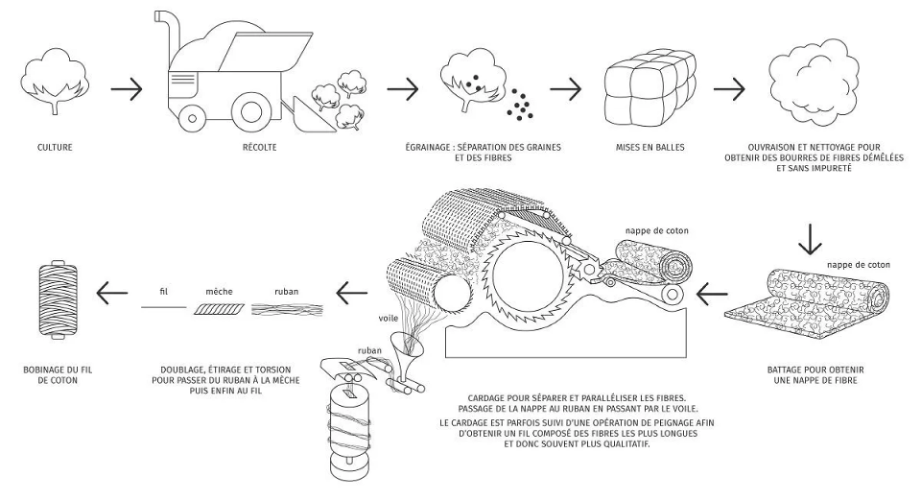
The transformation of the cotton boll into yarn requires several steps:
Step 1
Cultivation and harvesting
Cotton is first grown, then the boll is harvested once a year — either by hand or mechanically, depending on the producing country.
Step 2
Ginning and baling
The fibres are separated from the seeds by ginning, then baled for transport.
Step 3
Cleaning and web formation
The fibre tufts are cleaned, disentangled and transformed into a continuous web.
Step 4
Spinning
The web undergoes the spinning stages: combing (for fine or higher-quality yarns), doubling, drawing and twisting to obtain a yarn
Step 5
Yarn winding
The cotton yarn is wound and ready for the manufacture of fabrics or knitwear
To blend cotton and polyester, an intimate blend (mixing the fibres before the spinning stage) can be produced, by combining yarns, or within the fabric structure.
Production diagram
Environmental impact
Environmental issues related to production
💧 Very high water consumption
Water consumption linked to cotton production and processing depends on several factors: the cultivation method, water stress and uneven wastewater treatment across the world, and the product’s lifespan. According to ADEME, a low-cost T-shirt would consume almost 1,600 litres of water over its life cycle (excluding use), while a higher-priced T-shirt would consume half as much. 6
🌱 Land use and pressure on resources
Cotton cultivation uses around 33 million hectares of agricultural land worldwide, often competing with food crops in regions subject to increasing water stress. Soil depletion linked to intensive monocultures is documented by WWF.
🌡️ Significant carbon footprint
Conventional cotton production generates greenhouse gas emissions throughout its value chain: nitrogen fertilisers (which alone account for 47 to 66% of cotton’s carbon footprint), agricultural machinery, ginning, transport and processing. Cotton production generates an average of 0.9 tonnes of CO₂e per tonne of cotton produced, but with significant regional variability (from 0.3 to 1.4 tonnes of CO₂e per tonne of cotton depending on farming practices and countries).
🧪 Use of pesticides and fertilisers
Although it occupies only 2.4% of the world’s agricultural land, cotton accounts for around 16% of global insecticide consumption. These figures make it one of the most chemical-intensive crops in the world, with direct effects on the health of farmers and nearby populations. Runoff from pesticides and fertilisers contaminates groundwater and watercourses near growing areas, thereby affecting soil and freshwater biodiversity.
Eco-design issues
1. Durability 7
Cotton is a durable fibre in everyday use: its mechanical strength and ability to withstand many washes give it longevity for most clothing applications.
However, cotton’s low resistance to cutting and abrasion limits its physical durability. Cotton therefore represents a trade-off: good tensile strength and resistance to washing, but more limited performance in terms of abrasion and tearing.
The durability of a cotton product depends heavily on the quality of the fibre (fibre length, type of spinning) and the treatments applied during manufacturing.
Polyester or polyester/cotton blends (polycotton), for example, withstand washing and wear for longer than cotton. Polycotton is also the most commonly found blend. This blend can be produced as an intimate blend, by combining yarns, or within the fabric structure, and it helps enhance many properties: strength, crease resistance, dimensional stability, absorbency, ease of care and comfort.
Cotton blends with elastane are also very common, as elastane adds elasticity to the product. This blend is used in particular in denim to give items elastic “stretch” properties.
2. Recyclability
Cotton can be recycled through two main processes :
1. Mechanical recycling: non-reusable used textiles are prepared for recycling (stripped of hard points and cut into shoddy) and then defibred (shredded) to recover the fibres. This is the dominant process at industrial scale. However, shredding tends to shorten the fibres. Depending on their application, and particularly to obtain a new yarn with recycled cotton, the recycled fibres are blended with virgin material to maintain sufficient quality.
2. Chemical recycling: textiles are dissolved (selective solvent dissolution, enzymatic recycling, etc.) in order to isolate and regenerate cellulose monomers, which are then spun into new fibres. This process produces man-made cellulosic fibres (as dissolution affects the structure of cotton, it is impossible to recover cotton fibres). However, it is still not widely deployed at industrial scale.
Recycled cotton has many outlets: the creation of new textile yarns, paper manufacturing, nonwovens and insulation materials. Despite this potential, the share of recycled cotton in global production remains marginal (around 1% in 2024 for mechanical recycling), held back in particular by the difficulty of sorting and separating fibre blends.
3. Incorporation of recycled material
The incorporation of recycled cotton into new textile products faces several structural obstacles:
- The presence of fibre blends (examples: cotton/polyester, cotton/elastane) can make material identification and sorting more complex, making it difficult to obtain a pure cotton feedstock in sufficient quantities.
- Fibre degradation during mechanical recycling (shorter and more fragile fibres), which means that recycled cotton fibres from used textiles must be blended with virgin fibres to achieve the required mechanical properties. 8
Action levers
Points to watch
As with any eco-design approach, before choosing a material, it is essential to analyse the environmental impact of a product’s entire life cycle and to compare different scenarios in order to identify which one has the lowest environmental impact. There is no ideal material; a material must be chosen according to the product’s intended use and its environmental objectives.
There are several labels and certifications for this material; here are those eligible for Refashion’s “Environmental Labels” eco-modulation.
Eco-modulations: Refashion rewards product eco-design initiatives through a system of bonuses and penalties. Find out about the criteria and procedures for declaring eco-modulations.

GOTS (Global Organic Textile Standard)
Applicable to certified organic cotton. Cotton is explicitly one of the fibres covered by GOTS (Global Organic Textile Standard)

Ecocert ERTS certification (Ecological & Recycled Textile Standard)
Ecocert ERTS (Ecological & Recycled Textile Standard) certification is suitable for textiles made from natural and/or recycled fibres, which includes cotton

OEKO-TEX® MADE IN GREEN label
The OEKO-TEX® MADE IN GREEN label may apply to cotton textile items, including non-organic cotton. The label covers, in particular, safety, traceability and manufacturing processes

Bluesign label
The bluesign PRODUCT label is a certification for the finished product and its manufacturing processes, with no restriction to any particular fibre

Eu Ecolabel
The EU Ecolabel covers clothing and textile products, with criteria relating in particular to cotton fibres.

Fairtrade® Textile
Fairtrade® Textile applies to textiles incorporating Fairtrade cotton in particular, as well as other responsible fibres accepted by the standard.

Demeter®
Applicable to cotton from biodynamic practices, as cotton is one of the materials covered by the Demeter and DIRT textile standards.

Bioré®
The bioRe® Sustainable Cotton label specifically applies to cotton from organic farming and fair trade.
Available alternative materials
1. Recycled cotton
Recycled cotton comes from the recycling of used clothing (post-consumer), production offcuts (post-production) or unsold products (pre-consumer). Its production helps reduce the use of virgin cotton and the environmental impacts associated with cultivation. The traceability of recycled content can be guaranteed by Textile Exchange’s Global Recycled Standard (GRS) and Recycled Claim Standard (RCS) labels. 9
2. Organic cotton
Organic cotton is produced without synthetic pesticides or chemical fertilisers, and without genetically modified organisms (GMOs). Its cultivation is based on natural methods (crop rotation, composting, biological pest control) that preserve the health of soils and ecosystems. It significantly reduces farmers’ exposure to toxic substances. Organic cotton fibre is certified according to recognised standards such as GOTS (Global Organic Textile Standard) or Textile Exchange’s OCS (Organic Content Standard), which ensure physical segregation of organic fibre flows (mass balance is not accepted). 10
3. Regenerative cotton
Several standards exist for cotton fibre from regenerative agriculture, but Regenerative Organic Certified (ROC) is the benchmark standard for regenerative textiles. In addition to making organic farming certification a prerequisite, the ROC standard covers animal welfare and social equity criteria, and measures the impacts of farming practices on soil health in the field. Switching cotton to regenerative agriculture makes it possible in particular to act on the water retention capacity of soils through practices such as permanent cover crops, no-till farming or the incorporation of reconstituted organic matter. 11
Textile Exchange – Preferred Fiber & Materials Market Report (annual)
Published annually by Textile Exchange, this report is the sector benchmark for production volumes of the main textile fibres. For cotton, it tracks the progress of certified and recycled cotton in the global mix and provides the most up-to-date publicly available market data. The 2025 edition reveals that 34% of global cotton now comes from certified sources, a notable improvement but still insufficient given the pace of growth in total production.
Sources11
- 1 Texdata International, 2024 ; ICAC, Open Data Dashboard
- 2 ICAC Cotton Data Book, 2025: https://icac.org/wp-content/uploads/2023/06/DATABOOK-2025-sample.pdf
- 3 Textile Exchange, Preferred Fiber & Materials Market Report (PFMMR) 2025: https://textileexchange.org/app/uploads/2025/09/Materials-Market-Report-2025.pdf
- 4 Textile Exchange, Preferred Fiber & Materials Market Report (PFMMR) 2025: https://textileexchange.org/app/uploads/2025/09/Materials-Market-Report-2025.pdf
- 5 CIRAD
- 6 ADEME, 2026 : https://librairie.ademe.fr/economie-circulaire-et-dechets/7869-l-empreinte-eau-d-un-t-shirt.html
- 7 ScienceDirect, Cotton Fibre
- 8 Textile Exchange, Materials Market Report 2025 ; Fashion for Good, What is chemical recycling? (2023)
- 9 Textile Exchange, Preferred Fiber & Materials Market Report (PFMMR) 2025: https://textileexchange.org/app/uploads/2025/09/Materials-Market-Report-2025.pdf
- 10 Textile Exchange, Preferred Fiber & Materials Market Report (PFMMR) 2025: https://textileexchange.org/app/uploads/2025/09/Materials-Market-Report-2025.pdf
- 11 Paris Good Fashion
Plus de ressources sur le même sujet


