



Finishing processes
Understand finishing processes, their properties and applications, environmental issues, as well as information on durability, recyclability and the alternatives available to these finishing processes
30 min de lecture
Update : Oct 2026
72%
Of the water consumption associated with textile industry processing activities is generated by wet processing (dyeing and finishing processes).
36 %
Of greenhouse gas emissions in the supply chain come from the dyeing and finishing stages.
Introduction
Finishing is one of the manufacturing stages for textile products, used in particular to colour them and/or give them different properties. A finishing operation can be carried out on a fibre, a yarn, a fabric (woven, knitted or nonwoven), or on a finished product.
There is a wide variety of processes used during finishing. These processes can be grouped into three main categories, which are not systematically implemented and depend on the materials and desired objectives :
1. Pre-treatment, which consists of preparing the yarn or fabric for the following stages.
2. Dyeing, which is used to colour the yarn or fabric.
3. Finishes, which are used to modify the appearance, surface, feel or properties of the product. Embroidery, printing and flocking are also finishing processes, but will not be covered in this fact sheet.
Ces procédés ont un impact environnemental variable selon les techniques utilisées -consommation d'eau, produits chimiques, risques sanitaires - mais concentrent une part importante des impacts du secteur textile et chaussures.
Finishing processes and applications
Pre-treatment
After the materials (yarns or fabrics) have been received and checked, they may undergo several types of pre-treatment. The most common processes are:
- Desizing, an aqueous treatment mainly used during weaving preparation, removes the sizes used during spinning processes.
- Washing and degreasing remove animal fats, plant waxes, oils or impurities through different types of washing.
- Mercerisation, applied mainly to cotton fibres, modifies their structure through treatment with caustic soda, increasing the strength and lustre of the fabric, as well as its dye absorption capacity.
- Bleaching, mainly achieved through the use of oxidising agents, produces a lighter and more uniform-coloured textile, which is essential in preparation for light or bright dyeing.
Dyeing
Dyeing is a finishing process that consists of colouring a textile material through adsorption, diffusion and then fixation of the dye within the fibres that make it up.
Dyeing can be carried out in batches (on fibres, yarns and fabrics) or continuously (on fabrics only). The choice of dyeing process depends on the type of item (composition), the type of dye, the available equipment, etc.
In addition to the dye, many dyeing auxiliaries (fixing agents, dispersants, salts, etc.) are used to optimise the processes.
Finishes
Finishes are a series of operations applied to textiles at the end of manufacturing in order to modify and improve their properties, appearance, feel or care.
They are mainly used to waterproof fabrics, give them anti-crease or antibacterial properties, or make them more resistant to fire and stains.
Finishes can be mechanical, chemical or a combination of both processes. Mechanical finishes modify textile fibres through mechanical or thermal action. Textile materials are passed through heated, engraved or brush-covered cylinders, etc., in order to give them a new feel and appearance.
Examples of mechanical finishes: sueding (gives a “peach skin” feel), calendering (refines the material), embossing and blistering (give relief to materials), raising (brushing the fibres to give the material a softer feel), fulling (felts wool to make it more supple), etc.
Chemical finishes consist of depositing a product onto the textile material in order to modify its properties. Two techniques are mainly used: padding (soaking in a bath and passing between several rollers) and coating (applying the product to one side and removing the excess with a blade).
Examples of chemical finishes: matting (reduces shine), glazing (adds shine), flame-retardant treatment, water-repellent treatment, oil-repellent treatment, encapsulation (fixing capsules containing active substances), stain-resistant, non-felting, etc.
Environmental impact
Environmental issues of production
Textile finishing accounts for a significant share of the environmental impacts of the textile industry because it combines wet processes (baths and rinsing), thermal operations (heating, drying, etc.) and the use of numerous chemical substances.
Textile wet processing is mainly concentrated in Asia — China, Bangladesh, India and Vietnam — as well as in Turkey, where most dyeing and finishing sites worldwide are located. This concentration is not neutral: some of these areas are already experiencing high water stress, and regulatory frameworks on effluent treatment and chemical substances vary greatly from one country to another.
The impacts described below should therefore be read in light of this geographical heterogeneity, rather than as a uniform global average.
💧 Water consumption
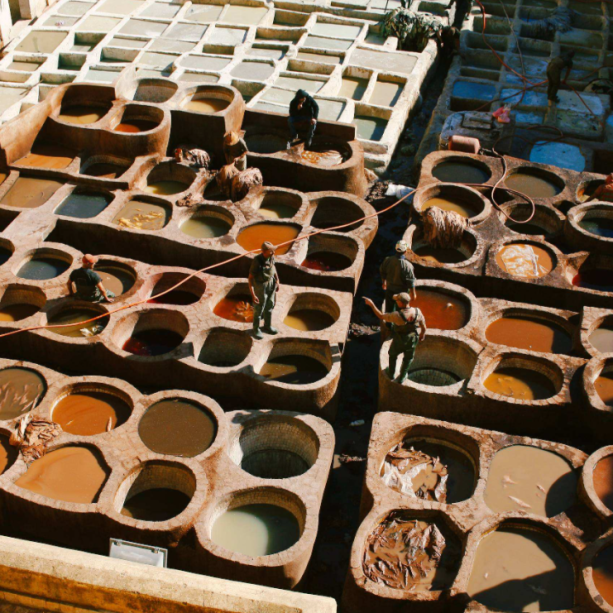
Dyeing and finishing processes are commonly referred to as “wet processing”, due to the key role played by water in most of the techniques used (aqueous treatments, dye baths, rinsing, etc.).
“Wet processing” accounts for around 72% of the water consumption associated with textile industry processing activities 1. For example, traditional aqueous dyeing requires between 100 and 150 L of water per kilogram of fibre (a figure that varies significantly depending on the type of fibre). 2
🌡️ Energy consumption
Energy demand is significant during finishing stages, both for mechanical processes and for chemical processes, which take place in baths maintained at high temperatures. The impact of this energy consumption varies mainly depending on the energy mix of the production areas. However, fossil fuels (coal, natural gas, etc.) remain predominant. 3
🧪 Effluent pollution
The textile industry is a major source of water pollution, particularly due to dyeing processes, which generate effluents heavily loaded with chemical substances and dyes. 6
Indeed, some of the dyes used during dyeing do not bind to the fibres and therefore end up in the effluents. The proportion of unfixed dye depends heavily on the fibre/dye combination and the process used.
The persistence of certain products used in finishing processes in the environment (dyes, salts, surfactants, etc.) threatens natural ecosystems and the health of local populations: toxicity to aquatic environments, water colouration, eutrophication, soil pollution, etc.
Eco-design issues
1. Durability
Some finishing processes, such as mercerisation or anti-shrink treatments, aim to improve the robustness of textile products and their durability over time. However, it is important to note that most other processes have an aesthetic purpose, modifying the feel or colour of the product in order to meet market expectations.
There can sometimes be trade-offs: for example, some anti-crease finishes based on cross-linking resins may slightly reduce the tensile or tear strength of the fabric, while pronounced sueding improves comfort to the touch but increases sensitivity to abrasion.
The challenge is therefore to find the right balance between mechanical performance, comfort, aesthetics and longevity suited to the intended use.
2. Recyclability
Chemical finishes can constitute a barrier to recycling at the end of products’ life. In particular :
- Coatings may damage recycling equipment, prevent garnetting and create impurities in recycled materials. The same applies to encapsulations. 7
- Oil-repellent, stain-resistant or water-repellent finishes can also make recycling more complex, particularly in connection with the use of PFAS associated with these processes, which durably contaminate recycling streams, prevent the purification of new fibres and pose major health risks for future users.
To find out more, consult our good design practice guides for recycling textiles and footwear !
Action levers
Points to watch
As with any eco-design approach, before choosing a material, it is essential to analyse the environmental impact of a product’s entire life cycle and to compare different scenarios in order to identify which one has the lowest environmental impact. There is no ideal material; a material must be chosen according to the product’s intended use and its environmental objectives.
Several labels and certifications apply to finishing processes; the following are eligible for Refashion’s “Environmental Labels” eco-modulation.
Eco-modulations: Refashion promotes product eco-design approaches through a system of premiums and penalties. Discover the criteria and procedures for declaring eco-modulations.

GOTS (Global Organic Textile Standard)
The Global Organic Textile Standard (GOTS) label applies to the supply chain and production sites. Regarding finishing processes, it lists the dyes/auxiliaries authorised for dyeing and finishing, with an audit of the processing site (environmental management, wastewater treatment).

OEKO-TEX® MADE IN GREEN label
The OEKO-TEX® MADE IN GREEN label applies to the product and production sites. It requires the absence of certain harmful substances in the finished product above defined thresholds. It also assesses environmental and social performance: chemical management, water and energy consumption, emissions, waste management, etc.

bluesign label
The bluesign label applies to the supply chain and production sites (mainly used for outdoor clothing). It requires chemical substances to be validated before use, as well as the optimisation of water, energy and resource consumption, and the reduction of emissions, etc.
Understanding your supply chain
As finishing stages are often outsourced, it can sometimes be difficult to identify the operators and suppliers in the supply chain. Access to information on the processes or products used can therefore be a challenge.
One of the first steps to prioritise in order to better understand the impacts of these stages in the product life cycle is therefore to work on their upstream traceability. This first step will make it possible to better diagnose and then mitigate the impacts of finishing processes.
Reducing the environmental impact of chemical inputs
Dyeing 8 9
Several action levers exist to reduce the environmental impact of dyeing processes. An in-depth study of these processes and an impact assessment are recommended.
These include :
- Natural dyeing: Natural dyeing is an ancestral and relatively artisanal practice. However, some dyers are developing processes to industrialise this practice.
- Dry dyeing: This covers processes that eliminate or drastically reduce the use of water baths. The two main industrial techniques are based on the use of supercritical CO₂ as a solvent, or on dope dyeing (integrating pigments into molten polymers before extrusion of synthetic fibres). Dyeing is possible on virgin fibres, but also on garnetted recycled fibres (after colour sorting and spectrometric analysis, precise dosing makes it possible to achieve the desired colour and thus also limit the use of chemical compounds).
- Digital dyeing: This is dyeing the fibre through to the core using a laser, which avoids the consumption of water and chemicals. In addition, ADEME recommends removing or limiting dyeing where possible (favouring the raw colours of recycled fibres, ecru for natural materials, etc.)
Focus on denim 10
New denim fading techniques are emerging and make it possible to avoid practices such as sandblasting, which are harmful to the environment (non-renewable material) and to workers (creation of silica dust that can cause silicosis).
These practices help reduce water and energy consumption :
- Laser fading engraves the surface of the fabric.
- Ozone fading exposes damp jeans to ozone to oxidise the fabric..
Sources10
- 1 Panda et al., Sustainable pretreatments in textile wet processing (2021): https://www.sciencedirect.com/science/article/abs/pii/S0959652621039020
- 2 Zheng et al., An industrial scale multiple supercritical carbon dioxide apparatus and its eco-friendly dyeing production (2016): https://www.sciencedirect.com/science/article/abs/pii/S2212982016302268
- 3 Textile Exchange, Materials Market Report 2025: https://textileexchange.org/app/uploads/2025/09/Materials-Market-Report-2025.pdf
- 4 Quantis, Measuring fashion (2018): https://media-pro.refashion.fr/2025/10/measuring-fashion-environmental-impact-of-the-global-apparel-and-footwear-industries-study.pdf
- 5 Apparel Impact Institute, Taking Stock of Progress Against the Roadmap to Net Zero (2025): https://apparelimpact.org/resources/taking-stock-of-progress-against-the-roadmap-to-net-zero-2025/
- 6 Aysha et al., Eco-friendly salt/alkali-free exhaustion dyeing of cotton fabric with reactive dyes (2022): https://www.nature.com/articles/s41598-022-26875-8
- 7 Refashion, Etude des perturbateurs et facilitateurs au recyclage des Textiles d’habillement, Linge de maison et Chaussures (2025): https://media-pro.refashion.fr/2025/10/revue-des-perturbateurs-et-facilitateurs-au-recyclage-des-tlc_vf_refashion_2025.pdf
- 8 Ademe, Tout comprendre : les impacts de la mode et de la fast-fashion (2024): https://librairie.ademe.fr/economie-circulaire-et-dechets/7747-tout-comprendre-les-impacts-de-la-mode-et-de-la-fast-fashion-9791029724602.html
- 9 Roadmap to Zero Programme: https://www.roadmaptozero.com/programme
- 10 Ademe, Le revers de mon look (2020): https://media-pro.refashion.fr/2025/11/le-revers-de-mon-look.pdf
Plus de ressources sur le même sujet


