
Leather
Understand the material, its key figures, the stages of its manufacturing process, its properties and applications, the environmental issues, as well as information on the durability, recyclability, and alternatives available to this material.
30 min de lecture
Update : Oct 2026
13.8 million tons
Of raw hides and skins from cattle, sheep, goats, and buffalo produced in 2024.
68 %
Of the raw hides and skins produced in 2024 were cattle hides.
China
Leading producer of raw hides and skins and cattle hides.
Introduction
Leather is a material obtained through a complex process of transforming animal skin, called tanning, which makes it rot-proof, durable, and resistant over time.
By definition, only this transformation makes it possible to refer to “leather”: synthetic or textile materials cannot bear this designation, which is strictly regulated. 1
Key data
- Fiber type : Natural animal material mainly derived from cattle, sheep and goat hides and skins, but also from exotic skins (ostriches or reptiles such as crocodiles, snakes, lizards, iguanas), and fish skins.
- Status : Leather is considered a co-product of the agri-food industry, derived from livestock farming and slaughter for meat and milk, and subsequently recovered through a transformation process (cattle, calves, sheep, goats, pigs). Leathers from species other than those traditionally used in leather goods are considered exotic leathers. This is the case for reptiles (crocodiles, alligators, caimans, pythons, lizards), fish (shagreen, salmon, sturgeon, eels) and birds such as ostriches. For certain exotic leathers (crocodilians, lizards, pythons, ostriches), trade is strictly regulated by the CITES Convention 2, which imposes traceability rules, quotas and controls on farming and harvesting in the wild. Skins from species threatened with extinction remain prohibited from international trade and are illegal.
- Global leather production : Measured in raw hides and skins from cattle, sheep, goats and buffalo, it is estimated at 13.8 million tons in 2024 3. Cattle hides are the most commonly used type of hide or skin (68%), followed by sheep skins (16%), then goat skins (10%) and buffalo hides (5.7%) 4. Exotic leathers account for less than 1% of global leather production. There is no single institutional statistic, as these supply chains are fragmented and only certain species are systematically monitored, notably through CITES. For example, the global crocodilian market was estimated at 1.3 million skins in 2023 5, mainly from farming.
Global raw hides and skins market
Cattle hides produced in 2024
68%
Sheep skins produced in 2024
16%
Goat skins produced in 2024
10%
Buffalo hides produced in 2024
5.7%
Exotic skins produced in 2024
0.3%
- Main raw hides and skins producing countries (FAO, 2024) 6 :
- China : 21,98%
- India : 11,55%
- United States : 8,61%
- Brazil : 8,01%
- Pakistan : 4,09% - Main raw cattle hides producing countries (FAO, 2024) :
- China : 19%
- United States : 14%
- Brazil : 13%
- Argentina : 6%
- Australia : 4%
Properties and examples of applications
Leather is a natural material valued because it is both strong, supple and comfortable. It offers good resistance to wear and tear (tensile stress, tearing, flexing) 8, can last for many years and remains pleasant to wear.
The properties of leather can therefore be highly diverse and vary depending on the type of tanning used and the finishes applied. Thanks to these properties, it is found in many everyday items: shoes, bags, clothing, furnishings or transport, where durability, comfort and aesthetics are all sought after.
Production
Stages of the production process
Step 1
Preparation and preservation of raw hides and skins
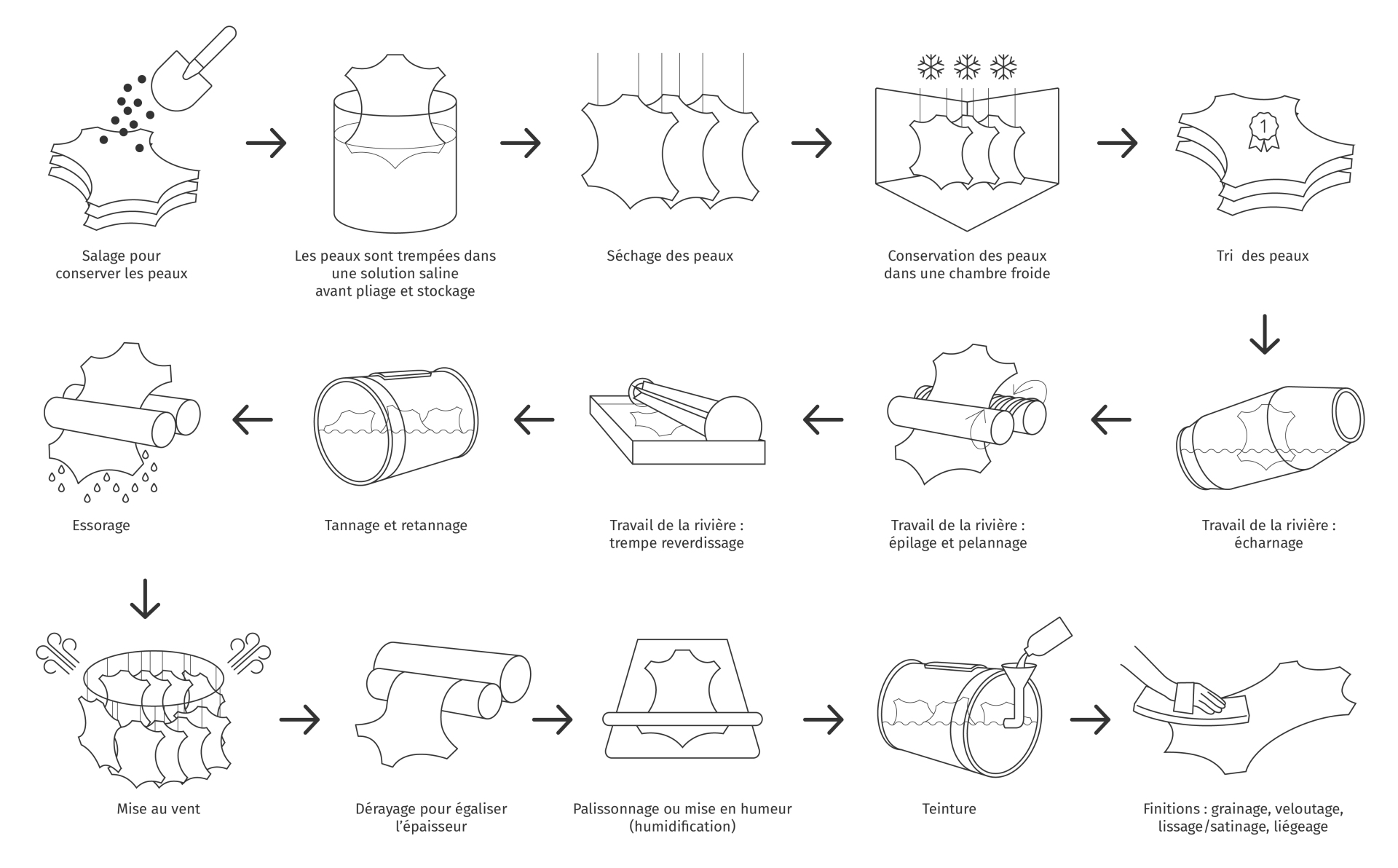
9 In slaughterhouses, the hide or skin is removed from the carcass during the skinning operation, carried out manually or mechanically depending on the facilities. The hide or skin is then trimmed to remove residues, limit the risks of microbiological degradation and facilitate the subsequent transformation operations.
Once salted and dried, hides and skins can be sold as “raw hides and skins” to tanners, either directly or through traders and collectors.
To be tanned, raw hides and skins undergo a preparation phase called river work, the aim of which is to rehydrate and clean them, and to remove the epidermis, hair, and residual fatty tissue.
Tanning processes :
1. Mineral tanning, pmainly carried out with chromium salts, accounts for more than 80% of global production 12. It is performed by soaking hides and skins in drums and has the advantage of being particularly fast, requiring only a few hours to a few days. This method produces supple, lightweight and highly resistant leathers, which explains its widespread use in the footwear, leather goods, clothing and furnishings sectors. At the end of the treatment, the leather obtained is called wet blue because of its characteristic bluish colour and can be sold before the retanning, dyeing and finishing operations. Its main advantage lies in its industrial efficiency and in the mechanical properties of the leather obtained (suppleness and resistance), making it particularly suitable for large-scale production. However, the use of chromium salts raises environmental and health concerns, particularly regarding effluent treatment and the management of tannery waste.
2. Plant tanning is an older method using natural tannins extracted from bark, leaves or roots. It accounts for around 20% of global tanned leather production 13. The process consists of immersing hides and skins in vats rich in tannins for several days, or even several months. Its main advantage lies in the use of renewable raw materials as well as in the natural and authentic appearance of the leather obtained, which is valued in high-end leather goods and craftsmanship. Nevertheless, this process is longer, more costly and less suited to mass production. The leathers obtained are generally firmer and less supple than those produced through mineral tanning. They are mainly used to make soles, saddles, belts, shoulder straps and bag handles, waist belts and in furnishings.
3. Synthetic tanning is based on the use of synthetic tanning agents, called syntans, chemically produced from organic compounds such as phenols or sulphonated naphthalenes. Developed in the early 20th century to supplement or replace certain natural tannins, they can be used alone or in combination with chrome or plant tanning during retanning operations. Its main advantage is its great flexibility: it makes it possible to obtain, relatively quickly, highly homogeneous, lighter-coloured leathers (synthetically tanned leather is called wet white), which are more supple, have good light resistance, and make dyeing easier. Conversely, it relies on the use of synthetic chemical compounds that generate effluents requiring specific treatment. It is therefore less valued by consumers seeking natural processes. It is mainly used for leathers intended for clothing, soft leather goods and furnishings, when specific aesthetic or technical performance characteristics are required 14.
Step 3
Finishing: from tanned leather to finished leather
As the final manufacturing stage, this is the point at which leather acquires its visual and sensory appearance, including its colour, shine, grain, relief and touch/feel. Depending on the treatments applied, the same leather may have a smooth, grained, matte, glossy, supple or velvety finish. This stage includes the application of various finishing products such as dyes, pigments, resins, waxes, oils or varnishes. These treatments not only modify the appearance of leather, but also improve some of its functional properties (resistance to stains, water, rubbing, UV rays or ageing). This finishing stage accounts for a significant share of the chemical substances used in leather production, which raises health and environmental issues related to their composition, use and treatment.
Production diagramn
Environmental impact
Environmental issues of production
The environmental impact of leather is mainly linked to the farming of the animals from which the hides and skins are derived, and to the transformation processes, particularly tanning.
The transformation of hides and skins is the second main area of environmental concern. Tanning, dyeing and finishing opérations consume water, energy and numerous chemical products.
🌡️ Greenhouse gas emissions
The environmental impact of leather is mainly linked to the farming of the animals from which the hides and skins are derived, and to the transformation processes, particularly tanning. Life cycle analyses (LCA) indicate that farming and upstream stages account for approximately 68% of the climate impact (GWP – Global Warming Potential) of leather production, compared with 32% for industrial transformation operations 15.
For leathers derived from cattle, which make up the majority of the market, the main issues focus on the contribution to climate change, resource consumption, land use, pollution of natural environments and biodiversity erosion. Greenhouse gas emissions mainly come from methane emitted by ruminants during digestion, as well as methane and nitrous oxide generated by the decomposition of manure and slurry.
💧Pressures on soil, water and biodiversity
Depending on the production context, livestock farming can also contribute to pressure on water resources, soil degradation, deforestation and the transformation of natural ecosystems.
In the case of exotic leathers, environmental issues vary depending on the species concerned. Crocodile and alligator farms are characterised in particular by high water consumption required to renew basins, and by the production of effluents rich in organic matter, nitrogen and phosphorus, which may contribute to water pollution and the eutrophication of aquatic environments in the absence of appropriate treatment 16. Some supply chains also rely on harvesting from the wild, which raises additional issues related to traceability and species preservation 17.
Tanning, dyeing and finishing operations consume water.
🧪 Pollution of natural environments
Tanning, dyeing and finishing operations consume numerous chemical products. They generate effluents and emissions that can affect the quality of water, soil and air, with particularly significant impacts on ecotoxicity, eutrophication and resource consumption indicators.
Chrome tanning remains the most widely used technique, but alternatives such as plant tanning or chrome-free processes are being developed to reduce certain chemical risks 18. THowever, these solutions do not systematically guarantee a better overall environmental performance and may, depending on the processes used, have higher impacts on certain indicators such as water and energy consumption or eutrophication potential 19. Furthermore, their implementation may contribute to increasing production costs and therefore the final price of products 20.
Thus, the main areas of concern in the leather sector relate to greenhouse gas emissions linked to livestock farming, pressures on soil, water and biodiversity, as well as the control of pollution and resource consumption associated with tanning and finishing operations.
Eco-design issues
1. Durability
Leather is often presented as a durable material because of its long service life. Products made from high-quality leather, particularly full-grain leathers, can remain functional for several decades when they are designed to be repaired and reused.
This longevity is now taken into account in certain environmental assessment methodologies for materials 21. Indeed, when a product is used for many years, the impacts associated with its manufacture are spread over a longer period of use.
However, the durability of leather varies significantly depending on its quality, manufacturing method and use. Full-grain leathers and certain vegetable-tanned leathers generally offer better resistance to ageing and repair than corrected or heavily pigmented leathers. The actual service life of an item also depends on its exposure to mechanical stresses, its use and the quality of its design. There is therefore no single service life for leather, but a wide range of performance levels depending on the products considered 22.
2. Recyclability
The manufacturing of leather products generates significant quantities of solid waste throughout the transformation chain. For example, during the manufacture of footwear and leather goods, it is estimated that 20 to 30% of finished leather becomes cutting scraps 23. Only part of these scraps is transformed into new materials; the rest is recovered for other uses or disposed of. Leather recyclability remains possible but relatively complex. There are several ways to recover leather waste 24:
- Upcycling or reconditioned leather consists of recovering leather from a product in order to reuse it as it is and give it a second life, without changing its composition.
- Bonded leather 25(regenerated or reconstituted leather) is made by recovering leather and leather scraps from tanneries or production workshops, which are then ground and mixed with other composite materials such as latex to create a paste. This paste is then dried and rolled out into a thin layer to recreate usable material from leather waste that would usually be discarded.
The recovery of leather at end of life remains limited today by several technical constraints. Leather products are often combined with other materials (textiles, foams, rubber, metal) or covered with coatings and surface finishes that make their identification, sorting and recycling more difficult. In the case of footwear in particular, the diversity of components makes dismantling and material separation especially complex. Furthermore, chrome tanning, which is widely used in the industry, can limit certain recycling routes because it requires specific precautions to avoid the formation of toxic compounds during thermal treatments. Coatings and surface treatments can also degrade the quality of the recycled material. In this context, despite the development of new sorting and recycling technologies, recovery solutions remain limited and require further research and development efforts. The sector therefore currently prioritises an approach based primarily on durability, repair, reuse and extending product lifespans, complemented by the gradual development of recycling and recovery solutions within a circular economy approach.
Footwear generally contains regulatory pictograms informing consumers about the composition of the three main parts of the shoe (upper, lining and outsole). Predominant materials such as leather must therefore be clearly indicated as shown below 26:

Action levers
Points to watch
As with any eco-design approach, before choosing a material, it is essential to analyse the environmental impact of a product’s entire life cycle and to compare different scenarios in order to identify which one has the lowest environmental impact. There is no ideal material; a material must be chosen according to the product’s intended use and its environmental objectives.
27 Alternative materials to leather :
There are now many alternatives to leather, which may be of synthetic or plant-based origin. These materials address different issues, such as reducing the use of animal resources, textile innovation or waste recovery. However, they cover very diverse realities in terms of composition and impact.
Plastic materials, often called faux leather or “leather-like” materials, are the oldest and most widespread alternatives. They are generally made from polymers such as polyurethane (PU) or polyvinyl chloride (PVC), derived from petroleum, and designed to imitate the appearance of leather. Produced on a very large scale and widely integrated into global supply chains, they benefit from established industrial infrastructure and relatively low production costs. Their industrial maturity is therefore considered very high, with global availability. Although these materials have the advantage of being less costly and offering an alternative to traditional leather, they also raise serious environmental issues: they generate significant plastic waste as well as polluting emissions during their production and at end of life 28.
Finally, alternatives grouped under the term plant-based or bio-based materials are developing rapidly. They can be produced from agricultural waste (pineapple fibres, apple or grape residues), fungi (mycelium), bacteria or cork 29. These materials aim to reduce dependence on animal-based resources and recover certain agricultural co-products, while offering an appearance similar to leather. For example, pineapple-fibre textile uses fibres from leaves derived from agriculture, while mycelium is cultivated to create a supple and biodegradable material. However, their level of industrial maturity remains variable, and many are still produced on a small or medium scale. Furthermore, it is important to note that many of these alternatives still incorporate synthetic binders, coatings or backings to improve their durability, which limits their recyclability. Although they represent interesting avenues for innovation, these alternatives still struggle to match leather in terms of resistance, repairability and service life 30. Their real environmental performance therefore depends heavily on the manufacturing processes, their composition, but above all on their duration of use and therefore their resistance.
Existing labels and certifications :
The certifications applicable to leather are key reference points for identifying more responsible practices. They enable companies and consumers to better guide their choices. The Leather Working Group (LWG) 31, certification, the most widespread in the leather industry, is based on a system of environmental audits of tanneries. In particular, it assesses water and energy management, effluent and waste treatment, atmospheric emissions, supply traceability, as well as the management of chemicals used throughout the manufacturing process.
The OEKO-TEX Leather Standard focuses on the safety of finished products. It certifies that leathers have been tested for harmful substances at each stage of production, according to strict scientific criteria.
Other more local certifications, such as ICEC in Italy, also contribute to traceability and to the control of inputs and processes in tanneries.
Sources29
- 1 CONSEIL NATIONAL DU CUIR, Le cuir, une histoire de savoir-faire [en ligne], 2018 : https://www.tanneriedumas.com/wp-content/uploads/2018/07/Livret-Le-Cuir.pdf
- 2 Office français de la biodiversité (OFB), « La Convention sur le commerce international des espèces sauvages (CITES) », consulté le 19 juin 2026: https://ofb.gouv.fr/la-convention-sur-le-commerce-international-des-especes-sauvages
- 3 TEXTILE EXCHANGE, Materials Market Report 2025, septembre 2025: https://textileexchange.org/app/uploads/2025/09/Materials-Market-Report-2025.pdf
- 4 TEXTILE EXCHANGE, Materials Market Report 2025, septembre 2025: https://textileexchange.org/app/uploads/2025/09/Materials-Market-Report-2025.pdf
- 5 Caldwell, J., World Trade in Crocodilian Skins 2021-2023, UNEP-WCMC, 2025, figure 1: https://www.iucncsg.org/365_docs/attachments/protarea/f9b02063956a7e1ff10f58f5a9d70eb6.pdf
- 6 AOSTAT (FAO), données téléchargées depuis https://www.fao.org/faostat/fr/#data/QCL et agrégées par l’auteur.
- 7 Alliance France Cuir, « La polyvalence du cuir », consulté le 19 juin 2026: https://alliancefrancecuir.org/la-polyvalence-du-cuir/
- 8 Meyer, M., Dietrich, S., Schulz, H., & Mondschein, A. (2021). Comparison of the Technical Performance of Leather, Artificial Leather, and Trendy Alternatives. Coatings, 11(2), 226: https://doi.org/10.3390/coatings11020226
- 9 Tannerie Dumas, Livret d’information sur la matière cuir, s.l., Tannerie Dumas, juillet 2018: https://www.tanneriedumas.com/wp-content/uploads/2018/07/Livret-Le-Cuir.pdf
- 10 Tannerie Dumas, Livret d’information sur la matière cuir, s.l., Tannerie Dumas, juillet 2018: https://www.tanneriedumas.com/wp-content/uploads/2018/07/Livret-Le-Cuir.pdf
- 11 COVINGTON, Anthony D., Tanning Chemistry: The Science of Leather, Cambridge, Royal Society of Chemistry, 2009, 483 p.: https://books.rsc.org/books/monograph/773/Tanning-Chemistry-The-Science-of-Leather
- 12 Business Research Insights, « Taille et part du marché du tannage du cuir [2026 2035] », rapport de marché, dernière mise à jour avril 2025: https://www.businessresearchinsights.com/fr/market-reports/leather-tanning-market-120699
- 13 Valèsens, Livret d’information sur la matière cuir, 2021, consulté le 19 juin 2026 : https://valesens.com/wp-content/uploads/2021/01/livret-dinformation-sur-la-matie%CC%80re-cuir.pdf
- 14 DEGACHE, F., « Le tannage : une chimie ancestrale toujours d'actualité », L'Actualité Chimique, n° 293, janvier 2006, p. 3-10: https://new.societechimiquedefrance.fr/wp-content/uploads/2019/12/2006-293-janv-Degache-p.3.pdf
- 15 Leather Working Group (LWG), Measuring the Environmental Impact of Leather – Life Cycle Assessment Report Summary, 2024: https://www.leatherworkinggroup.com/fileadmin/user_upload/LWG_LCA_2024_Summary_.pdf
- 16 HAMILTON, Douglas W., Waste Management for Alligator Farming and Ranching, Oklahoma State University, février 2020, https://extension.okstate.edu/fact-sheets/waste-management-for-alligator-farming-and-ranching
- 17 Ménard, Jean Marc, « Cuirs exotiques : l’enjeu crucial du bien être animal et de la traçabilité », Leather Fashion Design, n° 2, 2019: https://leatherfashiondesign.fr/cuirs-exotiques-tracabilite/
- 18 FILK Freiberg Institute, Comparaison des performances techniques du cuir, du cuir artificiel et des alternatives émergentes, 2021: https://leatherfrance.com/system/files/medias/library/documents/etude_filk_complete_fr.pdf
- 19 Leather Working Group, Life Cycle Assessment (LCA) Report Summary: Measuring the Environmental Impact of Leather, 2024
- 20 Mesbah, Marion, « Le cuir : avantages et inconvénients de cette matière », Marques de France, publié le 9 août 2023, mis à jour le 25 décembre 2024: https://www.marques-de-france.fr/definition/cuir/
- 21 Leather Working Group, Guidance for Life Cycle Assessment (LCA): A Recommendation for Harmonization, version 5: https://leatherpanel.org/sites/default/files/publications-attachments/guidelines_leather_lca_recommendation_for_harmonization_5.pdf.
- 22 Covington, A. D., Life Cycle Assessment and Leather Production, Journal of Leather Science and Engineering, vol. 2, article 26, 2020, Springer Nature: https://doi.org/10.1186/s42825-020-00035-y
- 23 Sivakumar, V., « Preparation and Characterization of Composite Sheets from Solid Leather Waste with Plant Fibers: A Waste Utilization Effort », Clean Technologies and Environmental Policy, 2023: https://doi.org/10.1007/s10098-023-02642-9
- 24 WeDressFair, « Cuir recyclé »: https://www.wedressfair.fr/matieres/cuir-recycle
- 25 Textile Addict, « Cuir recyclé, la revalorisation des déchets et chutes de cuir », publié le 10 octobre 2023: https://textileaddict.me/cuir-recycle-la-revalorisation-des-dechets-et-chutes-de-cuir/
- 26 DGCCRF, Étiquetage des chaussures, https://www.economie.gouv.fr/dgccrf/les-fiches-pratiques/etiquetage-des-chaussures
- 27 Leather Working Group (LWG), « Deforestation Regulation »: https://www.leatherworkinggroup.com/our-impact/deforestation/deforestation-regulation/
- 28 Hebdo Cuir, « Au-delà des apparences : analyse approfondie de l’écologie du cuir et des matériaux synthétiques », publié le 25 avril 2024: https://www.hebdocuir.com/au-dela-des-apparences-analyse-approfondie-de-lecologie-du-cuir-et-des-materiaux-synthetiques/11290/
- 29 IDTechEx, Emerging Alternative Leathers 2024–2034: Technologies, Trends, Players, IDTechEx Research: https://www.idtechex.com/en/research-report/emerging-alternative-leathers/980
Plus de ressources sur le même sujet


