

Linen and hemp
Understand the material, its key figures, the stages of its manufacturing process, its properties and applications, the environmental issues, as well as information on the durability, recyclability, and alternatives available to this material.
30 min de lecture
Update : Oct 2026
0.6 million tonnes
Of linen and hemp produced worldwide in 2024, representing around 0.5% of the global fibre market.
70 %
Of the world’s flax used for fibre is grown in Western Europe.
France
World’s leading producer
Introduction
Linen and hemp are bast fibres extracted respectively from the flax stem and the hemp stem.
With a similar structure, these two plants can produce long fibres (used for yarn), short fibres (tow), as well as co-products such as shives and seeds.
Key data
Global fibre market
Flax produced in 2024
0.2%
Hemp produced in 2024
0.3%
Other fibres produced in 2024
99.5%
- Fibre type: Natural bast fibres
- Global production: Flax and hemp account for around 0.6 million tonnes of fibres produced in 2024, representing around 0.2% of the global textile fibre market for hemp and 0.3% for flax. 1 Flax and hemp are niche fibres with strong growth potential. Together, they represent less than 1% of global textile fibre production, which was dominated by polyester (59%) and cotton (19%) in 2024. Their share remains modest but is growing, driven by increasing demand for natural, bio-based and locally sourced materials. 2
- Main producing countries 3:
- Flax: three quarters of global long flax fibre production comes from the Benelux region and Northern France, where the climate is particularly suitable. France is the world’s leading producer of long fibres, with 135,000 tonnes produced in 2024, followed by Belgium and the Netherlands. Around 70% of the world’s flax used for fibre is grown in Western Europe 4. More secondary production also exists in Eastern Europe (Russia, Belarus, Romania), as well as in China, mainly for short fibres intended for industrial uses and textile blends.
- Hemp: France is the world’s leading producer of textile hemp and the second-largest producer worldwide across all production types after China. In 2024, only 20 countries were growing fibre hemp, according to the Food and Agriculture Organization (FAO).5 - Agricultural land used:
- Flax: textile flax was grown on around 200,000 ha in Western Europe in 2025, compared with 185,849 ha in 2024. France accounts for 88% of this area, i.e. 162,124 ha. European acreage has increased sharply, more than doubling in ten years, from under 100,000 ha in 2015 to 200,000 ha in 2025. 6
- Hemp: the global area cultivated with fibre hemp is estimated at between 250,000 and 300,000 ha (all production types combined). In Europe, 48,500 ha were dedicated to hemp for all uses in 2024, with France accounting for the largest share. It is difficult to obtain a precise figure for textile hemp. In France, fibres account for only 10% of crop outlets, after paper production (50%) and insulation (29%). The textile hemp sector remains emerging in Europe, where textile trials are still under development. 7
Properties and examples of applications
Flax and hemp are bast fibres extracted respectively from the flax stem and the hemp stem. With a similar structure, these two plants can produce long fibres (used for yarn), short fibres (tow), as well as co-products such as shives and seeds.
The main properties are as follows :
Common properties :
- High mechanical tensile and abrasion resistance 8
- Lightness and low density relative to their strength
- Excellent breathability and thermal regulation: linen allows air and water vapour to pass through better than cotton, viscose or polyester 9
- Moisture absorption and quick drying
- Natural hypoallergenic and antistatic properties
Distinctive properties:
- Linen stands out for its fineness, elegant appearance and soft feel from first use. Its long fibres give it low pilling. It is particularly valued for high-end household linen and clothing.
- Hemp has a thicker and more robust fibre, with superior abrasion resistance. It gradually softens with washing. Its resistance to mould, ultraviolet (UV) rays and intensive wear makes it a material of choice for more robust use.
Linen and hemp are used in a wide variety of textile products:
- Household linen: sheets, towels, table linen (mainly linen, hemp for more robust uses)
- Clothing: shirts, dresses and summer clothing in linen; workwear and high-stress garments in hemp
- Footwear and accessories: canvases, espadrilles, bags and belts in linen and hemp; laces and reinforcements in hemp for its strength
Production
Stages of the production process 10
Step 1
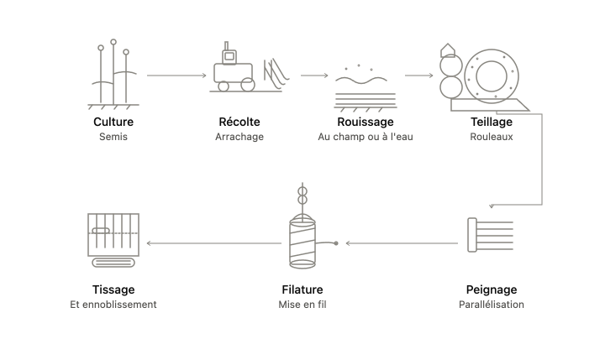
Cultivation and harvesting
In Western Europe, flax is sown in early spring and harvested after around 100 days by pulling, in order to preserve fibre length. Hemp is sown later and then mown during the August–September period
Step 2
Retting
11This is a controlled decomposition process (through the action of micro-organisms, water or chemical products) of the pectic tissues that bind textile fibres to the plant stem, allowing them to be separated. This stage is decisive for fibre quality and environmental impact, and varies depending on geography. Three main methods coexist:
- Dew retting: the standard method in Europe, where the climate is particularly favourable. Micro-organisms naturally break down the pectin in the stems laid out on the ground, which binds the fibres to the stem. The retting time is adjusted according to weather conditions and determines the final quality of the fibre.
- Water retting: here, the stems are immersed. Water penetrates the stem, causes the internal cells to swell and promotes the action of bacteria that break down the pectin. This method is very widespread in China and Egypt because it produces good-quality fibre simply and quickly, but in return consumes large volumes of water and generates industrial effluents heavily loaded with organic matter.
- Chemical retting: increasingly used in Asia, the fibres are released using caustic soda, which acts on lignin and pectin, producing a stable but lower-quality fibre. In addition, this method raises issues around the management and recycling of chemical effluents from a circular economy perspective.
.
Step 3
Scutching
The retted stems are mechanically crushed, then beaten and separated from the woody part: the long fibres are thus separated from the shives (woody part) and short fibres (tow). Hemp, whose stem is more rigid and bulky, requires adaptations to scutching equipment initially designed for flax. This stage is mostly carried out in the producing countries.
Step 4
Combing
The long fibres are combed to align them and remove the last impurities, producing fibres intended for fine spinning and tow for less demanding applications. This stage is mainly carried out in the producing countries of the Benelux region.
Step 5
Spinning
12 Flax is mainly wet-spun, a process used to obtain fine, even yarns. Hemp requires adaptations to the spinning process due to its naturally thicker and more rigid fibres. This stage sees 90% of European scutched flax volumes exported to Asia. Exports to India alone have tripled in ten years, reaching 15,000 to 20,000 tonnes annually, in addition to flows to China, which accounts for 30% of French exports of unspun flax. For hemp, the situation is even more pronounced: the spinning and weaving of long fibres adapted to textile processes remain at the research and development (R&D) stage in Europe, with processing mainly carried out in Asia.
Production diagram
Example of a flax and hemp production diagram :
Environmental Impact
Environmental issues of production
🌱 Land use, greenhouse gas emissions, acidification and fossil resource depletion
The agricultural phase accounts for most of the impacts of flax and hemp. According to the life cycle analysis (LCA) of European Flax scutched flax fibre 13, 92% of the total environmental impacts of flax are generated during cultivation, compared with 7% for scutching and 1% for transport. The main impacts relate to land use, greenhouse gas emissions, as well as acidification and fossil resource depletion, attributable to fertiliser production. Hemp follows a similar profile: the agricultural phase dominates, with the main contributors being fuel consumption, emissions linked to nitrogen fertilisers and land occupation. 14
💧 Water consumption
Although the water requirements of flax and hemp vary significantly depending on the climate context, these two fibres are recognised as having relatively low water requirements during the agricultural phase compared with other crops such as cotton; as a result, irrigation needs for these crops in Western Europe are almost zero. However, with its fairly short root system, flax is often limited in its access to groundwater 15, Although the water requirements of flax and hemp vary significantly depending on the climate context, these two fibres are recognised as having relatively low water requirements during the agricultural phase compared with other crops such as cotton; as a result, irrigation needs for these crops in Western Europe are almost zero. However, with its fairly short root system, flax is often limited in its access to groundwater.
🧪 Pollution of natural environmentsWater or chemical retting
Significant pollution can also occur during retting when it is carried out in water or chemically. Water retting (very widespread in Asia and Egypt), in addition to higher water consumption, generates wastewater heavily loaded with organic matter, with high concentrations of chemical oxygen demand (COD) and biochemical oxygen demand (BOD). If discharged untreated into natural environments, this wastewater leads to high oxygen consumption by micro-organisms in the receiving environment, which can suffocate aquatic fauna and promote the eutrophication of waterways. 16
Flax and hemp stand out as having a relatively favourable environmental profile among natural textile fibres. The following points can be noted :
- An almost complete absence of plant protection treatments 17
- Full recovery of the plant: long fibres for textiles, short fibres for nonwovens, shives for construction and insulation, seeds for food and cosmetics.
- Conditional biodegradability: in their raw state (scutching offcuts, tow), flax and hemp fibres are biodegradable, but the rate and speed vary depending on the environment (soil, industrial compost, water) and the condition of the material (raw fibre, fabric, finished product). This property does not automatically extend to the finished textile item, which is generally associated with finishes, dyes or seams that can slow down degradation. 18
- Improved soil structure and an excellent preceding crop in crop rotation, particularly for hemp, whose deep root system structures the soil for the following crop.
- High yields: around 1,200 to 1,350 kg of long fibres per hectare for flax, 1,500 to 2,000 kg of fibres per hectare for hemp, compared with a global average of 400 to 500 kg per hectare for cotton. 19
- The resource and supply chain are generally available locally and rely on mechanical processing methods without the use of synthetic chemicals.
Eco-design issues
1. Durability
Unlike many textile fibres that gradually deteriorate with washing, linen and hemp become softer and more supple with each wash, while retaining their mechanical properties.
Their natural antistatic properties limit dust attraction and reduce washing frequency, while their natural resistance to mould and bacteria limits the risk of degradation in damp conditions over the long term.
To maximise their lifespan, it is recommended to wash them at a moderate temperature using a mild detergent, without chlorine bleach, which weakens the fibres, and to avoid harsh spinning. Air drying is preferable to tumble drying. Ironing should preferably be done inside out, on slightly damp fabric. Properly cared for, a linen or hemp product can last for several decades, significantly reducing its environmental footprint relative to its lifespan.
2. Recyclability
Linen and hemp are recyclable through mechanical processing (garnetting). The most sought-after applications remain nonwovens and composites, due to their lightness and ease of processing.
For closed-loop recycling, linen and hemp feedstocks in post-consumer textiles and household linen are extremely limited and are not among the fibres detectable by automated sorting tools (cellulosic fibres that are extremely close to cotton). Chemical recycling, which produces a regenerated cellulosic fibre from the viscose/lyocell family, is still at the research and development stage for these fibres specifically. Recyclers’ efforts are mainly focused on cotton, which is predominant in the textile feedstock.
3. Incorporation of recycled materials
The incorporation of recycled materials into new products remains embryonic, hindered by the limited availability of sorted post-consumer feedstocks and the difficulty of identifying these materials during sorting — as they can be confused with other cellulosic materials such as cotton — as well as blends with synthetic fibres or cotton, and the absence of industrialised chemical recycling.
Several pioneering initiatives are nevertheless currently being developed to structure the recycling sector, such as the European HEMP4CIRCULARITY project.
Action levers
Points to watch
As with any eco-design approach, before choosing a material, it is essential to analyse the environmental impact of a product’s entire life cycle and to compare different scenarios in order to identify which one has the lowest environmental impact. There is no ideal material; a material must be chosen according to the product’s intended use and its environmental objectives.
Several labels and certifications exist for these materials; the following are eligible for Refashion’s “Environmental Labels” eco-modulation. 24
Eco-modulations: Refashion promotes product eco-design approaches through a system of premiums and penalties. Discover the criteria and procedures for declaring eco-modulations.

Oeko-Tex Made in Green
This label covers the finished product and its production site. It guarantees the absence of certain harmful substances in the finished product above defined thresholds, based on testing for more than 300 substances. It also assesses the environmental and social performance of the production site: chemical management, water and energy consumption, emissions and waste management. Each certified item carries a unique identifier that makes it possible to trace its manufacturing site.

GOTS (Global Organic Textile Standard)
This label covers the supply chain and the production site, from retting onwards for flax and hemp. It guarantees a minimum organic fibre content in the finished product, at 95% for the “organic” level or 70% for the “made with organic” level. It is based on a positive list of dyes and auxiliaries authorised for dyeing and finishing, with an audit of the processing site covering environmental management and wastewater treatment. Minimum social criteria are added to these requirements, such as the prohibition of child labour and decent working conditions.
Sources24
- 1 Textile Exchange, Materials Market Report 2025, Textile Exchange, septembre 2025: https://textileexchange.org/materials-market-report/
- 2 Ibid
- 3 FranceAgriMer, Fiche filière lin textile et chanvre 2026, FranceAgriMer, janvier 2026: https://www.franceagrimer.fr/sites/default/files/2026-02/22_FICHE_FILIERE_LIN_2026.pdf https://www.franceagrimer.fr/sites/default/files/2026-02/23_FICHE_FILIERE_CHANVRE_2026.pdf
- 4 Textile Exchange, Materials Market Report 2025, Textile Exchange, septembre 2025: https://textileexchange.org/materials-market-report/
- 5 FAO, FAOSTAT, base de données statistiques, Food and Agriculture Organization of the United Nations, 2024: https://www.fao.org/faostat/fr/#data/QCL
- 6 Alliance for European Flax-Linen & Hemp, Observatoire économique lin et chanvre, 2025 et 2026: https://allianceflaxlinenhemp.eu/fr/observatoire-economique-lin-chanvre
- 7 Ibid
- 8 Fan, M., « Characterization and performance of elementary hemp fibres: factors influencing tensile strength », BioResources, vol. 5, n° 4, 2010, p. 2307-2322, consulté le 29 juin 2026, disponible à l'adresse : https://bioresources.cnr.ncsu.edu/BioRes_05/BioRes_05_4_2307_FanMizi_Char_Perform_Elementary_Hemp_Fibers_Factors_Tensile_1164.pdf
- 9 Alliance for European Flax-Linen & Hemp, Comfort and Performance Study, laboratoire CETELOR, Épinal, 2014: https://allianceflaxlinenhemp.eu/fr/performances-proprietes-lin
- 10 Alliance for European Flax-Linen & Hemp, Tout savoir sur l'Alliance du Lin et du Chanvre Européens, Alliance for European Flax-Linen & Hemp, rapport 2024: https://allianceflaxlinenhemp.eu
- 11 Angulu, M., Gusovius, H.-J., « Retting of Bast Fiber Crops Like Hemp and Flax—A Review for Classification of Procedures », Fibers (MDPI), vol. 12, n° 3, 28, Leibniz-Institute for Agricultural Engineering and Bioeconomy (ATB), 15 mars 2024, DOI : https://doi.org/10.3390/fib12030028
- 12 Alliance for European Flax-Linen & Hemp, Tout savoir sur l'Alliance du Lin et du Chanvre Européens, Alliance for European Flax-Linen & Hemp, rapport 2024: https://allianceflaxlinenhemp.eu
- 13 Alliance for European Flax-Linen and Hemp, Analyse détaillée de Cycle de Vie (ACV) de la fibre European Flax™, étude réalisée selon la méthode PEF v.2.0, Paris, février 2022: https://allianceflaxlinenhemp.eu/fr/mediatheque-lin-chanvre-europeens/12/analyse-detaillee-de-cycle-de-vie-acv-de-la-fibre-european-flax
- 14 Van der Werf, H.M.G., « Life cycle analysis of field production of fibre hemp, the effect of production practices on environmental impacts », Euphytica, vol. 140, 2004, p. 13-23 (https://doi.org/10.1007/s10681-004-4750-2) ; Campiglia, E., and all.« Hemp seed production: environmental impacts of Cannabis sativa L. agronomic practices by life cycle assessment (LCA) and carbon footprint methodologies », Sustainability, vol. 12, n° 16, 2020, art. 6570 (https://doi.org/10.3390/su12166570)
- 15 Stavropoulos, P., Mavroeidis, A., Papadopoulos, G., Roussis, I., Bilalis, D., Kakabouki, I., "On the Path towards a 'Greener' EU: A Mini Review on Flax (Linum usitatissimum L.) as a Case Study," Plants, 12(5), 1102, MDPI, 1er mars 2023, consulté le 3 août 2026, https://pmc.ncbi.nlm.nih.gov/articles/PMC10005532/, DOI : 10.3390/plants12051102.
- 16 Water retting process with hemp pre-treatment: effect on the enzymatic activities and microbial populations dynamic," Applied Microbiology and Biotechnology, Springer, 2024, DOI : 10.1007/s00253-024-13300-5, consulté le 3 août 2026.
- 17 European Commission, Directorate-General for Agriculture and Rural Development, Hemp, page officielle, consulté le 20 juillet 2026, https://agriculture.ec.europa.eu/farming/crop-productions-and-plant-based-products/hemp_en
- 18 CIFOR-ICRAF (Center for International Forestry Research and World Agroforestry), Plant fibres for the European Union, Working Paper n° 58, consulté le 20 juillet 2026, https://www.cifor-icraf.org/publications/pdf_files/WPapers/CIFOR-ICRAF-WP-58.pdf
- 19 Alliance for European Flax-Linen & Hemp, Observatoire économique lin et chanvre, 2025 et 2026 (https://allianceflaxlinenhemp.eu/fr/observatoire-economique-lin-chanvre); FranceAgriMer, Fiche filière chanvre 2026, FranceAgriMer, janvier 2026 (https://www.franceagrimer.fr/sites/default/files/2026-02/23_FICHE_FILIERE_CHANVRE_2026.pdf); FAO, FAOSTAT, base de données statistiques, Food and Agriculture Organization of the United Nations, 2025 (https://www.fao.org/faostat/fr/#data/QCL)
- 20 Alliance for European Flax-Linen & Hemp, « Washing linen: Linen care tips »: https://allianceflaxlinenhemp.eu/en/flax-performance-and-properties/washing-linen-care-advice
- 21 Étude de caractérisation des flux entrants et sortants de centres de tri," synthèse publique, avril 2023: https://pro.refashion.fr/en/app/uploads/2025/10/synthese_etude_caracterisation_refashion_2023_fr.pdf
- 22 Refashion, CETIA, "État de l'art des solutions de tri, délissage et démantèlement des textiles et chaussures en Europe," juillet 2026: https://pro.refashion.fr/en/app/uploads/2026/07/etat-de-lart-solutions-tri-textiles-etude-actualisee-refashion-2026.pdf
- 23 HEMP4CIRCULARITY, « From idea to reality: a European hemp textile value chain », Hemp4Circularity, publié le 22 avril 2026: https://hemp4circularity.nweurope.eu/blog/hemp4circularity-news-12/from-idea-to-reality-a-european-hemp-textile-value-chain-1740
- 24 Alliance for European Flax-Linen & Hemp, Tout savoir sur l'Alliance du Lin et du Chanvre Européens, Alliance for European Flax-Linen & Hemp, rapport 2024: https://allianceflaxlinenhemp.eu
Plus de ressources sur le même sujet


