

Other synthetic fibres (elastane, acrylic, etc.)
Understand the material, its key figures, the stages of its manufacturing process, its properties and applications, the environmental issues, as well as information on the durability, recyclability, and alternatives available to this material.
30 min de lecture
Update : Oct 2026
6.3 million tonnes
Of elastane, acrylic and polypropylene produced worldwide in 2024, representing around 4.7% of the global fibre market.
3,2 %
Of global elastane production is recycled
0,8 %
Of global acrylic production is recycled
Key data
- Fibre type: Synthetic fibres
- Main types: The most widely produced synthetic fibres worldwide are polyester and polyamide. This fact sheet covers the three other main synthetic fibres used in textiles: acrylic, elastane and polypropylene.
Other synthetic fibres are used in the textile industry, such as polytrimethylene terephthalate (PTT), which is similar to polyethylene terephthalate (PET, used to manufacture polyester). Their production volumes are very low worldwide and they are therefore not specifically covered on this page. - Annual global production:
- Elastane: production increased from 1.1 million tonnes in 2020 to almost 1.5 million tonnes in 2024, and continued to represent around 1.1% of the global fibre market. 3.2% of production comes from recycling (this share has increased since 2020, when it stood at 2.3%). Note: although volumes are relatively low, elastane is present in many garments, in small quantities. Growth in its production is notably driven by the rise of sportswear, including for everyday use.
- Acrylic: acrylic represents a market share of 1.2%, including 0.8% for recycled acrylic. Its production is declining over the years, as this fibre tends to be replaced by polyester.
- Polypropylene: polypropylene represents a market share of 2.4% (3.2 Mt), including 0.4% for recycled polypropylene. Its production has been relatively stable for several years, but is mostly intended for non-clothing uses.
Global fibre market
Elastane, acrylic and polypropylene produced in 2024
4.7%
Other fibres
95.3%
- Main producing countries:
- For elastane: South Korea (30%), China and Japan 2
- For acrylic and polypropylene: Asia-Pacific (68.10%), particularly China3 4
- Share of global synthetic fibre production: The combined production volumes of these three fibres represented 5% of global fibre production in 2024.
- Fossil-based share: Between 96.8% and 99.6%, depending on the fibre, based on the share of production from recycling.
Properties and examples of applications
Elastane (also known by the trade names Spandex or Lycra®)
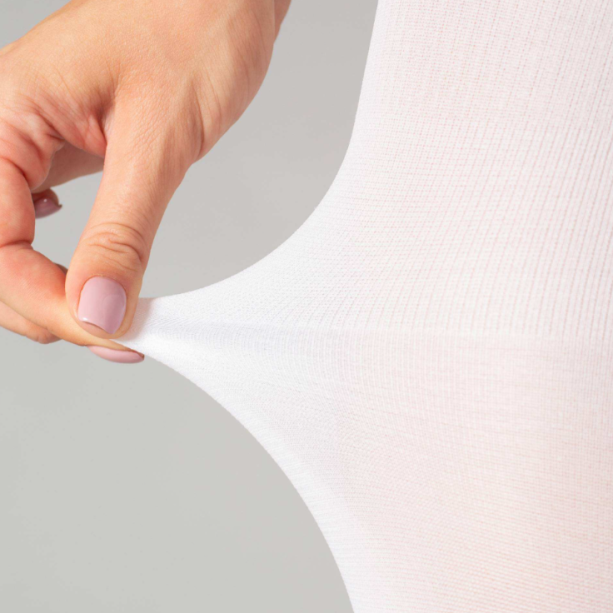
Elastane is a synthetic fibre renowned for its elasticity. Able to stretch several times its original length before returning to its initial shape, it is generally used in small proportions in textiles to improve comfort and fit.
Its main properties are as follows:
- Very high stretchability and short-term elastic recovery
- Comfort and freedom of movement
- Lightweight and flexible
- Compatible with many fibre blends (cotton/elastane, polyester/elastane, polyamide/elastane, etc.)
It is used in many textile products, often in proportions ranging from 2% to 10% of the composition:
- Sportswear and fitness clothing (leggings, sports bras, compression garments)
- Swimwear
- Underwear and lingerie
- Stretch casualwear (trousers, T-shirts, shirts, etc.)
- Socks and tights
Despite being present in small quantities in finished products, it can block recycling. Indeed, when elastane accounts for more than 5% of the composition, it is a disruptor for product recycling and may even completely hinder the recycling process. 6
Alternative elastic materials to elastane exist :
- modified elastanes, which retain the mechanical properties of elastane while improving their source (more circular) or their end-of-life.
In addition, elastic materials of a different chemical nature offer complementary solutions, such as :
- Elastolefins, chemically similar to polypropylenes and polyethylenes.
- Elastodienes (natural elastomers such as rubber, or synthetic elastomers), mainly used for technical applications such as tyres or seals (very rarely in textiles: covered yarns).
- Materials from the polyester family: elastic due to the conformation or texturing of the fibre (through processing):
- PBT (polybutylene terephthalate) and PTT (polytrimethylene terephthalate): thermoplastic materials with intrinsic elasticity;
- Elastomultiesters (or EME: polyester copolymers).
Acrylic 7
Acrylic is a synthetic fibre often used as an alternative to wool. It offers good thermal comfort while being easy to care for.
Its main properties are as follows:
- Wool-like appearance and feel
- Lightweight and soft
- Good thermal insulation
- Resistance to ultraviolet (UV) rays and weathering
- Good dimensional stability
- Easy care and quick drying
- Compatible with fibre blends (wool/acrylic, cotton/acrylic, etc.), for example to make care easier or reduce production costs
While acrylic may be seen as an alternative to wool in terms of feel and static thermal properties, it does not have wool’s thermoregulating properties (active moisture absorption, bidirectional hot/cold regulation).
Acrylic is used in many textile products, often knitted:
- Pullovers, cardigans and winter clothing
- Hats, scarves and gloves
- Blankets and throws
- Faux fur
Polypropylene 8
Polypropylene is a very lightweight synthetic fibre, recognised for its technical performance and low density. Its resistance to moisture and chemicals makes it particularly suitable for technical applications and performance textiles.
Polypropylene is mainly used for industrial and technical applications (geotextiles, nonwovens, carpets) and, to a lesser extent, in the clothing industry, for example for technical underwear and sportswear or outdoor activity clothing (including winter sports).
Production
Stages of the production process
The production stages for the three fibres have common features, with a few differences :
Step 1
Chemical processing of oil
Oil is chemically processed to extract base compounds, which are not the same for the three fibres.
Step 2
Polymerisation
These compounds are polymerised: this is the chemical reaction used to obtain a polymer, often in the form of pellets.
Step 3
Melting and dissolution of pellets
The pellets are melted or dissolved:
- For elastane: most of the time, the polymer (polyurethane/PU) does not go through the pellet stage: it is dissolved directly in a solvent
- For acrylic: the polymer (polyacrylonitrile/PAN) is dissolved in a solvent
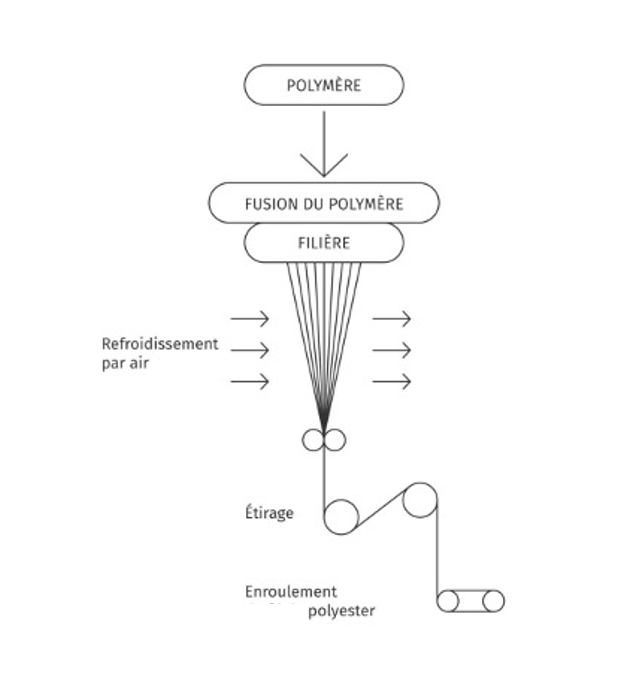
- For polypropylene: the polymer (polyolefin) is melted
Step 4
Spinning
The material is spun:
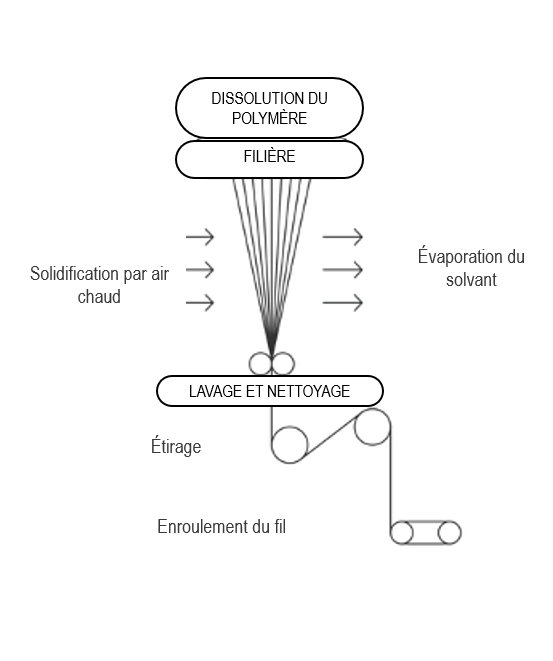
- For elastane: spinning is carried out by the dry process (in a hot air column, where the solvent evaporates), then the material is washed and dried to remove solvent residues.
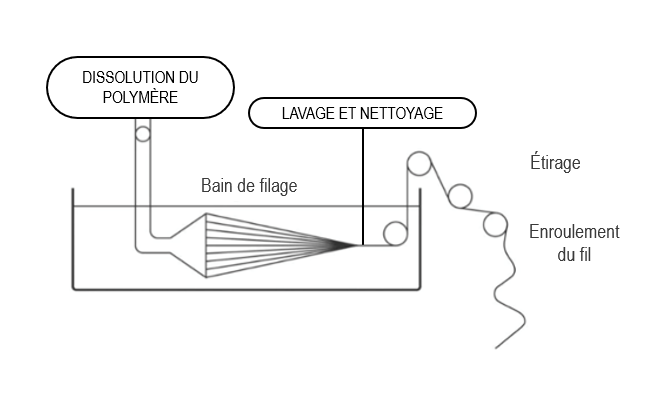
- For acrylic: spinning is carried out by the dry or wet process, then the material is washed and dried to remove solvent residues.
- For polypropylene: spinning is carried out by passing the molten polymer through a spinneret to extrude it
Step 5
Shaping
The filaments are stretched to give them the desired mechanical properties (strength, elasticity).
Step 6
Winding onto bobbins
The yarns are wound onto a bobbin.
Production diagram
Dry spinning
Wet spinning
Melt spinning
A diagram showing an example of a complete process can be found in the dedicated polyester fact sheet
🌱 Non-renewable resource(life cycle stage: production)
With between 96.8% and 99.6% of global production still fossil-based in 2024, each tonne of virgin synthetic fibre produced contributes to the depletion of oil reserves, a non-renewable fossil resource. 11
🌡️ Energy consumption and associated greenhouse gas emissions(life cycle stage: production)
The melt process used to produce polypropylene, which is solvent-free, is generally less energy-intensive than the solvent-based processes used for acrylic and elastane, which are more complex and energy-intensive (for example, to recover and recycle solvents). Greenhouse gas emissions are particularly significant if the energy consumed comes from fossil fuels (energy mixes vary by country).
🧪 Chemical impact(life cycle stage: production)
The DMAc/DMF solvents that may be used for spinning elastane and acrylic are reprotoxic. The acrylonitrile monomer used to produce acrylic is classified as carcinogenic by INRS. 12
🧪 Plastic pollution and microfibres(throughout the life cycle)
The synthetic fibres studied here are plastic materials. Throughout their life cycle (production, use, washing, end of life), they can contribute to plastic pollution flows in the environment. During domestic washing, mechanical abrasion leads to the release of synthetic microfibres, some of which pass through wastewater treatment systems before reaching aquatic environments. 13 In Europe, textile washing accounts for 8% of microplastic releases into the environment. 14 Acrylic may release more microplastics than the other two fibres covered on this page because its fibres are mechanically fragile (they have lower abrasion resistance than polyester, for example). Polypropylene microfibres float and are particularly mobile in aquatic environments. Polyurethane (elastane) microfibres are chemically stable and persistent. They can accumulate in the food chain.
💧 Persistence at end of life and soil/water pollution(life cycle stage: product end of life)
These fibres are not biodegradable and can persist for many years in landfill, where their gradual degradation promotes the release of microfibres and chemical substances into the environment. These limitations highlight the importance of reuse and recycling in improving the circularity of value chains for these synthetic fibres. 15
Eco-design issues
1. Durability 16
1. Elastane is a fibre recognised for its elasticity and its ability to return to its original shape after stretching. However, its long-term resistance can be affected by repeated exposure to heat, ultraviolet (UV) rays, chlorine or certain chemicals, which can lead to a gradual loss of its elastic properties. The progressive loss of elasticity is the main factor in the premature disposal of stretch items, even if the rest of the fabric is intact.
2. Acrylic generally allows products to retain their colours and thermal properties over time. However, its abrasion resistance is lower than that of some other synthetic fibres, and it tends to pill, which can alter the appearance of textiles after repeated use.
3. Polypropylene has characteristics that allow it to maintain its performance in technical, sports or outdoor applications, including after many use cycles. However, its sensitivity to heat and ultraviolet (UV) radiation can lead to faster degradation when it is exposed to outdoor environments over a long period without specific treatment.
For all three fibres, durability depends on the applications and conditions of use or care.
2. Recyclability 17 18
- Elastane: mainly used in small proportions in textile blends (cotton/elastane, polyester/elastane, etc.), it is very difficult to isolate during recycling. Its presence is a major barrier to currently available mechanical, thermomechanical and chemical recycling processes, although some chemical recyclers (at pilot stage, with no industrial capacity yet) have developed methods to extract it.
- Acrylic: mechanical recycling is more widely used for acrylic textiles (mostly knitted and perfectly suited to garnetting), although a few players also offer chemical recycling solutions.
For polypropylene, acrylic and elastane, textile-to-textile recycling solutions exist or are under development, but they currently remain little deployed at industrial scale
3. Incorporation of recycled materials
1. Elastane, being a recycling disruptor, a good practice is to limit the proportion of elastane in fabrics to 5%. To go further, favouring fabrics with as little elastane as possible, or even no elastane (when the product’s use allows), is beneficial from a recyclability perspective.
Using recycled elastane as a replacement for virgin elastane can help limit the use of non-renewable resources.
2. Acrylic: Using recycled acrylic as a replacement for virgin acrylic can help limit the use of non-renewable resources.
3. Polypropylene: The use of polypropylene can be reserved for technical applications where its properties are irreplaceable. For other uses, it can in some cases be replaced by other synthetic fibres from recycling.
Action levers
Points to watch
As with any eco-design approach, before choosing a material, it is essential to analyse the environmental impact of a product’s entire life cycle and to compare different scenarios in order to identify which one has the lowest environmental impact. There is no ideal material; a material must be chosen according to the product’s intended use and its environmental objectives.
Several labels and certifications exist for this material; the following are eligible for Refashion’s “Environmental Labels” eco-modulation.
Eco-modulations: Refashion promotes product eco-design approaches through a system of premiums and penalties. Discover the criteria and procedures for declaring eco-modulations.

OEKO-TEX® MADE IN GREEN label
The OEKO-TEX® MADE IN GREEN label covers chemical safety, processes and traceability. It is not limited to natural fibres

bluesign label
The bluesign PRODUCT label applies to finished textile products, particularly clothing and household textiles, with no specific restriction to these fibres.

EU Ecolabel
The EU Ecolabel distinguishes textile products with a reduced environmental impact throughout their entire life cycle. The three fibres are explicitly covered by the European textile standard: elastane, acrylic and polypropylene.

GOTS (Global Organic Textile Standard)
The Global Organic Textile Standard (GOTS) label allows elastane and polypropylene as additional fibres within certain limits. Acrylic is prohibited. In GOTS version 7.0, applicable in 2026, recycled synthetic fibres are allowed up to 20%, and authorised virgin fibres, including elastane and polypropylene, up to 10%.

Fairtrade® Textile
Possible if the fibre is a responsible fibre accepted by Fairtrade, particularly when it is recycled and covered by an approved scheme such as GRS or RCS. This is not the applicable route for a virgin synthetic fibre not covered by a recognised scheme

Ecocert ERTS certificate (Ecological & Recycled Textile Standard)
Ecocert’s Ecological & Recycled Textile Standard (ERTS) certification should only be considered when the fibre falls within the categories authorised by ERTS, particularly recycled material or material from a renewable resource. Virgin fossil-based synthetic fibres are not the standard route under the standard.
Sources18
- 1 Textile exchange – Materials Market Report 2025: https://textileexchange.org/knowledge-center/reports/materials-market-report-2025/
- 2 Marques de France – Page web l’élasthane : ses avantages et inconvénients: https://www.marques-de-france.fr/definition/elasthanne/
- 3 Mordor Intelligence, TAILLE ET PART DU MARCHÉ DES FIBRES ACRYLIQUES - ANALYSE DE LA CROISSANCE, TENDANCES ET PRÉVISIONS (2026 - 2031): https://www.mordorintelligence.com/fr/industry-reports/acrylic-fiber-market
- 4 Mordor Intelligence, TAILLE ET PART DU MARCHÉ DES FIBRES DE POLYPROPYLÈNE - ANALYSE DE LA CROISSANCE ET PRÉVISIONS (2026 - 2031): https://www.mordorintelligence.com/fr/industry-reports/polypropylene-market
- 5 Austin Publishing Group, Reviewing the production process,physical and chemical properties of spandex fibers (https://austinpublishinggroup.com/textile-engineering/fulltext/arte-v5-id1051.php); The Good Goods, Page matière élasthane (https://www.thegoodgoods.fr/matieres/elasthanne/)
- 6 Refashion, Étude des perturbateurs et facilitateurs au recyclage des Textiles d’habillement, Linge de maison et Chaussures: https://media-pro.refashion.fr/2025/10/revue-des-perturbateurs-et-facilitateurs-au-recyclage-des-tlc_vf_refashion_2025.pdf
- 7 Textile Addict, Page sur l’acrylique: https://textileaddict.me/fibre-textile-les-acryliques-pan/
- 8 Textile Engineering, Polypropylene Fiber : Properties, Production and Uses: https://textileengineering.net/polypropylene-fiber-properties-production-and-uses/
- 9 Shen L. et al., Cradle to gate environmental impact assessment of acrylic fiber manufacturing: https://www.researchgate.net/publication/290648667_Cradle_to_gate_environmental_impact_assessment_of_acrylic_fiber_manufacturing
- 10 Van der Velden et al., LCA benchmarking study on textiles made of cotton, polyester, nylon, acryl and elastane, The International Journal of Life Cycle Assessment: https://www.researchgate.net/publication/258220983_LCA_benchmarking_study_on_textiles_made_of_cotton_polyester_nylon_acryl_or_elastane
- 11 Textile Exchange, Materials Market Report 2025: https://textileexchange.org/app/uploads/2025/09/Materials-Market-Report-2025.pdf
- 12 INRS
- 13 Microplastic pollution from textile consumption in Europe, European Environment Agency, 2022: https://www.eionet.europa.eu/etcs/etc-ce/products/etc-ce-products/etc-ce-report-1-2022-microplastic-pollution-from-textile-consumption-in-europe
- 14 Marine plastic debris and microplastics: global lessons and research to inspire action and guide policy change UNEP, 2018: https://apps1.unep.org/resolutions/uploads/unep_aheg_2018_1_inf_4_unea2_edited.pdf
- 15 Palacios‑Mateo et al. Analysis of the polyester clothing value chain to identify key intervention points for sustainability: https://www.researchgate.net/publication/348291092_Analysis_of_the_polyester_clothing_value_chain_to_identify_key_intervention_points_for_sustainability
- 16 Austin Publishing Group, Reviewing the production process,physical and chemical properties of spandex fibers (https://austinpublishinggroup.com/textile-engineering/fulltext/arte-v5-id1051.php); The Good Goods, Page matière élasthane (https://www.thegoodgoods.fr/matieres/elasthanne/); Textile Addict, Page sur l’acrylique (https://textileaddict.me/fibre-textile-les-acryliques-pan/); Textile Engineering, Polypropylene Fiber : Properties, Production and Uses (https://textileengineering.net/polypropylene-fiber-properties-production-and-uses/)
- 17 Textile Exchange – Page web sur les matières synthétiques: https://textileexchange.org/other-synthetics/
- 18 Refashion – Etude des perturbateurs et facilitateurs au recyclage des Textile d’habillement, Linge de maison et Chaussures (2025): https://media-pro.refashion.fr/2025/10/revue-des-perturbateurs-et-facilitateurs-au-recyclage-des-tlc_vf_refashion_2025.pdf
Plus de ressources sur le même sujet


