

Polyamide
Understand the material, its key figures, the stages of its manufacturing process, its properties and applications, the environmental issues, as well as information on the durability, recyclability, and alternatives available to this material.
30 min de lecture
Update : Oct 2026

7 million tonnes
Of polyamide produced worldwide in 2024, representing around 4% of the global fibre market.
More than 60 %
Of the Asian polyamide market is concentrated in China
2 %
Of polyester placed on the market in 2024 was recycled.
Key data
- Fibre type: Textile polyamide, also known by the trade name nylon, is a synthetic fibre that includes several polymers. The two main types used in textiles are polyamide 6 (PA6, accounting for around 60% of the nylon market) and polyamide 6-6 (PA66), although the latter is not the reference polyamide for apparel textiles, as it is mainly intended for technical applications.
- Annual global production: 7 million tonnes in 2024, representing around 5% of global fibre production. Polyamide is the second most widely produced synthetic fibre in the world after polyester, but far behind it, as it accounts for only around 5% of global fibre production in 2024, compared with 59% for polyester. 2
- Main producing countries: China, which accounts for more than 60% of the Asian polyamide market, followed by Taiwan, South Korea and Japan. India, for its part, has the fastest production growth in the region. 3 The distinction between the two nylon variants is structuring from this perspective, because while PA6 production is concentrated in Asia, PA6.6 production takes place mainly in Europe and North America.
Global fibre market
Polyamide produced in 2024
5%
Other fibres
95%
- Fossil-based share: Around 97.6% of production comes from virgin fossil-based raw materials.
- Recycled share: 2% of the polyamide produced in 2024 was recycled. This share remains stable and significantly lower than that of polyester. Recycled polyamide mainly comes from post-production waste (production offcuts) or post-consumer materials such as used fishing nets and end-of-life carpets. Technical challenges related to collection and sorting, as well as the higher cost of recycled polyamide compared with virgin material, continue to hinder its development.
- Bio-based share: 0.4% of the polyamide produced worldwide in 2024 was bio-based. Produced, for example, from castor oil, this share remains marginal: price, the availability of renewable raw materials and questions about the sustainability of these alternatives are currently slowing its growth.
Share of fossil-based, recycled and bio-based material
Fossil-based polyamide
Recycled polyamide
Bio-based polyamide
Properties and examples of applications
4 Among the two main variants used in textiles, PA6, which is more flexible and easier to dye, is dominant in uses for clothing and lingerie, activewear, hosiery and swimwear, while PA6-6, whose structure is more crystalline, offers better abrasion resistance and greater dimensional stability, making it more suitable for technical and high-performance sports uses, premium tights and stockings, luxury lace and embroidery, and high-strength sewing threads.
The main properties of polyamide are as follows:
- High tensile and abrasion resistance
- Good elasticity and recovery after stretching
- Lightweight and soft feel
- Quick drying and low moisture absorption (but higher than polyester)
- Resistance to mould and fungi
- Compatibility with many fibre blends (polyamide/elastane, cotton/polyamide, wool/polyamide, etc.)
It is used in a wide variety of textile products:
- Lingerie, underwear and lace
- Stockings and tights (one of the very first historical uses of polyamide)
- Swimwear and sportswear
- Outdoor and technical clothing (abrasion and tear resistance)
- Household linen (stretch blends for bed linen, particularly in polyamide 6-6)
In terms of characteristics, the basic fundamental principle is the same for polyester and polyamide, but melting and heat-treatment thresholds vary, because the molecular chains of polyester and polyamide do not have the same thermal resistance. Similarly, polyamide has a higher elongation rate and breaking elasticity than polyester: post-extrusion mechanical drawing is therefore adjusted to give polyamide its high elasticity and polyester its high dimensional stability. Lastly, polyamide absorbs more moisture than polyester (around 4% compared with nearly 0%), which changes the processing conditions and surface treatments (spin finishes) during spinning.
Production
Stages of the production process 5
The production process for PA6 and PA66 differs
Step 1
Chemical processing of oil
Oil is chemically processed to produce the base monomers: caprolactam for polyamide 6, or hexamethylenediamine and adipic acid for polyamide 6-6.
Step 2
Polymerisation
These monomers react through polymerisation (the mechanism differs depending on the type: for PA6, a single molecule closes in on itself in repeated rings; for PA6-6, two different molecules assemble alternately, like links in a chain) to form polyamide polymer pellets.
Step 3
Extrusion
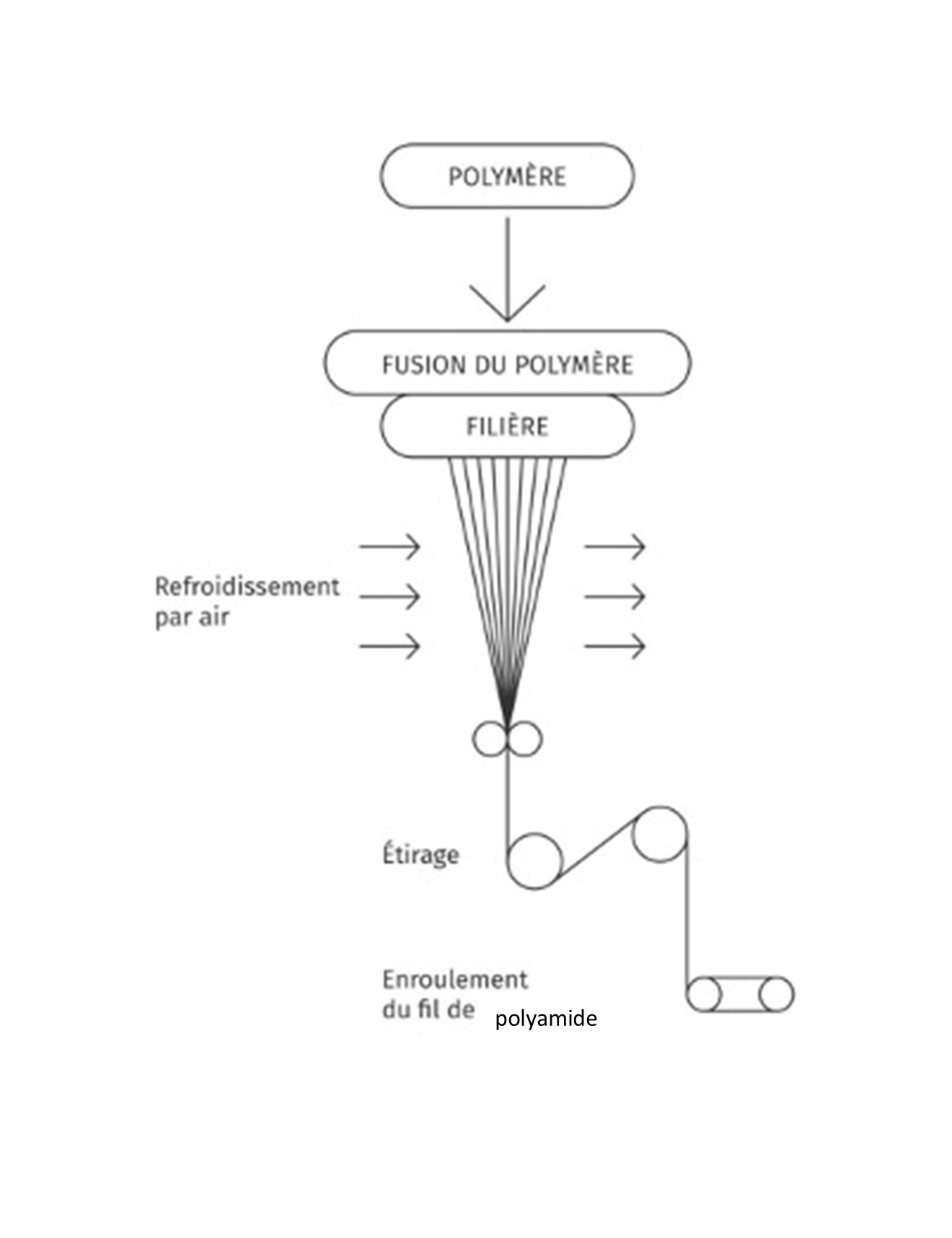
The pellets are melted and then extruded (pushed through a small opening) through a spinneret to form continuous filaments.
Step 4
Cooling and shaping
The filaments are cooled, drawn and textured to give them the desired mechanical properties and feel.
Step 5
Spinning
Spinning produces a polyamide yarn. Depending on the techniques used, the yarn can be made with continuous filaments (producing a strong yarn and a smooth fabric, used particularly for lingerie and tights) or with short fibres spun together to form the yarn (for example, blended with wool for socks).
Step 6
Winding
The polyamide yarn is wound onto bobbins and is ready for the production of woven or knitted fabrics.
Production diagram
Like polyester, polyamide is processed using a melt-spinning process: the polymer is melted and then extruded through a spinneret before the yarn is cooled, drawn and wound.
Environmental impact
Environmental issues of production
🌱 Non-renewable resource(life cycle stage: production)
With around 97.6% of global production still fossil-based in 2024, each tonne of virgin polyamide produced contributes to the depletion of oil reserves. Virgin polyamide is made from petrochemical derivatives processed into caprolactam or into adipic acid and hexamethylenediamine, depending on the type of polymer required. 6
🧪 Nitrous oxide emissions related to adipic acid production – specific to PA66(life cycle stage: production)
The production of adipic acid, used to manufacture polyamide 6-6, generates nitrous oxide (N₂O) emissions, a gas whose global warming potential can be up to 298 times that of CO₂ and which also contributes to ozone layer depletion. Global adipic acid production is around 2.5 million tonnes per year and has increased by around 10% since 1990, although N₂O destruction technologies have been deployed by European producers since the 2000s, significantly reducing the impact. This issue, which remains little known, specifically concerns polyamide 6-6; polyamide 6, produced from caprolactam, is not exposed to it. 7
🌡️ High energy and water consumption(life cycle stage: production)
Polymerisation (particularly monomer synthesis) and extrusion are the most energy-intensive stages, while water consumption is mainly concentrated during downstream dyeing and wet treatments. The vast majority of this energy still comes from fossil sources, particularly in Asia, where global production is concentrated, especially for PA6, meaning that greenhouse gas emissions are higher there. 8
🧪 Plastic pollution and microfibres(throughout the life cycle)
Polyamide is a plastic material. Throughout its life cycle (production, use, washing, end of life), it can contribute to plastic pollution flows in the environment. During domestic washing, mechanical abrasion leads to the release of synthetic microfibres, some of which pass through wastewater treatment systems before reaching aquatic environments. 9 In Europe, textile washing accounts for 8% of microplastic releases into the environment. 10
💧 Persistence at end of life and soil/water pollution(life cycle stage: product end of life)
Polyamide is not biodegradable: its degradation can take several decades (30 to 40 years, according to estimates). 11
Eco-design issues
1. Durability 12
Polyamide 6-6, with its more crystalline structure, offers better abrasion resistance and greater dimensional stability than polyamide 6, allowing it to retain its performance over repeated use, particularly in technical and sports applications. Polyamide 6, which is more flexible, is better suited to fine and delicate items such as lingerie or activewear.
In these very fine items, however, the high strength of polyamide yarn does not prevent runs or snags, which remain the main reason for discarding these products, even when the rest of the item is intact.
2. Recyclability 13
Polyamide can be recycled through two main processes :
1. Mechanical: polyamide textiles are rarely sent for garnetting, except for pullovers and other knitted items that can undergo garnetting. Other types of items (lingerie, sportswear, swimwear) are typically excluded from this material recovery route (small items made from dense and elastic fabrics, unsuitable for garnetting) 14. The PAMREC project, led by Filatures du Parc, explores a defibering route adapted to polyamide (tights, T-shirts, sportswear) for the production of recycled yarn intended for the hosiery sector. 15
2. Chemical: polyamide 6 can be depolymerised (chemically broken down) back into its base molecule, caprolactam (through various processes), then re-polymerised to obtain a material of comparable quality to virgin fibre. This is the route used by some players, from post-production and post-consumer waste (used fishing nets, production offcuts, carpets, textiles). Chemical recycling of polyamide 6-6, which requires re-separating adipic acid and hexamethylenediamine, is currently less mature at industrial scale.
An alternative route is based not on depolymerisation but on dissolution: PA6 is dissolved in a solvent without breaking its chemical bonds (the polymer remains intact), allowing it to be separated from a material blend and then reprecipitated as such. This is a chemical route in its own right, distinct from depolymerisation, but still at the development stage. 16
Material blends complicate the recycling of polyamide, particularly in lingerie and tights combining polyamide and elastane: elastane, often present in high proportions in this type of item, is a major barrier to recycling, especially when it is hidden at the core of a covered yarn, making detection by optical sorting impossible 17. The main textile applications for polyamide almost systematically contain elastane.
3. Incorporation of recycled material 18
Recycled polyamide can come from post-production waste (production offcuts) or post-consumer waste (used fishing nets, end-of-life carpets and rugs, textiles). Its share remains low (2% in 2024) due to higher production costs than virgin polyamide, and collection and sorting challenges, particularly for multi-material and complex products such as lingerie or tights.
Some chemical recycling processes can produce recycled polyamide of comparable quality to virgin fibre, notably from used fishing nets or production offcuts. However, the large-scale development of these streams remains dependent on the availability and collection of sufficiently homogeneous polyamide feedstocks.
Action levers
Points to watch
As with any eco-design approach, before choosing a material, it is essential to analyse the environmental impact of a product’s entire life cycle and to compare different scenarios in order to identify which one has the lowest environmental impact. There is no ideal material; a material must be chosen according to the product’s intended use and its environmental objectives.
Several labels and certifications exist for this material; the following are eligible for Refashion’s “Environmental Labels” eco-modulation. 19
Eco-modulations: Refashion promotes product eco-design approaches through a system of premiums and penalties. Discover the criteria and procedures for declaring eco-modulations..

Ecocert ERTS certificate (Ecological & Recycled Textile Standard)
Ecocert’s Ecological & Recycled Textile Standard (ERTS) certification only covers polyamide in recycled form, which may count towards the label’s minimum threshold of 70% natural, renewable or recycled fibres; virgin polyamide, of non-renewable petrochemical origin, cannot be counted towards this threshold.

OEKO-TEX® MADE IN GREEN label
The OEKO-TEX® MADE IN GREEN label explicitly covers synthetic fibres, including polyamide, by combining testing for harmful substances on the finished product with verification of responsible production conditions, without any requirement for natural or organic origin.

bluesign label
The bluesign PRODUCT label explicitly classifies polyamide among the “man-made fibres of synthetic origin” covered by its fibre manufacturing criteria, and focuses on the management of chemical inputs throughout the production chain (particularly dyeing), rather than on the origin of the raw material.

EU Ecolabel
The EU Ecolabel includes a technical criterion specifically dedicated to polyamide, requiring either a minimum content of 20% recycled nylon or compliance with nitrous oxide emission limits during monomer production (10 g/kg for PA6, 50 g/kg for PA6-6)
Available alternative materials
Focus on chemically recycled polyamide
Some recycled polyamide fibres are produced from polyamide waste collected worldwide, such as abandoned fishing nets, industrial offcuts or used carpets. The process used is closed-loop chemical recycling, which in theory allows the fibre to be recycled indefinitely without any loss of quality.
Bio-based polyamide (bio-PA) 20
Bio-based alternatives exist, such as polyamide 11, obtained from castor oil and claimed by some manufacturers to be of 100% renewable origin, or polyamide 6.10, which is partially bio-based. However, these polyamides remain technical polymers, used more in industrial applications than in mass-market textiles. Their share remains marginal (0.4% of the global polyamide market in 2024), limited by price, raw material availability and questions about the sustainability of these alternatives.
Among innovative players, companies are working on the production of bio-based monomers for PA6,6. These developments illustrate the trend towards substitutes for fossil-based fibres in the textile sector.
Sources26
- 1 Textile Exchange, Materials Market Report 2025: https://textileexchange.org/app/uploads/2025/09/Materials-Market-Report-2025.pdf
- 2 Textile Exchange, Materials Market Report 2025: https://textileexchange.org/app/uploads/2025/09/Materials-Market-Report-2025.pdf
- 3 Mordor Intelligence, Asia-Pacific Polyamide Market Size & Share Analysis: https://www.mordorintelligence.com/industry-reports/asia-pacific-polyamide-market
- 4 The Good Goods, Page matière polyamide (https://www.thegoodgoods.fr/matieres/polyamide/); Fulgar, Polyamide 6 and Polyamide 66: differences, performance and selection criteria in textiles (https://www.fulgar.com/en/feature/300/polyamide-6-and-polyamide-66-differences-performance-and-selection-criteria-in-textiles)
- 5 Fulgar, Polyamide 6 and Polyamide 66: differences, performance and selection criteria in textiles (https://www.fulgar.com/en/feature/300/polyamide-6-and-polyamide-66-differences-performance-and-selection-criteria-in-textiles); ChemAnalyst, Understanding the Production Process of Adipic Acid (https://www.chemanalyst.com/NewsAndDeals/NewsDetails/understanding-the-production-process-of-adipic-acid-38038)
- 6 Textile Exchange, Materials Market Report 2025: https://textileexchange.org/app/uploads/2025/09/Materials-Market-Report-2025.pdf
- 7 ICVCM, Nitrous Oxide Abatement in Adipic Acid Production: https://icvcm.org/nitrous-oxide-abatement-in-adipic-acid-production/
- 8 The Good Goods, Page matière polyamide: https://www.thegoodgoods.fr/matieres/polyamide/
- 9 Microplastic pollution from textile consumption in Europe, European Environment Agency, 2022: https://www.eionet.europa.eu/etcs/etc-ce/products/etc-ce-products/etc-ce-report-1-2022-microplastic-pollution-from-textile-consumption-in-europe
- 10 Marine plastic debris and microplastics: global lessons and research to inspire action and guide policy change, UNEP, 2018: https://apps1.unep.org/resolutions/uploads/unep_aheg_2018_1_inf_4_unea2_edited.pdf
- 11 The Good Goods, Page matière polyamide: https://www.thegoodgoods.fr/matieres/polyamide/
- 12 Fulgar, Polyamide 6 and Polyamide 66: differences, performance and selection criteria in textiles (https://www.fulgar.com/en/feature/300/polyamide-6-and-polyamide-66-differences-performance-and-selection-criteria-in-textiles); The Good Goods, Page matière polyamide (https://www.thegoodgoods.fr/matieres/polyamide/)
- 13 Textile Exchange, page dédiée au Nylon (https://textileexchange.org/nylon/); ECONYL® by Aquafil, Sustainability (https://econyl.aquafil.com/sustainability/)
- 14 Refashion, TERRA, "Étude des perturbateurs et facilitateurs au recyclage des Textiles d'habillement, Linge de maison et Chaussures," février 2025: https://media-pro.refashion.fr/2025/10/revue-des-perturbateurs-et-facilitateurs-au-recyclage-des-tlc_vf_refashion_2025.pdf
- 15 Refashion, "Innovation #09 : Les lauréats du Challenge Innovation 2019," 2020: https://media-pro.refashion.fr/2026/03/mag-inno-09-fr.pdf
- 16 Tonsi, G., et al., "Polyamide recycling by selective dissolution approach: Life Cycle Assessment study and environmental impacts comparison with different recycling technologies," Polymer Engineering & Science, 2025, (https://doi.org/10.1002/pen.27041); Refashion, "Quel potentiel pour la fin de vie des articles de lingerie ? État des lieux et perspectives du réemploi et du recyclage," mai 2025: https://media-pro.refashion.fr/2025/10/livre_blanc_collectif_lingerie_recyclage.pdf
- 17 Refashion, Étude des perturbateurs et facilitateurs au recyclage des Textiles d'habillement, Linge de maison et Chaussures, 2025: https://media-pro.refashion.fr/2025/10/revue-des-perturbateurs-et-facilitateurs-au-recyclage-des-tlc_vf_refashion_2025.pdf
- 18 Textile Exchange, page dédiée au Nylon (https://textileexchange.org/nylon/); ECONYL® by Aquafil, Sustainability (https://econyl.aquafil.com/sustainability/)
- 19 Textile Exchange, Recycled Claim Standard & Global Recycled Standard (https://textileexchange.org/recycled-claim-global-recycled-standard/)
- 20 Arkema, Rilsan® PA11 – high-performance polymer of 100% renewable origin (https://www.arkema.com/global/en/products/product-finder/product/technicalpolymers/rilsan-family-products/rilsan-pa11/); Textile Exchange, Materials Market Report 2025 (https://textileexchange.org/app/uploads/2025/09/Materials-Market-Report-2025.pdf)
Plus de ressources sur le même sujet


