

Polyester
Understand the material, its key figures, the stages of its manufacturing process, its properties and applications, the environmental issues, as well as information on the durability, recyclability, and alternatives available to this material.
30 min de lecture
Update : Oct 2026

78 million tonnes
Of polyester produced worldwide in 2024, representing approximately 59% of the global fibre market.
1st
Most widely produced fibre in the world
12 %
Of the polyester placed on the market in 2024 was recycled polyester.
Introduction
Polyester is a synthetic fibre derived from petrochemical derivatives. The most common polyester is PET (Polyethylene Terephthalate); it is produced by the polymerisation of ethylene glycol and terephthalic acid monomers.
The plastic polymer is melted and extruded through dies in order to give it a continuous filament structure and thus create a yarn.
Key data
- Type of fibre : Synthetic fibre (polyethylene terephthalate – PET).
- Global polyester production : 78 million tonnes in 2024
- Position in global production : polyester is the leading fibre produced worldwide, accounting on its own for 59% of global fibre production in 2024. Since the late 2000s, polyester has overtaken cotton as the main fibre in the textile industry. Its global production has been increasing steadily ever since. Nevertheless, according to the characterisation study of incoming and outgoing streams from sorting centers conducted by Refashion in 2023, cotton remains the predominant material in the non-reusable feedstock.
Global fibre market
Polyester produced in 2024
59%
Other fibres
41%
- Share of fossil-based material : 88% of production comes from virgin fossil-based raw materials.
- Share of recycled material : 12% of the polyester produced in 2024 was recycled polyester. This share is slightly down compared with 2023, but the absolute volume increased slightly (from 8.9 to 9.3 million tonnes). In recent years, the absolute volume produced has remained fairly stable, but the share has been decreasing since 2021 due to an increase in the volumes of virgin polyester produced. The vast majority of recycled polyester used in clothing comes from PET bottles (98%).
Properties and examples of applications
Polyester is a synthetic fibre with versatile characteristics and low production costs, which explains its dominance in the global textile industry.
Its main properties are as follows:
- Lightweight and tensile strength
- Very low water absorption and quick drying
- Resistance to abrasion, ultraviolet radiation and chemicals
- Easy care (machine washable, crease-resistant)
- Resistance to shrinkage
- Compatibility with many fibre blends (cotton/polyester, polyester/elastane, wool/polyester, etc.)
It is used in a wide variety of textile products:
- Sportswear and performance clothing (jerseys, shorts, outdoor clothing)
- Everyday clothing (T-shirts, fleece pullovers, linings)
- Household linen (bed linen – polycotton sheets, polyester satin, etc.; bathroom linen – towels, microfibre mats, etc.; table linen – tablecloths, cloths, etc.)
- Bags, luggage, technical items
- Technical applications (nonwoven fabrics, padding)
Production
Production process steps
Step 1
Chemical transformation of oil
Oil is chemically transformed to produce terephthalic acid (PTA) and ethylene glycol (MEG).
Step 2
Polymerisation
These two compounds react together through polycondensation to form PET polymer pellets.
Step 3
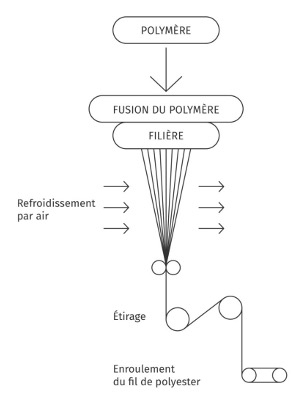
Polymer melting
The pellets are melted, then extruded through a die to form continuous filaments.
Step 4
Filament texturing
The filaments are cooled, drawn and textured to give them the desired mechanical properties and feel: for example, to add bulk and reduce the plastic-like feel.
Step 5
Spinning
Spinning produces polyester yarn. Depending on the techniques used, the yarn can be made with continuous filaments (resulting in a highly resistant yarn and a rather smooth fabric) or with short fibres spun together to form the yarn (giving a denser feel that can resemble natural materials). The two types of yarn correspond to different uses in the textile industry depending on the product and the properties sought.
Step 6
Yarn winding
The polyester yarn is wound and is ready for the manufacture of fabrics or knitwear.
Please note: in the case of thermomechanically recycled polyester, the recycled material enters the production process in the form of pellets, before being melted and then extruded. In the case of chemically recycled polyester, the polyester is depolymerised and the recycled material therefore consists of monomers, which can be introduced at step 2.
Production diagram:
Environmental impact
Environmental issues related to production
💧 Non-renewable resource(life cycle stage: production)
With 88% of global production still fossil-based in 2024, every tonne of virgin polyester produced contributes to the depletion of oil reserves. Polyester is by far the most widely produced synthetic fibre (59% of textile production in 2024), making it the leading contributor to the textile industry’s dependence on fossil resources. 2
Virgin polyester is produced from two major petrochemical intermediates: purified terephthalic acid (PTA) and monoethylene glycol (MEG). The production of these two substances is the main contributor to the environmental impacts of virgin polyester in most of the impact categories studied in a life cycle assessment. 3
🌡️ High energy consumption(life cycle stage: production)
The production of virgin polyester is energy-intensive at every stage: oil refining, chemical synthesis of PET, melting and extrusion of filaments. The vast majority of this energy still comes from fossil sources, particularly in Southeast Asia, where global production is concentrated. The life cycle assessment carried out by Textile Exchange shows that electricity and heat consumption is the second largest contributor to the environmental impact of virgin polyester, after the production of petrochemical precursors (PTA and MEG)
🌡️ Main contributor to fashion’s greenhouse gas emissions (GHG)(life cycle stage: production)
Polyester is the main source of greenhouse gas emissions associated with the production of textile raw materials (43% according to Textile Exchange 4). Its production, rooted in Southeast Asia and mainly in China, explains the high greenhouse gas impact due to highly carbon-intensive energy mixes. Global production increased from around 71 Mt in 2023 to 78 Mt in 2024, making fossil-based synthetic fibres the main driver of the sector’s recent rise in emissions.
🧪 Plastic pollution and microfibres(throughout the life cycle)
Polyester is a plastic material. Throughout its life cycle (production, use, washing, end of life), it can contribute to plastic pollution flows in the environment. During domestic washing, mechanical abrasion leads to the release of synthetic microfibres, some of which pass through wastewater treatment systems before reaching aquatic environments 5. In Europe, textile washing accounts for 8% of microplastic releases into the environment. 6
🧪 Persistence at end of life and soil/water pollution(life cycle stage: product end of life)
Polyester is not biodegradable; it can persist for many years in landfill, where its gradual degradation promotes the release of microfibres and chemical substances into the environment. Incineration, another common treatment route, reduces waste volumes but generates greenhouse gas emissions and air pollutants. These limitations highlight the importance of reuse and recycling to improve the circularity of the polyester value chain. 7
Eco-design issues
1. Durability
Polyester is a fibre that, depending on its use and manufacturing process, can offer qualities such as good mechanical strength, low sensitivity to moisture and good resistance to ultraviolet radiation. These properties can enable it to maintain its characteristics over many washing cycles. This durability can help reduce the frequency of product replacement. However, an environmental benefit is only observed if this durability actually translates into a longer product lifespan.
2. Recyclability 8
Polyester can be recycled using several processes :
1. Thermomechanical : asuitable for thermoplastic fibres such as polyester, it consists of shredding and then melting the material before extrusion and granulation. This process makes it possible to obtain a new raw material, but may lead to a gradual degradation of the polymer’s properties over successive cycles. 9 Polyester must be pure to avoid any contamination in the recycled material
2. Chemical : it is based on the depolymerisation (chemical or enzymatic) of PET into monomers, followed by repolymerisation. In theory, it makes it possible to obtain a quality identical to virgin fibre, but remains more expensive and has not yet been deployed at industrial scale. 10
3. Mechanical : polyester textiles can be processed through physical treatments such as shredding (only for textiles suitable for shredding, such as trousers or fleece garments). The outlets are either “open-loop”, i.e. intended for reincorporation into sectors other than textiles (for example, materials for the building sector), or “closed-loop”, i.e. for the textile industry. 11
New chemical recycling technologies are currently being developed and may offer promising solutions, particularly for textiles that are difficult to recycle mechanically, although they are not without certain limitations (high energy consumption, issues relating to material purity, etc.).
3. Incorporation of recycled material 12
Recycled polyester can come from textiles or from other PET objects such as bottles. In both cases, this may involve products that have already been used (post-consumer) or production offcuts (post-production).
The incorporation of recycled polyester into new products raises specific issues of evidence and traceability, distinct from the challenges of recycling as such.
The growth of recycled polyester has significantly increased the use of recycled materials in the textile industry and reduced reliance on virgin fossil resources. Nevertheless, most of the recycled polyester used today still comes from recycled PET bottles (98%) rather than end-of-life textiles.
The “bottle-to-textile” process removes bottles from the closed-loop recycling system in order to recycle them into clothing, causing them to lose their food-grade status. 13 Developing a genuine large-scale textile-to-textile loop for polyester therefore remains a challenge for the sector and is the focus of significant research and development (R&D) efforts.
Action levers
Points to watch
As with any eco-design approach, before choosing a material, it is essential to analyse the environmental impact of a product’s entire life cycle and to compare different scenarios in order to identify which one has the lowest environmental impact. There is no ideal material; a material must be chosen according to the product’s intended use and its environmental objectives.
Available alternative materials
Bio-based polyester (bio-PET) 14:
Alternative polyester value chains based on renewable raw materials (sugar cane, corn, agricultural residues) are gradually being developed. These bio-polyesters can replace all or part of the petrochemical monomers with bio-based equivalents, thereby reducing the material’s carbon footprint, while still remaining non-biodegradable. Their production remains marginal in volume (0.01% of the total volume of polyester produced in 2025) and costly at large scale.
Textile Exchange – Preferred Fiber & Materials Market Report (annual)
Published annually by Textile Exchange, this report is the sector benchmark for the production volumes of the main textile fibres. For polyester, it tracks the progress of recycled polyesters in the global mix and provides the most up-to-date publicly available market data
Sources14
- 1 Textile Exchange, Materials Market Report 2025: https://textileexchange.org/app/uploads/2025/09/Materials-Market-Report-2025.pdf
- 2 Textile Exchange, Materials Market Report 2025: https://textileexchange.org/app/uploads/2025/09/Materials-Market-Report-2025.pdf
- 3 TEXTILE EXCHANGE POLYESTER LIFE CYCLE ASSESSMENT (LCA) STUDY, 2026: https://textileexchange.org/knowledge-center/reports/polyester-life-cycle-assessment/
- 4 Key Findings from the Climate+ Dashboard, Textile Exchange: https://textileexchange.org/news/market-report-shows-climate-progress-despite-industry-growth/
- 5 Microplastic pollution from textile consumption in Europe, European Environment Agency, 2022: https://www.eionet.europa.eu/etcs/etc-ce/products/etc-ce-products/etc-ce-report-1-2022-microplastic-pollution-from-textile-consumption-in-europe
- 6 Marine plastic debris and microplastics: global lessons and research to inspire action and guide policy change UNEP, 2018: https://apps1.unep.org/resolutions/uploads/unep_aheg_2018_1_inf_4_unea2_edited.pdf
- 7 Palacios‑Mateo et al. Analysis of the polyester clothing value chain to identify key intervention points for sustainability: https://www.researchgate.net/publication/348291092_Analysis_of_the_polyester_clothing_value_chain_to_identify_key_intervention_points_for_sustainability
- 8 Textile Exchange, Materials Market Report 2025 (https://textileexchange.org/app/uploads/2025/09/Materials-Market-Report-2025.pdf) ; Fashion for Good, What is chemical recycling? (2023) (https://www.fashionforgood.com/our_news/what-is-chemical-recycling/) ; Fashion for Good, T-REX Project Blueprint (2025) (https://www.fashionforgood.com/case-study/eu-funded-projects/t-rex-project/), TEXTILE EXCHANGE POLYESTER LIFE CYCLE ASSESSMENT (LCA) STUDY, 2026 (https://textileexchange.org/knowledge-center/reports/polyester-life-cycle-assessment/); Refashion, le recyclage chimique des textiles, 2024 (https://media-pro.refashion.fr/2025/09/synthese_recyclage_chimique_refashion_juin_2024.pdf) ; Refashion, Etude de caractérisation des flux entrants et sortants de centres de tri, 2023 (https://media-pro.refashion.fr/2025/10/synthese_etude_caracterisation_refashion_2023_fr.pdf)
- 9 THERMOMECHANICAL RECYCLING OF TEXTILES, Refashion: https://media-pro.refashion.fr/2025/11/study_thermomechanical_recycling_refashion2025.pdf
- 10 Communiqués de Carbios (https://www.carbios.com/newsroom/en/carbios-celebrates-the-groundbreaking-of-its-pet-biorecycling-plant/) et Ioniqa (https://ioniqa.com/ioniqa-attracts-e-10-million-funding/)
- 11 LE RECYCLAGE MÉCANIQUE DES TEXTILES, Refashion: https://pro.refashion.fr/app/uploads/2025/09/refashion_recyclage_mecanique_2025-1.pdf
- 12 Textile Exchange, Recycled Claim Standard & Global Recycled Standard (https://textileexchange.org/recycled-claim-global-recycled-standard/); Fashion for Good, Tracing Textile Waste – Case Study (2023–2025) (https://www.fashionforgood.com/case-study/tracing-textile-waste/)
- 13 Changing Markets Foundation : Spinning Greenwash: How the fashion industry’s shift to recycled polyester is worsening microplastic pollution: https://changingmarkets.org/report/spinning-greenwash/
- 14 Textile Exchange, Materials Market Report 2025 (https://textileexchange.org/app/uploads/2025/09/Materials-Market-Report-2025.pdf) ; Fashion for Good, T-REX Project Blueprint (2025) (https://www.fashionforgood.com/case-study/eu-funded-projects/t-rex-project/) ; Textile Exchange, The Future of Synthetics (https://textileexchange.org/knowledge-center/reports/the-future-of-synthetics/)
Plus de ressources sur le même sujet


