

Rubber
Understand the material, its key figures, the stages of its manufacturing process, its properties and applications, the environmental issues, as well as information on the durability, recyclability, and alternatives available to this material.
30 min de lecture
Update : Oct 2026
15 million tonnes
Of rubber produced worldwide in 2024, across all uses
85 %
Its production relies on approximately 10 million farmers
7 %
Of the rubber produced is used in footwear
Introduction
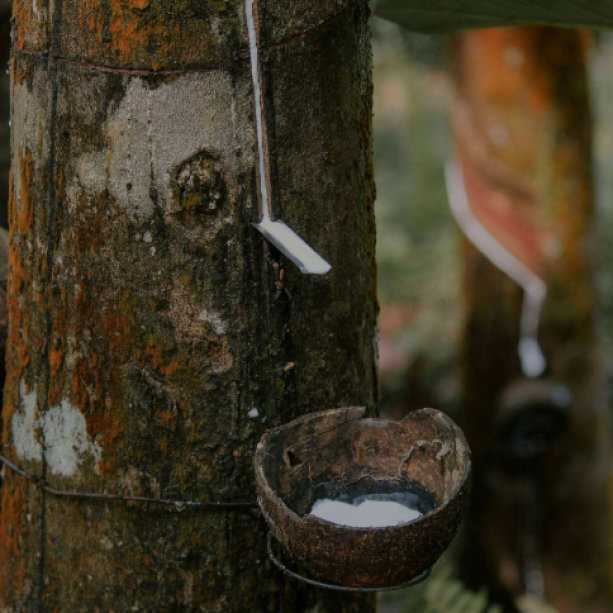
Natural rubber comes from latex, a milky sap harvested by tapping the bark of the rubber tree (Hevea brasiliensis), a tree native to the Amazon and now mainly cultivated in Southeast Asia. Synthetic rubber, by contrast, is an elastomer made from petroleum derivatives, with no connection to this plant-based raw material. In both cases, it is a type of polymer with elastic properties (elastomer or rubber), which can stretch under tension and return to its original shape when released. 1
Key data
- Type of fibre : Natural elastomer (rubber tree latex, Hevea brasiliensis) or synthetic elastomer (petrochemical derivative).
- Global rubber production : Global natural rubber production (across all uses) was around 15 million tonnes in 2024. 2 Synthetic rubber production was slightly higher, reaching 16 million tonnes in the same year. 3
- Main rubber-producing countries : The leading natural rubber-producing countries are Thailand (32% of global production), Indonesia (18%) and Côte d’Ivoire (10%). 4 More broadly, the 13 member countries of the Association of Natural Rubber Producing Countries (ANRPC), an intergovernmental organisation based in Asia, account for around 84% of global production on their own. 5
Synthetic rubber is based on dispersed petrochemical production carried out in many industrial countries, including China, the United States, Russia, Japan, Germany and South Korea, making it difficult to access consolidated figures. - Structure of the value chain : The natural rubber supply chain is complex and fragmented. Around 85% of its production relies on approximately 10 million farmers worldwide, within a family farming model (farm sizes ranging from 0.5 to 10 ha). 6 Between producers and end users, multiple intermediaries are involved, such as raw material traders, processing units, distributors and manufacturers of rubber products.
Properties and examples of applications
Globally, the use of natural rubber remains very largely dominated by a single sector: tyres, which absorb 65 to 70% of production. The remainder is distributed as follows: gloves and condoms (13%), shock absorbers and anti-vibration components (8%), footwear (7%), and adhesives (2%). 7
Footwear represents only a minor share of natural rubber uses worldwide (7% of the rubber market). In soles themselves, blends of natural and synthetic rubber are common. The exact proportion varies depending on the intended use: natural rubber (“gum rubber”) is preferred for its aesthetics and flexibility in the soles of classic vulcanised sneakers (increasing the material’s flexibility and resistance), while synthetic rubber, particularly styrene-butadiene rubber (SBR), dominates by volume in technical sports shoes and entry-level footwear, for reasons of cost and consistency of properties.
Global rubber market
Tyres
70%
Gloves and condoms
13%
Shock absorbers and anti-vibration components
8%
Footwear
7%
Adhesives
2%
Natural rubber is distinguished by exceptional elasticity and resilience, qualities that explain its preferred use in applications requiring high flexibility and grip (adhesion / traction). It is, however, more sensitive to ageing caused by heat, light and ozone than some synthetic rubbers, notably silicone and ethylene-propylene-diene monomer, which are often preferred for uses involving extreme conditions or long service life. Like most elastomers, whether natural or synthetic, it offers good impermeability and good insulating properties, which broadens its field of application beyond soles alone: boots, elastic elements in textiles (waistbands, straps, sportswear), or glues and adhesives used in footwear repair
Production
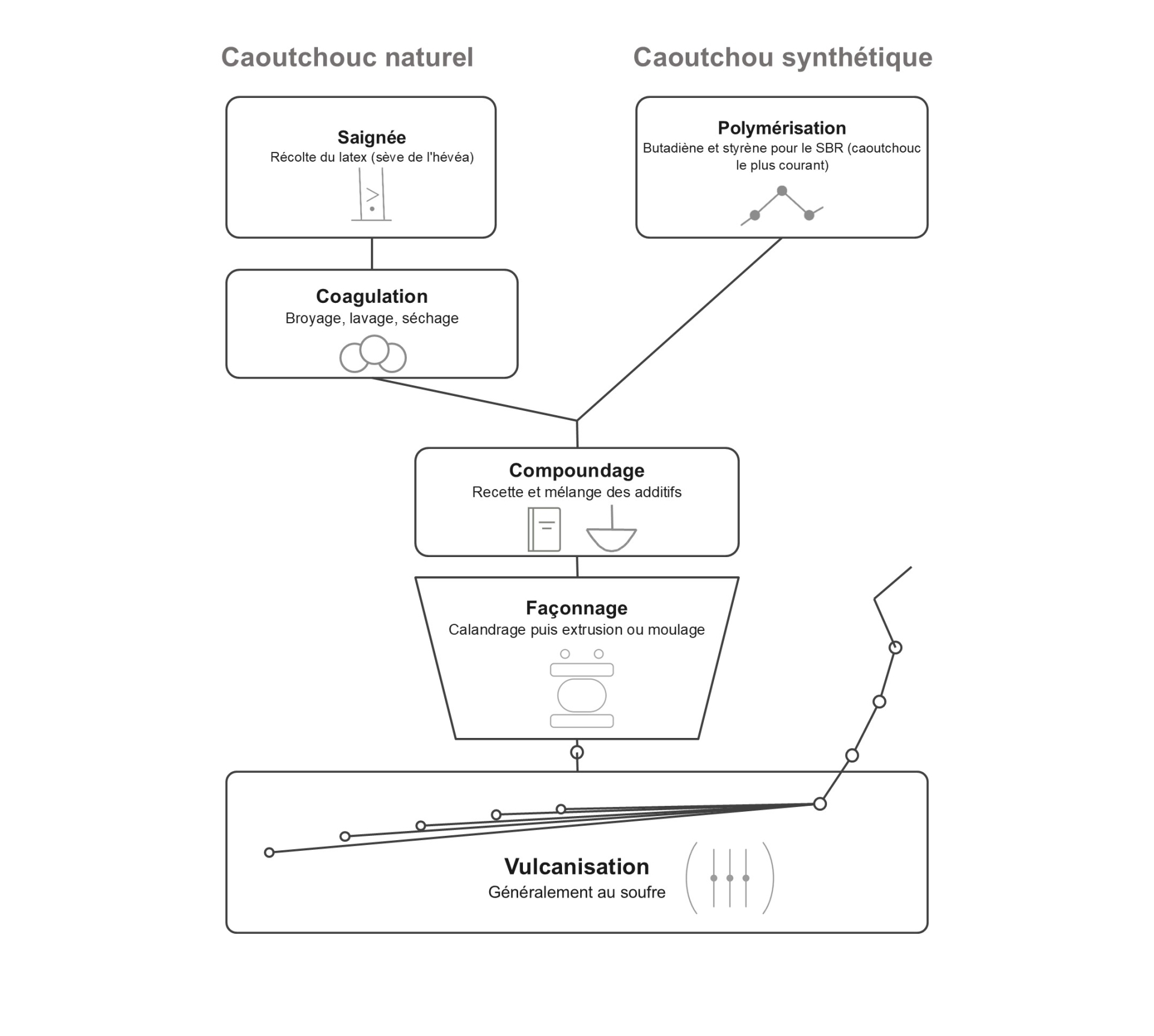
Stages of the production process
Production processes vary depending on the origin of the rubber: natural or synthetic.
Step 1
Natural rubber: tapping
From the age of 5–6 years, the bark of the rubber tree is incised to harvest the sap, producing around 50 g of dry rubber per tapping. 8 Two processing routes then exist depending on the intended form: for products obtained by dipping, such as gloves, the latex is processed by rapid rotation, which separates the water from the rubber and concentrates its content without coagulation; it remains in liquid form until final shaping. 9 For dry forms, such as technically specified rubber, smoked sheets or crepe rubber, the latex is first solidified, either naturally, through the action of bacteria that lower its acidity, or by adding acid, a process that transforms the liquid into a compact mass. It is then washed, crushed and dried, either in the air or by smoking, depending on the intended form. 10
Step 1
Synthetic rubber: polymerisationS
Synthetic rubber is made from molecules derived from petrochemicals, mainly butadiene and styrene for SBR (styrene-butadiene rubber, the most common rubber). These molecules are chemically assembled (polymerisation) to form long rubber chains. 11
Shaping 12: once the raw material has been obtained, natural and synthetic rubbers follow a similar processing route.
Step 2
Compounding
The formulation is defined (which additives, in what proportions) to stabilise the polymer, add solid materials such as carbon black to make the compound more resistant to wear, or sometimes extend it to reduce the final cost.
Step 3
Mixing
The formulated additives are physically incorporated into the rubber.
Step 4
Forming
The compound, still uncrosslinked (not yet chemically cured), is then formed using the technique suited to the intended product
Step 5
Vulcanisation
13 Rubber is heated in the presence of sulphur (or peroxide), which creates stable chemical bonds between the polymer chains. This is the stage that gives rubber its durable structural integrity and resistance to deformation. At this stage, rubber can no longer be melted or remoulded simply by applying heat. Unlike a thermoplastic, these bonds can only be broken by dedicated processes, such as devulcanisation.
Production diagram
Environmental impact
Environmental issues related to production
🌱 Deforestation and land-use change(natural rubber)
Faced with rapidly growing global demand for natural rubber, the area planted with rubber trees has expanded significantly: the global plantation area reached around 14.1 million hectares in 2020, nearly double the area recorded three decades earlier. 14 A recent study shows that deforestation linked to rubber cultivation has been largely underestimated: more than 4 million hectares of forest have been lost since 1993, and actual deforestation is thought to be 2 to 3 times higher than the estimates used so far to shape public policies. More than one million hectares of plantations are now located in key biodiversity areas. 15 The share of natural rubber-producing forests covered by FSC and PEFC-type certifications is very low: 3.2% in 2024. 16
🌡️ Greenhouse gas emissions (GHG)(cross-cutting)
Both value chains are carbon-intensive, but for structurally different reasons. Rubber tree cultivation contributes to climate change mainly because of the land-use change involved in its production and the significant use of chemicals and fertilisers. 17
Synthetic rubber, meanwhile, derives its carbon footprint directly from its fossil origin: it is made from oil, from which the two basic components, butadiene and styrene, are extracted in refineries. 18 This extraction takes place at very high temperatures and itself consumes a large amount of energy. Finally, the processing operations common to both value chains are highly energy-intensive.
💧 Water consumption and pollution during processing(cross-cutting)
For natural rubber, latex coagulation and washing generate approximately 20.5 litres of effluent per kilogram produced. This water contains ammonia and acid residues (used for coagulation), and is therefore highly polluting if not properly treated.
For synthetic rubber, wastewater from SBR production has a high COD (chemical oxygen demand) load. 19 If discharged untreated, this wastewater leads to high oxygen consumption in the receiving environment, with a risk of asphyxiation for aquatic fauna.
🧪 Microfragment pollution(cross-cutting)
Common to both value chains, rubber wear particles (generated by friction, whether from a tyre or a sole) are the leading source of primary microfragments in the environment worldwide: approximately 5.9 million tonnes are released each year, representing 60 to 70% of all primary microfragment emissions. 20 These particles are thought to account for up to 45% of the microfragments found in soils and water. 21
🌱 Persistence at end of life and complex recycling
At end of life, natural and synthetic rubbers converge around a common issue: the crosslinking created by vulcanisation makes the material difficult to recycle through conventional routes (remelting, remoulding). Globally, this difficulty results in a considerable volume of waste: around 17 million tonnes of tyre waste are generated each year. 22 The footwear sector is not spared: in the European Union alone, post-consumer footwear waste is estimated at more than 1 million tonnes per year. 23 These limitations highlight the importance of reuse and recycling to improve the circularity of the value chain.
💧 Non-renewable resource(synthetic rubber)
Unlike natural rubber, which is by nature a renewable resource, synthetic rubber depends entirely on non-renewable fossil resources: its basic monomers (butadiene, styrene) are derived from petrochemical refining. Every tonne of synthetic rubber produced contributes to the depletion of oil reserves.
Eco-design issues
1. Durability
Despite its sensitivity to ageing already mentioned in the “Properties & examples of applications” section, rubber has high resistance to mechanical wear
Indeed, both natural and synthetic rubber are known for their high resistance to abrasion, a key quality that explains their preferred use in all applications subject to intense friction (tyres, soles, industrial seals).
In soles specifically, this resistance is assessed using standardised test methods, which measure the material loss of a sample subjected to standardised abrasion, making it possible to objectively compare different material formulations according to the intended use (sports, safety, everyday use). Rubber remains the benchmark material for soles on this criterion, clearly outperforming lighter alternatives such as ethylene-vinyl acetate (EVA) or thermoplastic rubber (TPR), which are more prone to premature wear. This behaviour depends above all on the precise composition of the compound rather than solely on the natural or synthetic origin of the raw material.
2. Recyclability
Footwear recycling remains limited: in the European Union, post-consumer footwear waste is estimated at more than 1 million tonnes per year, with a recycling rate below 5%. 24
Two structural factors explain this lag compared with textiles: firstly, vulcanisation makes rubber infusible and non-remouldable, 25 which rules out any recycling by remelting; secondly, a shoe can contain up to 40 different components and types of materials, making disassembly particularly complex. 26
Overall, the sector is progressing rapidly from a technical standpoint, with increasingly mature recycling solutions. Since the sole represents 40 to 50% of a shoe’s total weight and is currently the most recyclable part, it should be the priority focus for eco-design efforts. 27
3. Incorporation of recycled material
Tests carried out by Refashion and CETIA on used soles show that recycled rubber must be blended with virgin rubber up to a certain threshold in order to retain properties equivalent to those of a conventional sole.
Up to 30% devulcanised rubber, or 10 to 20% micronised rubber, can therefore be incorporated without compromising the durability of the final product. 28 These thresholds depend mainly on three factors: insufficiently precise sorting of the different types of rubber, impurities still present in used soles, and the quality of the virgin rubber used to complete the compound. More rigorous sorting would improve these thresholds, but would make large-scale collection more complex.
These limits are not fixed: some specialised industrial players are already achieving higher rates thanks to sorting carried out upstream by their suppliers, up to 50% recycled material for the Italian company Rubber Conversion, which works with pre-sorted soles supplied directly by major brands. In France, The 8 Impact applies a similar process for its OKTARA™ range: pre-sorting by sneaker type, followed by an 8-step mechanical separation by densimetry, enabling the extraction of rubber, EVA and textile fibres with 98% purity. 29
Action levers
Points to watch
As with any eco-design approach, before choosing a material, it is essential to analyse the environmental impact of a product’s entire life cycle and to compare different scenarios in order to identify which one has the lowest environmental impact. There is no ideal material; a material must be chosen according to the product’s intended use and its environmental objectives.
Available alternative materials
A more sustainable way to produce 30 :
Part of the response to the environmental impact of natural rubber lies in transforming existing production practices. Several levers have already been identified :
- Agroforestry systems, combining rubber trees with other crops rather than growing them in monoculture, which can help preserve biodiversity and limit deforestation
- Optimised tapping systems, which increase productivity per hectare without expanding planted areas
- Varietal selection, to develop rubber trees that are more resistant to disease and water stress in the face of climate change
Alternative sources to the rubber tree :
Due to the risk of allergic reactions to Hevea latex, the threat of the spread in Asia of the fungus Microcyclus ulei, which would decimate production if it reached Southeast Asia, and the desire to diversify in response to supply tensions (with 95% of the world’s natural rubber supply currently dependent on a single species), several competing plants to the rubber tree are being studied :
- Russian dandelion or Taraxacum kok-saghyz: its root produces a rubber identical to that of the rubber tree, but current yields remain below the threshold for commercial viability (an alternative that is not yet very advanced). 31
- Guayule or Parthenium argentatum, is a Mexican shrub and is further advanced: it has already been validated by Bridgestone and Cooper Tire in an application as demanding as tyres, with performance considered equivalent to conventional rubber. 32
Recycled rubbers are an interesting alternative to consider for reducing a product’s environmental footprint, but the value chain is still young: it is currently focused on production offcuts rather than genuinely used footwear, with incorporation rates still limited by the quality of sorting and of the available feedstock.
Sources32
- 1 Encyclopédie Universalis, "Élastomères ou Caoutchoucs," article de chimie: https://www.universalis.fr/encyclopedie/elastomeres-caoutchoucs/
- 2 Textile Exchange, Materials Market Report 2025, Textile Exchange, septembre 2025: https://textileexchange.org/materials-market-report/
- 3 International Rubber Study Group (IRSG), Rubber Statistical Bulletin, vol. 79, n° 7-9, janvier-mars 2025, cité par le Rubber Board (Inde),: https://www.rubberboard.gov.in/rbfilereader?fileid=1166
- 4 Textile Exchange, Materials Market Report 2025, Textile Exchange, septembre 2025: https://textileexchange.org/materials-market-report/
- 5 Association of Natural Rubber Producing Countries (ANRPC), site officiel: https://www.anrpc.org/
- 6 International Rubber Study Group (IRSG), Rubber Statistical Bulletin, vol. 79, janvier-mars 2025, cité dans Cirad, "Synthèse de la feuille de route hévéa : Vers une culture durable de l'hévéa [2024-2034]," septembre 2025.
- 7 Cirad, "Synthèse de la feuille de route hévéa : Vers une culture durable de l'hévéa [2024-2034],": https://cirad.fr
- 8 Encyclopædia Britannica, "Rubber – Tapping, Coagulation, Processing,": https://www.britannica.com/science/rubber-chemical-compound/Tapping-and-coagulation
- 9 "Various coagulation techniques and their impacts towards the properties of natural rubber latex from Hevea brasiliensis — a comprehensive review related to tyre application," ScienceDirect, 2022
- 10 "Processing and Grading of Technically Specified Rubber (TSR)," Agriculture.Institute, 2026
- 11 Valmet, "Application report: Styrene-butadiene rubber," fiche technique industrielle, juin 2022
- 12 "Rubber," chapitre d'ouvrage académique, ScienceDirect, 2008: https://sciencedirect.com/science/article/pii/B9780815514084500077
- 13 "Influence of Sulfur-Curing Conditions on the Dynamics and Crosslinking of Rubber Networks: A Time-Domain NMR Study," Polymers, MDPI, vol. 14, n° 4, article 767, février 2022, DOI : 10.3390/polym14040767
- 14 Srisawasdi, W., Cortes, J.R., "Natural Rubber Trade and Production Toward Sustainable Development Goals: A Global Panel Regression Analysis," ABAC Journal, vol. 43, n° 3, 2023, DOI : 10.59865/abacj.2023.31
- 15 "High-resolution maps show that rubber causes substantial deforestation," Nature, octobre 2023
- 16 Textile Exchange, Materials Market Report 2025, Textile Exchange, septembre 2025: https://textileexchange.org/materials-market-report/
- 17 "Environmental impacts associated with the life cycle of natural rubbers: A review and scientometric analysis," ScienceDirect, décembre 2024
- 18 "Evaluating the profitability and global warming potential of manufacturing styrene-butadiene rubber with chemicals synthesised from bulk waste plastic and CO2 emissions," ScienceDirect, 2024
- 19 "Influence of COD in Toxic Industrial Wastewater from a Chemical Concern on Nitrification Efficiency," PMC, 2022
- 20 "Tire Wear Particles' Environmental Distribution and Potential Threats to Human Health," Bulletin of Environmental Contamination and Toxicology, Springer Nature, 2026
- 21 Leibniz-Institute of Freshwater Ecology and Inland Fisheries (IGB), "How tire abrasion pollutes water and endangers animals,"
- 22 "Environmental impacts associated with the life cycle of natural rubbers: A review and scientometric analysis," ScienceDirect, décembre 2024
- 23 CORDIS, Commission européenne, "Sustainable and Circular Footwear Training Program (SCARPA)," programme Horizon Europe, fiche projet: https://cordis.europa.eu/project/id/101227206
- 24 European Outdoor Group, "Alternative Footwear Materials for the Outdoor Industry," S.E.L. Bulman, septembre 2025 (citant notamment Rahimifard, 2014 et la Commission européenne/Life Kanna Green Project, 2024)
- 25 CETIA, "État de l'art des solutions de tri, délissage et démantèlement des textiles et chaussures en Europe," juillet 2026: https://pro.refashion.fr/en/app/uploads/2026/07/etat-de-lart-solutions-tri-textiles-etude-actualisee-refashion-2026.pdf
- 26 European Outdoor Group, "Alternative Footwear Materials for the Outdoor Industry," S.E.L. Bulman, septembre 2025 (citant notamment Rahimifard, 2014 et la Commission européenne/Life Kanna Green Project, 2024)
- 27 Refashion, CETIA, "État de l'art des solutions de recyclage des semelles de chaussures en Europe," juillet 2025: https://pro.refashion.fr/ressource/etudes/etat-de-lart-des-solutions-de-recyclage-des-semelles-de-chaussures-en-europe
- 28 Refashion, CETIA, "État de l'art des solutions de recyclage des semelles de chaussures en Europe," juillet 2025: https://pro.refashion.fr/ressource/etudes/etat-de-lart-des-solutions-de-recyclage-des-semelles-de-chaussures-en-europe
- 29 Refashion, CETIA, "État de l'art des solutions de recyclage des semelles de chaussures en Europe," juillet 2025: https://pro.refashion.fr/ressource/etudes/etat-de-lart-des-solutions-de-recyclage-des-semelles-de-chaussures-en-europe
- 30 Cirad, "Synthèse de la feuille de route hévéa : Vers une culture durable de l'hévéa [2024-2034]," septembre 2025
- 31 "Taraxacum kok-saghyz: From emergency wartime crop to synthetic biology platform – A comprehensive review of natural rubber biosynthesis, genetic engineering, and agricultural development," ScienceDirect, 2026
- 32 Bridgestone, "Tire maker Bridgestone invests in guayule rubber," Chemical & Engineering News, 2023 ; "Cooper Tests Tire Builds Made from Guayule Rubber," Tire Review Magazine, 2019
Plus de ressources sur le même sujet


