

Wool
Understand the material, its key figures, the stages of its manufacturing process, its properties and applications, the environmental issues, as well as information on the durability, recyclability, and alternatives available to this material.
30 min de lecture
Update : Oct 2026
1.98 million tonnes
Of raw wool produced worldwide in 2024, representing approximately 0.9% of the global fibre market
80 %
Of global merino wool production comes from Australia.
7 %
Of the wool placed on the market in 2024 came from recycled materials.
Introduction
Animal fibres used in textiles cover a wide variety of materials with diverse characteristics and uses: wool, mohair (Angora goat), cashmere (cashmere goat) and alpaca.
Strictly speaking, wool refers to the fibre from sheep (Ovis aries) and includes, in particular, merino wool, crossbred wool and lambswool. Among these, merino wool now holds a prominent place in the apparel textile industry thanks to the fineness of its fibres, which gives it a much-appreciated softness.
This factsheet therefore focuses on merino wool, whose challenges differ from those of other types of wool and animal fibres
.
Key data
- Type of fibre: Natural animal fibre from the fleece of Merino sheep. It produces a fine wool mainly intended for clothing.
- Global wool production: 1.98 million tonnes of raw wool (unwashed greasy wool), equivalent to 1 million metric tonnes of clean wool fibre in 2024. These data compile production across all types of wool. They represent only 0.9% of the global fibre market. 1
- Main merino wool-producing countries: Australia (80% of global production and 90% of the global supply of fine wool intended for high-end apparel) ) 2, South Africa, Argentina, Uruguay and New Zealand.
Global fibre market
Raw wool produced in 2024
0.98%
Other fibre
99.02%
- Share of recycled material: Recycled wool represented 7% of all wool placed on the market in 2024. 3
- Share of certified material: Conventional wool (non-recycled) represented 96% of wool placed on the market worldwide (1.89 million tonnes), while the share of certified wool, produced in accordance with Responsible Wool Standard (RWS), ZQ, ZQ Regenerative Index (ZQRX), SustainaWOOL Green, Sustainablue, SustainaWOOL Gold, Sustainable Cape Wool (CWS) and Climate Beneficial Verified standards, was 4.3% (0.09 million tonnes) 4. Among these certified wools, RWS and its equivalents represented around 82% of this market share in 2024, i.e. 3.6% of the global greasy wool market.
Share of certified material
Conventional wool
Certified wool
Properties and examples of applications
Merino wool is a natural and renewable fibre produced by merino sheep. It is recognised for the fineness of its fibres, which is its main quality criterion. This is generally characterised by fibre diameter, expressed in microns (µm), with different categories such as superfine (< 17.5 µm), fine (17.5 to 19 µm) and medium (19 to 22 µm). This fineness gives it softness and comfort, which are particularly valued for clothing.
Merino wool also has thermoregulating properties. Its fibres can absorb up to around 30% of their weight in water vapour without feeling damp and trap air within their structure, thereby helping to maintain a stable body temperature in both cold and warm weather 5.
The presence of keratin in the fibres also limits the development of bad odours, making it possible to wash merino garments less frequently than many other textile materials.
Although wool represents only around 1% of global textile fibre production, merino wool holds a strategic position in the premium, outdoor and luxury segments thanks to its technical performance and its image as a high-quality natural fibre.
Production
Stages of the production process
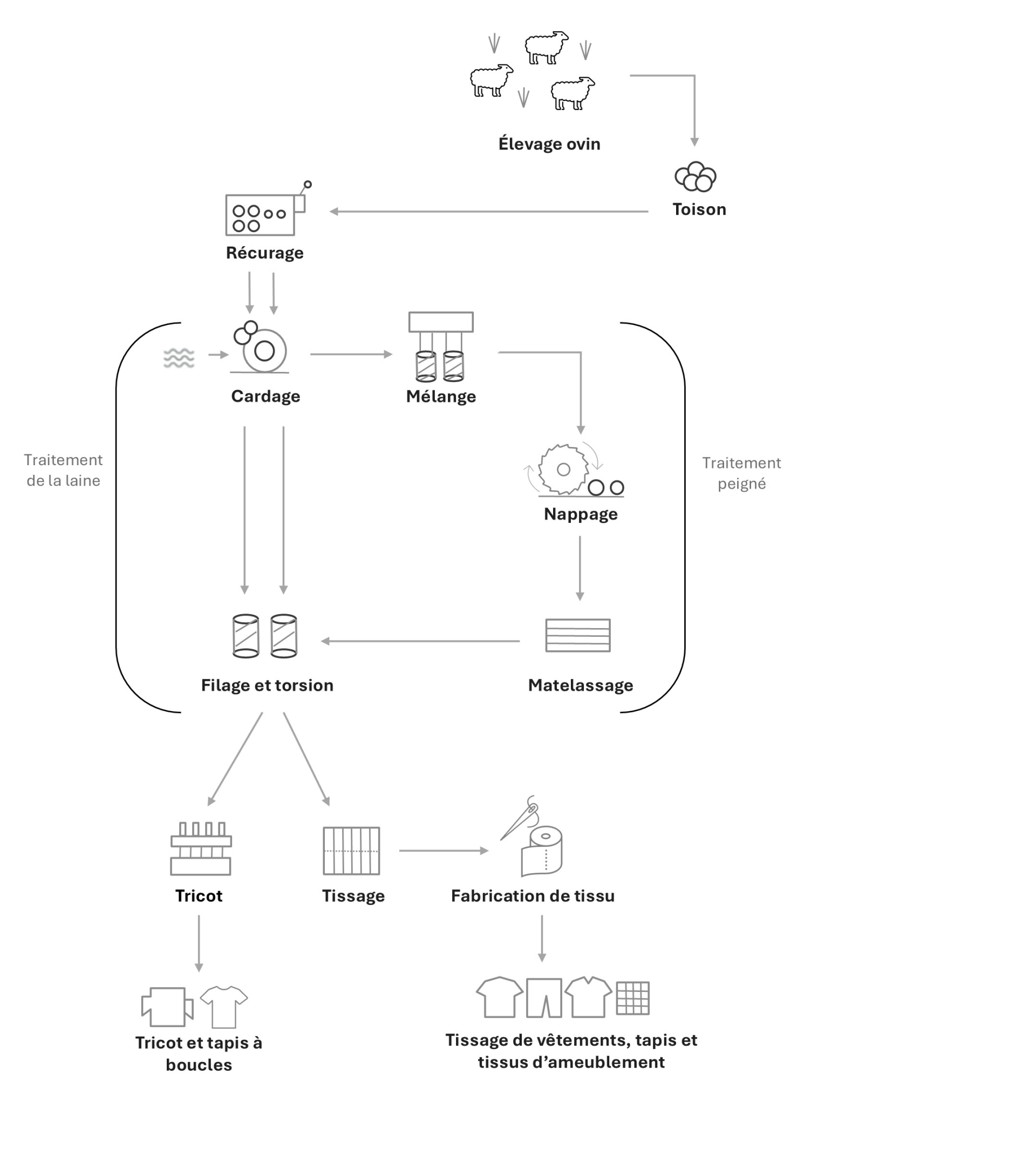
The transformation of wool into clothing is an industrial and highly internationalised process, consisting of several successive stages that may be carried out in different countries, aimed at preserving and then enhancing the fibre’s natural properties.
Step 1
Sheep shearing
The first step consists of shearing the sheep, generally once a year. On average, one sheep produces around 4.5 kg of wool per year, which is equivalent to several metres of fabric depending on the fabric weight 6. Shearing is carried out using mechanical clippers in order to remove the fleece in one piece. At this stage, the wool still contains many impurities (suint, wool grease, dust, sand, plant debris) and is called raw wool or greasy wool 7. After shearing, the fleeces are gathered, baled and then transported to sorting and processing centres.
Step 2
Sorting fibres according to several criteria
Once harvested, the fleece is examined and graded according to several criteria: fibre fineness (diameter in microns), fibre length, strength, colour, cleanliness and fleece uniformity8. The different parts of the sheep do not produce wool of the same quality. Fibres from the shoulders and flanks are generally the finest and most sought after for clothing, while those from the legs or belly are often reserved for more technical or decorative uses. This step therefore makes it possible to direct each batch towards its final use and to ensure the homogeneity of future textile production.
Step 3
Industrial washing
As it generally contains between 30% and 70% impurities, raw wool undergoes an industrial washing phase, known as scouring or wool washing 9. The fibres are immersed in a series of baths containing hot water, detergents and sometimes alkaline agents in order to remove all impurities. For some batches with a particularly high plant-debris content, an additional step called carbonising is carried out. This involves treating the wool with a diluted sulphuric acid solution and then heating it in order to weaken the plant matter, which is then removed 10.
Step 4
Carding
During the carding stage, the washed wool passes between cylinders fitted with metal pins, which progressively open, disentangle and align the fibres. This mechanical operation forms a continuous strand called a sliver 11. For high-quality textiles, the carded sliver is then combed to remove short fibres and obtain a homogeneous sliver.
Step 5
Spinning
Enfin, la filature est un procédé qui consiste à étirer puis torsader les fibres afin de former un fil continu avec une résistance nécessaire pour les opérations ultérieures. Selon le produit recherché, l’industrie distingue :
- Le système woollen (fil cardé) qui donne des fils plus volumineux et isolants.
- Le système worsted (fil peigné) qui produit des fils plus fins, réguliers et résistants.
Les fils de laine sont ensuite transformés en étoffes selon deux procédés principaux 12: le tricotage et le tissage.
Production diagram 13
Environmental impact
Environmental issues related to production
🌡️ Climate and atmosphereClimate change
The environmental impacts of wool production are mainly linked to sheep farming, which emits significant quantities of greenhouse gases, particularly methane, a powerful contributor to global warming. Taking Australian production as an example, current estimates put emissions at between 20 and 30 kg of CO₂ equivalent per kilogram of raw wool (greasy wool) 14 depending on the region and farming systems. The environmental impacts of wool depend heavily on farming practices: pasture management, energy consumption in farm buildings and the fertilisers used directly influence greenhouse gas emissions and other pressures on the environment. Wool’s environmental impact also varies depending on whether it is considered the main product of farming or a co-product of meat production. In the latter case, its impact is generally lower 15 . Merino has historically been part of a system focused on wool production, but Australian farming, for example, now mostly operates as a wool/meat co-production system, with the allocation depending on local prices.
🌱 Land use and biodiversity lossSoil degradation and desertification
Sheep farming also requires vast areas of land, which can contribute, in some regions, to soil degradation and the desertification of pastures due to overgrazing. Other countries go even further in combating desertification linked to livestock farming, such as China, with a ban on free grazing since 1978 and mandatory sheep enclosure for at least three months of the year. However, this can create other land-use issues, as animal feed must be supplemented by substantial inputs of hay and cereals, which also require agricultural land to be grown.
💧 Depletion of natural resourcesWater and fossil resource consumption
Beyond farming, wool processing stages (washing, carding, bleaching, dyeing and spinning) also consume water and energy resources. The processing stage with the highest environmental impact is industrial wool washing. This operation requires large quantities of water and energy.
🧪 Pollution of natural environmentsChemical pollution
Industrial washing also generates complex effluents containing lanolin, detergents and sometimes residues of veterinary treatments applied to sheep. Managing these effluents is a major environmental issue for the value chain. However, lanolin can be recovered and used as a co-product in the cosmetics, pharmaceutical or industrial sectors. The environmental impact of industrial washing also depends heavily on its geographical location, in particular the energy mix used to heat the washing baths (mainly natural gas, and coal in some Asian textile regions) and the performance of wastewater treatment facilities.
The wool sector is also characterised by the strong internationalisation of its value chain. Raw wool production is mainly concentrated in Australia, China and New Zealand, while a significant share of processing operations (washing, combing, spinning and garment manufacturing) is carried out in China.
Some regions nevertheless retain historical specialisations, such as Biella in Italy for high-end worsted fabrics. This geographical organisation significantly influences the fibre’s environmental profile, with the associated impacts depending in particular on farming systems, production practices, industrial performance and the energy mixes used during processing stages. Thus, beyond transport distances alone, the location of the different stages of the value chain is an important factor in the environmental assessment of wool.
Eco-design issues
1. Durability
Wool is a fibre recognised for its longevity. Although its environmental impact can be significant at the production stage, this analysis should be put into perspective in relation to its long lifespan. 16.
1. A longer lifespan
Indeed, wool garments generally have a longer lifespan than those made from other textile fibres 17 . For example, the average lifespan of wool garments is considered to be 50% longer than that of cotton garments, because they are worn for longer, replaced less frequently and are more often reused or recycled at end of use.
2. Fewer washes
This longevity helps spread the environmental impacts of their manufacture over a greater number of uses. In addition, wool’s natural properties, particularly its resistance to odours, stains and creasing, allow washes to be spaced out and reduce care requirements, thereby reducing water, energy and detergent consumption throughout the product’s life cycle.
3. Good abrasion resistance
Wool also has good abrasion resistance thanks to its naturally robust structure. Its fibre is composed of keratin, a highly resistant protein, and protected on the surface by fine scales that limit damage caused by friction. Combined with its ability to deform and then return to its original shape, wool retains its mechanical properties and appearance well over time. However, it can be sensitive to felting, a phenomenon caused by the combined action of moisture, heat and friction, which leads to irreversible tightening of the fibres. This sensitivity requires appropriate care conditions, although modern treatments (machine-washable wool, anti-felting treatments) now make it possible to greatly reduce this risk for many products.
2. Recyclability
Wool has the advantage of being an identifiable fibre that is highly valued in the recycling industry. With historically well-established recycling value chains, wool is part of a circular economy approach. The main recycling hubs include Prato in Italy, specialised in the recycling of high-value-added post-consumer textiles; Panipat in India, more focused on processing large volumes for more standard products; and several industrial value chains in China, mainly centred on the reuse of post-production textile waste 18.
Long fibres
Thanks to its long fibres, wool can easily be mechanically recycled without using complex chemical processes. Used garments and textile offcuts are sorted, defibred and then reintroduced into the manufacture of new yarns, fabrics or knitted textiles. This recyclability, combined with reuse and repair, can considerably extend the lifespan of wool fibre. A wool fibre can thus go through several successive use cycles and reach a cumulative lifespan of 20 to 30 years 19. However, shredding gradually shortens the fibres. They are then blended with other fibres, natural or synthetic, in order to preserve the mechanical properties of the yarns, or directed towards other applications such as insulation materials.
Recycled wool represented around 7% of the total global wool market in 2024 20, a relatively high share compared with other textile fibres. Its recycling helps limit the consumption of virgin raw materials and reduce the amount of textile waste generated 21.
3. Incorporation of recycled material
Recycled wool is now an increasingly used secondary raw material in the textile industry. Incorporating it into new products makes it possible to recover textile waste while reducing the consumption of virgin fibres. In recent years, progress in mechanical defibering (shredding) and spinning operations has significantly improved the quality of recycled fibres. New-generation equipment makes it possible in particular to better preserve fibre length and integrity during defibering, thereby limiting the degradation traditionally associated with mechanical recycling.
At the same time, innovations in spinning processes make it easier to produce more regular, stronger yarns suited to demanding textile applications. These advances have broadened the outlets for recycled wool and increased its incorporation rate in higher-value-added products. Depending on the desired technical, aesthetic or durability performance, recycled wool can be used on its own or blended with other fibres, thereby contributing to the development of circular production models.
.
Action levers
Points to watch
As with any eco-design approach, before choosing a material, it is essential to analyse the environmental impact of a product’s entire life cycle and to compare different scenarios in order to identify which one has the lowest environmental impact. There is no ideal material; a material must be chosen according to the product’s intended use and its environmental objectives.
There are several labels and certifications for this material; here are those eligible for Refashion’s “Environmental Labels” eco-modulation.
Eco-modulations: Refashion rewards product eco-design initiatives through a system of bonuses and penalties. Find out about the criteria and procedures for declaring eco-modulations.
Certified animal fibres 22 23 24:

RWS (Responsible Wool Standard)
The Responsible Wool Standard (RWS) by Textile Exchange is a voluntary standard that aims to improve animal welfare and respect for pastures. To date, most RWS-certified wool is merino wool. At the end of 2024, the number of sheep covered by RWS certification was estimated at 23 million.

GOTS (Global Organic Textile Standard)
The Global Organic Textile Standard (GOTS) label guarantees that the textile contains at least 70% certified organic fibres. It meets high environmental and social requirements throughout the production chain. For wool, washing and processing operations are regulated to limit the use of chemical substances that are harmful to the environment and health, and to control water and energy consumption.
Recycled wool from production offcuts
Recycled wool from production offcuts (post-production) or used clothing (post-consumption) can be certified under the Global Recycled Standard (GRS) or the Recycled Claim Standard (RCS), guaranteeing its recycled material content and traceability.

Ecocert ERTS certification (Ecological & Recycled Textile Standard)
Ecocert’s Ecological & Recycled Textile Standard (ERTS) certification covers textiles made from natural, renewable or recycled fibres. Applied to merino wool, it guarantees compliance with environmental requirements throughout textile processing and promotes the use of raw materials with a reduced impact.

OEKO-TEX® MADE IN GREEN label
The OEKO-TEX® MADE IN GREEN label certifies that the textile product has been tested for the presence of harmful substances and that it was manufactured in production facilities that comply with recognised environmental and social criteria. For merino wool, it also provides traceability guarantees across the different manufacturing stages.

bluesign label
The bluesign PRODUCT label certifies that the materials making up the product come from manufacturing processes that control resource consumption, the use of chemical substances, and impacts on workers and the environment. For merino wool, it mainly covers the industrial textile processing stages.

EU Ecolabel
The EU Ecolabel distinguishes textile products with a reduced environmental impact throughout their entire life cycle. For merino wool, it notably regulates the chemical substances used during manufacturing, pollutant emissions and certain residues present in raw wool, while requiring high levels of quality and durability.
Textile Exchange – Preferred Fiber & Materials Market Report (annual)
Published annually by Textile Exchange, this report is the industry reference for production volumes of the main textile fibres. For wool, it tracks the growth of certified and recycled wool in the global mix and provides the most up-to-date publicly available market data. The 2025 edition reveals that the combined market share of wool produced in accordance with the Responsible Wool Standard (RWS), ZQ, ZQRX, SustainaWOOL Green (SustainaWOOL under the Australian Wool Sustainability Scheme (AWSS)), Sustainablue (ResponsiWOOL under the AWSS), SustainaWOOL Gold, Sustainable Cape Wool Standard and Climate Beneficial™ Verified standards decreased, from around 5.2% in 2023 to 4.3% in 2024, with all these wool programmes recording lower or unchanged production volumes. For RWS, this trend is due to low wool prices in 2024 and to the fact that certified wool often does not benefit from a sufficient premium. Recycled wool accounted for around 7% of the global wool market in 2024.
Sources29
- 1 Textile Exchange, Materials Market Report 2025, Textile Exchange: https://textileexchange.org/app/uploads/2025/09/Materials-Market-Report-2025.pdf
- 2 Australian Wool Innovation (AWI), The Australian Wool Supply Chain, novembre 2025: https://www.learnaboutwool.com/globalassets/wool/about-awi/media-resources/publications/the-australian-wool-supply-chain/the-australian-wool-supply-chain---nov-25.pdf
- 3 Textile Exchange, Materials Market Report 2025, Textile Exchange: https://textileexchange.org/app/uploads/2025/09/Materials-Market-Report-2025.pdf
- 4 Textile Exchange, Materials Market Report 2025, Textile Exchange: https://textileexchange.org/app/uploads/2025/09/Materials-Market-Report-2025.pdf
- 5 Amélie Moraux, « Le paradoxe de la laine », Blog de l’ISIGE – MINES Paris PSL, 5 septembre 2023: https://blog-isige.minesparis.psl.eu/2023/09/05/le-paradoxe-de-la-laine/
- 6 International Wool Textile Organisation (IWTO), Wool Notes 2024, Bruxelles, IWTO, 2024: https://iwto.org/wp-content/uploads/2024/08/IWTO-Wool-Notes-Final-2024-Digital.pdf
- 7 The Woolmark Company, « Wool Processing »: https://www.woolmark.com/industry/product-development/wool-processing/
- 8 KAMEL, Eman Abdallah, « Wool Fiber: Grades and Production Stages », Long Way Education, 17 novembre 2024: https://longwayeducation.com/2024/11/17/wool-yarn-production-steps/
- 9 International Wool Textile Organisation (IWTO), « First Stage Processing »: https://iwto.org/wool-supply-chain/first-stage-processing/
- 10 International Wool Textile Organisation (IWTO), « First Stage Processing »: https://iwto.org/wool-supply-chain/first-stage-processing/
- 11 The Woolmark Company, « Top-making », How to Process Wool – Worsted Top-making: https://www.woolmark.com/industry/product-development/wool-processing/worsted-top-making/ (consulté le 7 juillet 2026)
- 12 The Woolmark Company, « Wool Processing »: https://www.woolmark.com/industry/product-development/wool-processing/
- 13 International Wool Textile Organisation (IWTO), Wool Notes 2024, Bruxelles, IWTO, 2024,: https://iwto.org/wp-content/uploads/2024/08/IWTO-Wool-Notes-Final-2024-Digital.pdf
- 14 BLIGNAUT, James N., SWAN, Paul et BLIGNAUT, Lemuel, « A biogenic life cycle approach towards estimating the carbon intensity of wool production: Evidence from six Australian case studies », Agricultural Systems, vol. 227, mars 2026, article 104631: https://www.sciencedirect.com/science/article/pii/S0308521X25003713
- 15 ADEME. J. Lhotellier, E.Less, E.Bossanne, S.Pesnel. 2017. Modélisation et évaluation du poids carbone de produits de consommation et biens d’équipements – Rapport. 217 pages: www.ademe.fr/mediatheque
- 16 The Woolmark Company, Mesurer l’empreinte de la laine, fiche d’information, 2021: https://www.woolmark.jp/globalassets/_06-new-woolmark/_industry/research/factsheets/fr/2021/woolmark_measuring_wools_footprint_4pp_fr_lr.pdf
- 17 Amélie Moraux, « Le paradoxe de la laine », Blog de l’ISIGE – MINES Paris PSL, 5 septembre 2023: https://blog-isige.minesparis.psl.eu/2023/09/05/le-paradoxe-de-la-laine/
- 18 Textile Exchange, Materials Market Report 2025, Textile Exchange: https://textileexchange.org/app/uploads/2025/09/Materials-Market-Report-2025.pdf
- 19 The Woolmark Company, Recycled Wool: The Ultimate Circular Solution: https://www.woolmark.com/industry/sustainability/recycled-wool-the-ultimate-circular-solution/
- 20 Textile Exchange, Materials Market Report 2025, Textile Exchange: https://textileexchange.org/app/uploads/2025/09/Materials-Market-Report-2025.pdf
- 21 Agence européenne pour l’environnement (EEA), 2024, Management of used and waste textiles in Europe’s circular economy: https://www.eea.europa.eu/en/analysis/publications/management-of-used-and-waste-textiles-in-europes-circular-economy
- 22 Textile Exchange, Responsible Wool Standard (RWS): https://textileexchange.org/responsible-wool-standard/
- 23 Textile Exchange, Materials Market Report 2025, Textile Exchange: https://textileexchange.org/app/uploads/2025/09/Materials-Market-Report-2025.pdf
- 24 ADEME, Global Organic Textile Standard (GOTS), Agir pour la Transition, publié le 23 octobre 2025: https://agirpourlatransition.ademe.fr/particuliers/mieux-consommer/mieux-choisir/labels-environnementaux/vetements-chaussures/vetements-global-organic-textile-standard
- 25 ICEA Certifica, Organic and Sustainable Textile Products: https://icea.bio/en/certifications/non-food/biological-and-sustainable-textile-products/
- 26 Ecocert Greenlife, Environmental & Recycled Textile Standard (ERTS): https://ecocert.app.box.com/v/STANDARD-ERTS
- 27 OEKO-TEX®, OEKO-TEX® MADE IN GREEN: https://www.oeko-tex.com/en/our-standards/oeko-tex-made-in-green/
- 28 bluesign®, What is bluesign® PRODUCT?: https://www.bluesign.com/what-is-bluesign-approved
- 29 EU Ecolabel Belgique, L'EU Ecolabel: https://www.ecolabel.be/fr/generalites/leu-ecolabel
Plus de ressources sur le même sujet


